

Singapore's robust IP ecosystem sees surge in patent filings by China firms
Figure up an average 55% a year over three years to 1,554 last year; Republic's strong dispute resolution framework also a draw

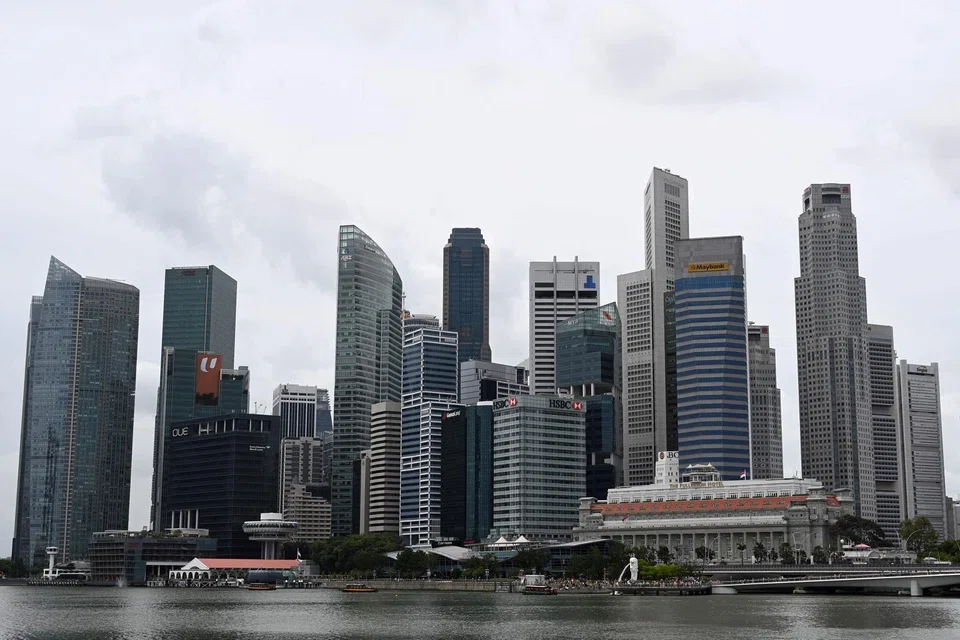
Singapore
CHINA companies are increasingly filing patents in Singapore, spurred on by their South-east Asian expansion and the strength of Singapore's intellectual property (IP) regime and alternative dispute resolution framework.
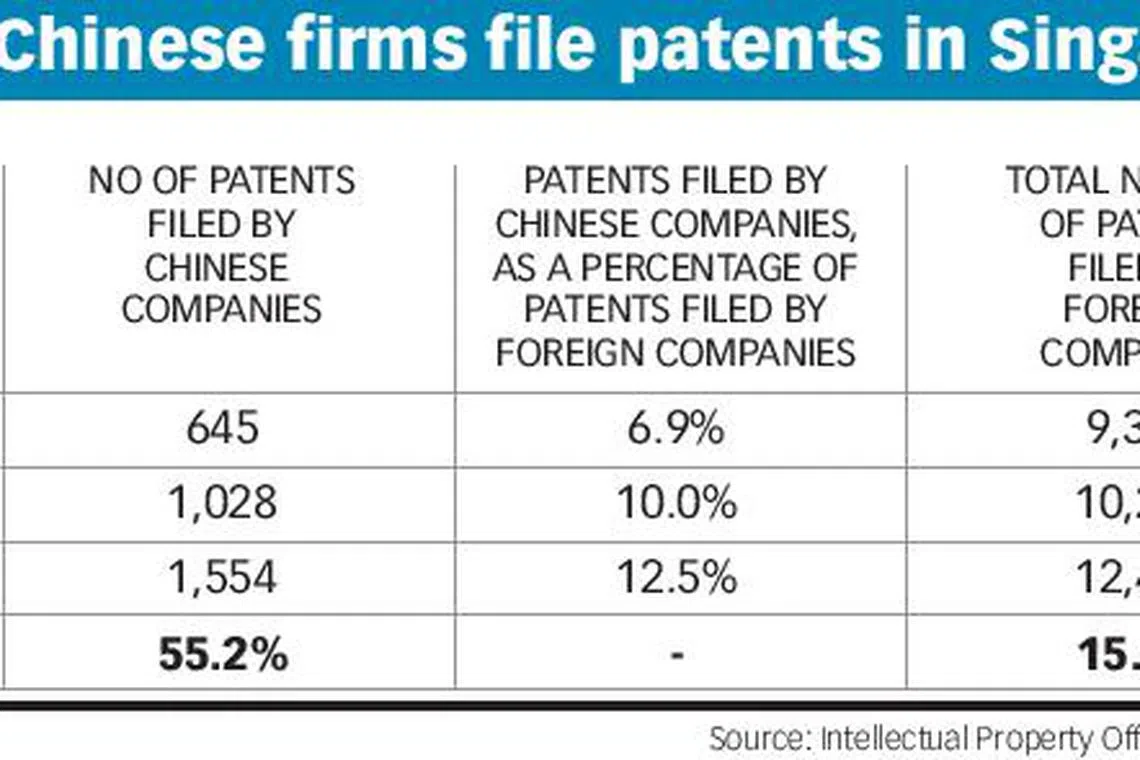
Data requested from the Intellectual Property Office of Singapore (IPOS) showed that the number of patent applications filed by Chinese companies from 2017 to 2019 increased an average of 55.2 per cent each year to reach 1,554 last year.
Over the three-year period, the percentage of China firms against all overseas companies filing patents here also grew from 6.9 per cent to 12.5 per cent.
Total patents filed by foreign companies have been on the rise too, increasing an average of 15.4 per cent each year to 12,409.
Heavyweight tech companies such as Alibaba are leading the charge.
Examples of the patents filed by Chinese firms include inventions related to artificial intelligence (AI) and digital and wireless communication, said IPOS.
"Singapore is one of Alibaba's global innovation hubs across the entire business, from Alibaba Cloud and Lazada, to Alibaba Group's payments affiliate Ant Financial, due to the strong technology talent pool and supportive environment for business here," an Alibaba Group spokesperson told The Business Times.
"These were also the reasons for us to base our international headquarters for Alibaba Cloud and the location of our first joint research institute outside of China, the Alibaba-NTU Singapore Joint Research Institute on AI, in Singapore."
Alibaba Group currently has 649 pending and published applications, and 87 published patents in force, according to IPOS' online database.
In August last year, the group also landed an AI patent in Singapore within a record-breaking three months, under IPOS' expedited initiative for AI. Such a patent typically takes two to four years to bag.
The programme is one of various IP acceleration networks built by IPOS, the agency said in a statement. "This has translated into an outcome of not only Chinese companies filing with Singapore, but other innovation and IP powerhouses like the US and Japan among our top five filers."
It noted that the neutrality and fairness of Singapore's dispute resolution platforms, as well as bilingual capabilities of its patent examiners, are natural draws for companies.
As world-class tech increasingly becomes a competitive edge for companies, more Chinese firms are looking to Singapore for research collaborations in tech development.
Fintech firm OneConnect, a unit of Ping An Group, is partnering Singapore Management University to jointly research and develop a proof of concept on the potential of quantum computing to augment blockchain technology.
The company is also an active filer of patents in the Republic. "In Singapore, OneConnect has applied for dozens of patents in technologies such as artificial intelligence, blockchain, and Big Data," said Tan Bin Ru, CEO for Asia-Pacific and United Arab Emirates.
The company has submitted 2,850 patent applications in China and 542 in other countries or regions, as of Sept 30, 2019.
The uptick in patent-filing activity comes as Chinese expansion in South-east Asia sees faster growth, driven by diversions in investment from the US and Europe, as well as fertile ground for tech development in Asean.
"Tighter US restrictions on investments from Chinese tech companies are probably diverting these flows to Asean, including to and via Singapore," said Maybank Kim Eng senior economist Chua Hak Bin.
"China tech investment has collapsed in the US as a result of these barriers, often justified on the grounds of natural security. The European Union is similarly raising the barriers to Chinese tech investments. Singapore is often the gateway for China tech companies into the region."
Chinese investments in Singapore increased more than 2.5 times from 2014 to 2018, growing to S$41.8 billion from S$16 billion, according to the Department of Statistics.
Dr Chua said he expects China's investments into Asean to continue rising, including in manufacturing foreign direct investments, Belt and Road-related flows, and tech investments.
Some China tech startups also appear to be looking to Singapore for IP protection.
ByteDance Technology, which owns the popular video-sharing app TikTok, currently has three pending and published patent applications related to media technology, according to IPOS' database.
Benjamin Cheong, a partner at Rajah and Tann who specialises in IP law, noted that in the past, Chinese companies were more concerned about how to penetrate a market and regulatory issues.
"But in recent years, we see Chinese companies being more concerned about IP protection in their overseas expansion plans," said Mr Cheong.
IPOS told BT that beyond patents, Chinese companies have been increasingly filing for protection of their IP portfolio, including trademarks and industrial designs, in Singapore.
"In addition to technology companies, many Chinese companies which offer the "traditional" goods and services are also expanding into South-east Asia. These include food and beverage, hotels, retail and clothing. These companies may not own much technology or inventions but instead are keen to protect their brands and products through trademark and design registration," said Mr Cheong.
Such Chinese companies are also very IP-savvy, know the value of IP protection and know how to protect every aspect of their IP portfolio, said Tony Yeo, managing director of Drew & Napier's IP practice.
"It will not surprise me that Chinese companies will soon be the biggest filers of every kind of IP in Singapore."
TRENDING NOW

Grab CEO’s wife Chloe Tong on life with Anthony Tan and finding her purpose

US trade chief to consider trade deal tariff caps in excess capacity probe
Bee Cheng Hiang customers’ e-mail addresses exposed in Singapore’s first case of AI-related data breach
DFI Retail to take over Starbucks business in Asia from Maxim’s Caterers

