

South-east Asia a major beneficiary of Sino-US rivalry, says George Yeo
He says instead of asking allies to pick between the US and China, Americans should ride on China's growth; through history, China's growth has benefited South-east Asia

Sharon See
Singapore
SOUTH-EAST Asia is a major beneficiary of Sino-US rivalry, which will continue for years to come, Singapore's former foreign affairs minister said, as he described China's rise as "the single most important phenomenon in the world today".
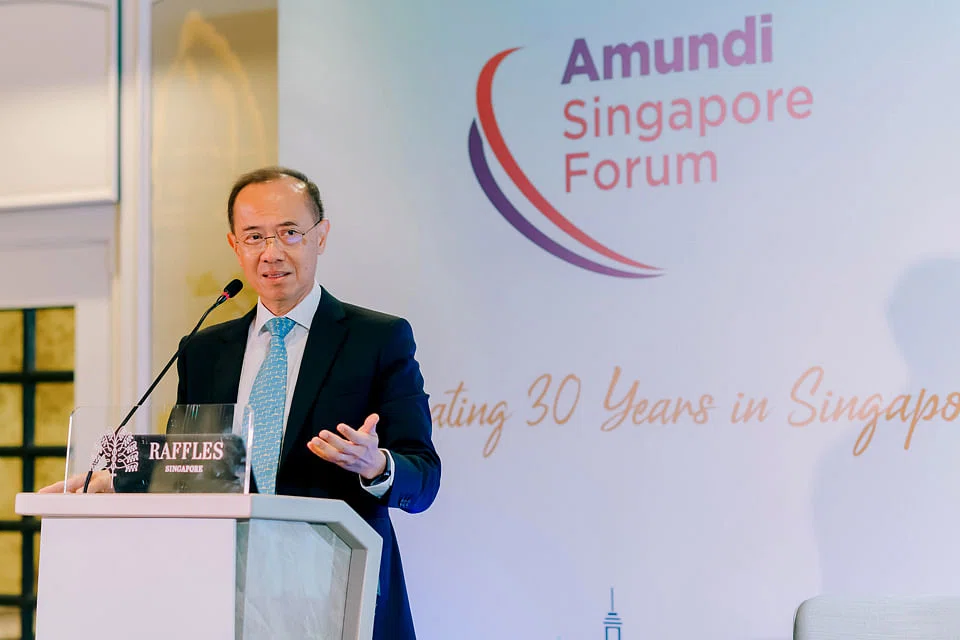
George Yeo, now senior advisor to Kuok Group and Kerry Logistics Network, was speaking at the Amundi Singapore Forum, which discussed the future of South-east Asia in the context of increasing global uncertainty.
In geopolitical terms, the Sino-US relationship is today the single most important relationship in the world, affecting people's lives, said Mr Yeo, who stepped down after his team was defeated in the 2011 general election.
He noted that anti-China sentiment in the United States has become "toxic" in the last two years, and that China is likely to become a major subject in the 2020 US presidential election.
Touching on relations between US and South-east Asian countries, Mr Yeo said: "The Americans come around and very often try to force the choice between China and the US. I tell my American friends: 'Don't do that. If you do that, for some countries, you may not get an answer that you want'."
Instead, he said the United States should ride on China's growth.
"If your country and your trade with China grows, after a while, you worry because China can then control you through economics.
"So automatically, every country that sees its account growing with China will want diversification. And therefore, we welcome the Americans, the Europeans and the Japanese," he said, as he urged a change in how China's growth should be perceived.
He said it is understandable that the Western world would see China in its own image; when the Western world was strong, "it was aggressive", which is why there is a tendency to think that China will be similarly aggressive when it is strong.
But he does not think this is the case, noting that it has always been a "defensive power" because of its sheer size.
The Belt and Road Initiative is thus not a strategy or a plan, Mr Yeo said, but the "inevitable corollary of the growth of the Chinese economy".
He pointed out that China is the largest trading partner for all countries in Asean, and that Asean as a whole is China's second largest trading partner, after Hong Kong.
This makes Asean a major beneficiary of China's growth; this has always been so in history, every time China has been united and prosperous, he said.
During a question-and-answer session following his keynote address, Mr Yeo was asked if he sees reconciliation between the US and China.
He expressed concern about anti-Chinese sentiment in the US, noting that suspicions do not only involve those from China, but ethnic Chinese, including Singaporean Chinese.
"The mood has turned a bit ugly. Some decoupling is inevitable. I think China has to help manage this and not make it worse.
"But for many American companies, China may well become a more important market than the US," he said, adding that some American companies may even decide to "decouple" from the US.
On Hong Kong's political crisis, he said he believed it will go on "for many more months", and that he does not see the protestors winning.
"The way specific incidents are reported on the mainland, there's now greater unity and greater patriotism and a greater sense of nationalism in China than we've seen for a while.
"Now, this does not augur well for Hong Kong because in the end, China holds all the cards," he said.
TRENDING NOW

Grab CEO’s wife Chloe Tong on life with Anthony Tan and finding her purpose

He built the Vingroup empire. Now South-east Asia’s richest man is handing some key roles to his sons
Can Mark Shaw bring Singapore back to Orchard Road and the movies?
Ex-Sembcorp Marine CEO Wong Weng Sun acquitted of charges in Brazil corruption case

