

S'pore drug development gets another shot in the arm
One goal for EDDC will be to create projects that are attractive to multinational pharmaceutical companies
Singapore
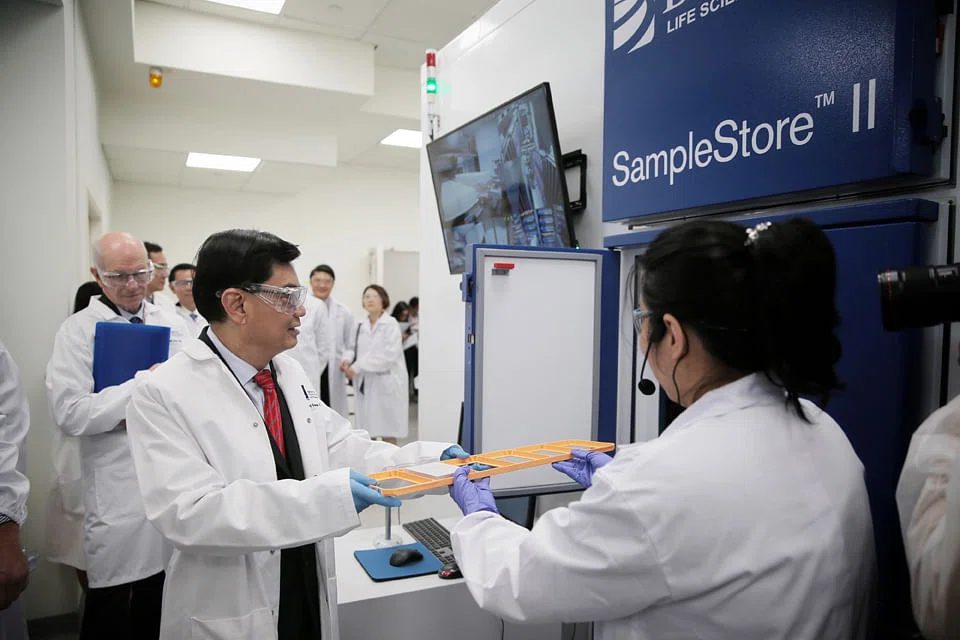
A*STAR officially opened the new Experimental Drug Development Centre (EDDC) on Wednesday to take more made-in-Singapore drugs from early-stage drug discovery to clinical trials and commercialisation.
Towards this end, the statutory board also launched the Target Translation Consortium (TTC), which coordinates drug discovery efforts in academia, healthcare institutions and government agencies, and consolidated three existing A*Star grants into the Singapore Therapeutics Development Review (STDR).
In its four-storey section of Biopolis, EDDC integrates three earlier A*Star drug discovery development units, to "better harness the synergies in talent, capabilities, technology and infrastructure," said A*Star chairman Chan Lai Fung.
The TTC will complement the EDDC by facilitating discussions of promising early-stage proposals across organisational boundaries. It will also establish and share methods and criteria for evaluating projects as they move through the development process. A*Star's new grant will fund early-stage projects up to S$750,000.
Singapore has an opportunity to meet the global demand for health, "especially as growth in Asia is expected to outpace the global average," said Deputy Prime Minister Heng Swee Keat, who officiated EDDC's opening ceremony. "We are the third largest health-tech investment ecosystem in Asia, after China and India," said Mr Heng, who is also chairman of the National Research Foundation and Minister for Finance.
"Singapore's biotech companies can collectively contribute to improving the lives of patients and their families in Asia, and open up new markets for their technologies and our economy. Our three largest biotech companies were reported to have an estimated collective valuation of more than US$1 billion."
The biotech boom in Singapore is a somewhat recent one, said A*Star's biomedical research council executive director, Benjamin Seet. For the first 10 to 15 years of Biopolis' lifetime, the number of biomedical companies in Singapore actually flatlined in the low tens, said Dr Seet. But in the last five years, that number has since shot up to nearly 100 today.
"What we're seeing is that increasingly, made-in-Singapore assets - whether it's in the universities, hospitals, or A*Star - are now going to the local pipeline," he said. "Even when you look at the companies, quantitatively they are stronger companies in terms of having assets that are in later stages of development, some even as late as Phase 3 clinical trial."
In 2017, Tessa Therapeutics, a Singaporean immunotherapy firm valued at S$650 million, acquired Euchloe Bio, an A*Star spinoff. The following year, Japanese drug maker Chugai Pharmaceutical invested an additional S$282 million in its Singapore research unit.
Local biotech has even caught the eye of venture capitalists. Singapore-based Venturecraft recently made a US$40 million Series A investment to merge with another A*Star spinoff, Mirxes.
One goal for EDDC will be to create projects that are attractive to multinational pharmaceutical companies, said EDDC CEO Damian O'Connell. "We're now already in negotiations with certain world-class, top-10 multinational pharmaceutical companies where we want to co-develop their assets with us. So it's not just handing over assets, potentially, but also them bringing assets into us."
Dr Seet offered several other measures of success for EDDC, such as made-in-Singapore drugs treating patients in Asia, licencing agreements with pharmaceutical or biotech companies, or, simply, successful Singapore companies.
"At the ecosystem level, a sustainable ecosystem comprises scientists, companies, venture capital, contract research organisations, supporting each other and creating economic output from their various activity. So it's all the way from treating a patient to building an ecosystem."






