Support in Budget 2022 anticipated Ukraine fallout: Wong
The finance minister adds that the government has put in a lot more resources and funding to help households cope with the possibility of rising prices

Singapore
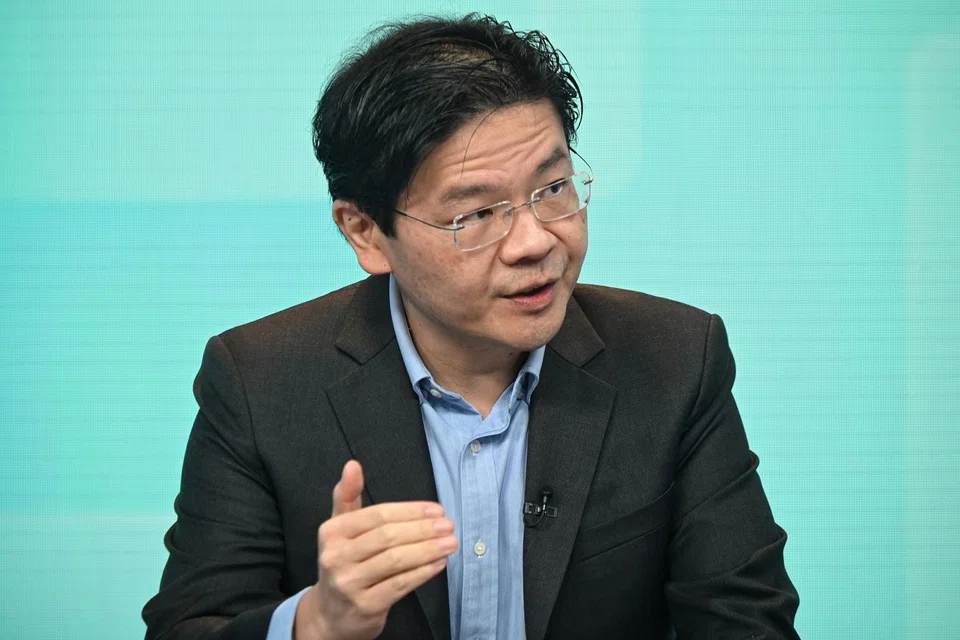
ANTICIPATING an economic fallout from rising tensions in Ukraine, the Singapore government put more resources and funding into Budget 2022 to help households cope with the possibility of inflation, said Finance Minister Lawrence Wong.
"At that time, there was not yet an invasion, but tensions were already rising, and one could already tell potentially that there would be some impact," Wong told a post-Budget roundtable jointly organised by The Straits Times (ST) and The Business Times (BT) and sponsored by UOB.
"And that's why in developing the packages in the Budget, we have put in a lot more resources and funding to help households cope with the possibility of rising prices," said Wong, whose Budget speech on Feb 18 came 6 days before Russia invaded Ukraine.
This means households will receive "significant help" in terms of cash, utilities rebates, Community Development Council vouchers and Service and Conservancy Charges rebates this year and in the coming years, he said.
Reiterating Singapore's limited links with Russia and Ukraine, Wong said the impact of the conflict on the Republic is likely to come from global supply chain disruptions and in turn, inflation.
As to whether a recession lies ahead, fellow panellist and UOB head of research Suan Teck Kin said it is still too early to tell amid the uncertainty, with inflation being one of the few certainties.
"How high is this inflation going to go and at what point it's going to eat into consumers' budgets, at what point it's going to eat into companies' budgets - that's where the uncertainty is," said Suan.
But even before the war, inflation has been creeping up due to factors such as the tighter labour market and supply chain disruptions caused by the Covid-19 pandemic, posited roundtable participant Sumit Agarwal, economics and finance professor from the National University of Singapore.
While inflation could be exacerbated by the war, it is also possible that merchants are taking advantage of the situation, he said, raising the spectre of price gouging and urging the government to monitor if there are "nefarious activities".
Wong acknowledged the possibility but said the direct impact on many businesses currently comes from the higher energy prices.
National Trades Union Congress (NTUC) secretary-general Ng Chee Meng, also a panellist, said the unions have been chipping in to help.
Wong said: "If things were to worsen, we will not hesitate to put out additional measures, and we have the means to do so."
The ST-BT Budget Roundtable, moderated by ST associate editor Vikram Khanna, was in agreement that this year's Budget struck a different note from previous years'.
Having weathered 2 years of Covid-19, Singapore now enters a post-pandemic future with a different social compact, while the need to decarbonise has taken on a new sense of urgency globally, said the panellists.
The need for more government support - for an ageing population and increasingly volatile world - also means the government has to find ways to raise more revenue to meet that funding gap, said Wong.
This has led to a series of tax reforms with the objective of building a fair and progressive system that would ensure sustainable finances for the future, he added.
But one common question, Khanna pointed out, is whether alternatives to the goods and services tax (GST) hike were also considered: for example, higher corporate taxes, higher income taxes or a broader tax base.
To that, Wong said Singapore's government expenditure is likely to increase by 2 per cent of gross domestic product (GDP) by 2030, which amounts to S$10 billion a year. The upcoming 2-percentage point hike from the current 7 per cent would only yield revenues of S$3.5 billion annually, he said.
"This whole debate about 'maybe there are alternatives to GST' misses the point, because it's not GST or something else; it's GST and other tax changes because the gap is that large," said Wong.
The GST is considered by economists to be a "better way of taxing", he added, as it imposes the least distortions on the economy and has the least impact on competitiveness, compared with personal or corporate income taxes.
Regressivity from the GST hike is "effectively neutralised" for the low-income groups, with permanent GST Vouchers, he said.
Noting that the S$1 million annual revenue threshold at which companies in Singapore can charge GST is about 5 times higher than thresholds elsewhere, Khanna asked if this could be lowered to broaden the tax base.
Wong replied that this is a judgment call that involves balancing between revenue needs and compliance, adding that small businesses could hurt the most, particularly at a time of rising cost pressures.
Turning the discussion to Singapore's reserves and the Net Investment Returns Contribution (NIRC), Khanna asked how the balance should be struck between "spending today" and "saving for tomorrow", adding: "Building up reserves has an opportunity cost in that it reduces present consumption in favour of future consumption."
Wong agreed, but stressed that Singapore is not "unnecessarily holding back the economy today because we are putting more monies into the reserves".
"Are we growing below potential? No. Where is our output gap today? No, we are at full potential. So from that macroeconomic point of view, no, we are not denying us opportunities today," he said.
READ MORE: