

Vaccinated travel lanes unlikely to save Singapore tourism sector just yet

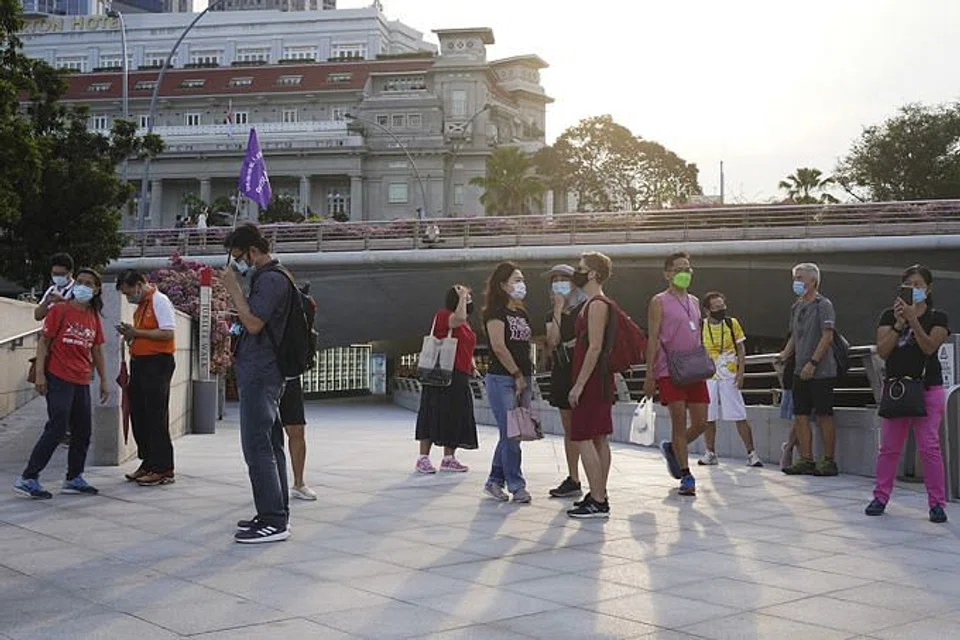
SCHEMES for travellers vaccinated against Covid-19 to enter Singapore could bear fruit only next year, watchers have told The Business Times, as international arrivals to the Republic dipped month on month in August.
Singapore drew some 15,880 visitors in August, higher by 78.2 per cent on the year-ago downturn, but a drop of 14.3 per cent from the month before, data from the Singapore Tourism Board (STB) indicates.
The latest figures were collated ahead of the early-September launch of the vaccinated travel lanes (VTLs) with Germany and Brunei. But these arrangements are unlikely to buoy tourism-related services in the year-end period, especially as Singapore grapples with a fresh surge in Covid-19 infections.
"We do not expect tourist arrivals to come back in a big way for the rest of the year," said DBS analyst Geraldine Wong, who covers hospitality real-estate investment trusts, citing ongoing social restrictions. "Pick-up in VTL will serve as upside to our estimates, but will likely be a catalyst for next year."
Wong Xian Yang, research head at Cushman & Wakefield, added: "While VTLs are a positive development for the hospitality and travel industry and a first step to reopening borders, they are unlikely to have a significant impact on international visitor arrivals and hotel occupancy rates."
In line with the trend in tourist headcount, hotel room revenue was S$68.7 million in August - up 5.9 per cent year on year, but lower by 6.7 per cent than the takings in July.
Revenue per available room (RevPAR) slipped to S$82.13 in August, from S$85.85 in July. The uptick in occupancy rate to 55.5 per cent from 51.8 per cent in July could not make up for the slide in average room rate, which fell to S$147.99 in August, from S$165.80 before.
Jesper Palmqvist, Asia-Pacific director at industry research firm STR, told BT that the domestic Covid-19 situation could also make it "hard to see any changes, regardless of more VTLs", before the end of the year.
"Staycations are going down due to restrictions and more hotels are again considering going back to do Stay-Home Notice (SHN) business," he said, referring to the government use of hotels to isolate new arrivals.
While he said he expects occupancy and revenue to hold steady in the next few months, he added that "the paradox is that high occupancy is bad", as such rates would reflect SHN bookings rather than "real occupancy or demand" from inbound tourism.
While Ms Wong suggested that room rates could get a boost from direct bookings by incoming travellers, she too estimated occupancy will stay "within the current band between 50 per cent and 60 per cent", with support from government contracts.
Separately, mainland Chinese arrivals continued to make up the bulk of August's arrivals - accounting for some 8,900 visitors, although their ranks fell sharply from 12,670 in July.
Among other source countries, the United States was a distant second, sending 828 travellers to Singapore in August, followed by Malaysia, at 683.
The outsized role of Chinese visitors - who, Ms Wong noted, made up 42 per cent of arrivals in the year to date, against 19 per cent pre-pandemic - comes on border closures affecting travellers from regions hit by the coronavirus, such as South-east Asia.
"Chinese arrivals may have been the main feeder market for Singapore pre-Covid because of new tourist attractions, and partnerships and marketing by the STB...," observed Zhang Jia Hao, associate director of CBRE Hotels for the Asia-Pacific. "Notably, China is still the top feeder market into Singapore, as key cities such as Chongqing, Guangdong, Shanghai and Zhejiang within China are on the fast-lane scheme that facilitates essential business and official travel."
Still, Mr Palmqvist said Singapore is not relying on travellers from any particular country, "since volumes are so low and they bring such a small amount to retail, food and beverage, and hotel revenue". His prognosis encompasses arrivals from Germany - despite the recent launch of the VTL.
Mr Wong cited early data from the first few weeks of the scheme, which indicated that VTL approvals for German visitors constituted less than 4 per cent of the year's average monthly arrivals.
Mr Zhang said that there could thus be a recovery in Q4 2021 as vaccinations in the Asia-Pacific rise, but "more so in 2022, following the gradual ease of border restrictions and more countries being added to the VTL list".
TRENDING NOW

Chairman’s role in spotlight with raft of proposed new rules for Singapore boards
Director of PR firm sacked for secretly recording internal meeting loses wrongful dismissal claim

Indonesia stocks suffer worst plunge in nearly 30 years as MSCI proposes standalone status

If Europe goes to war, the fallout will be felt in East Asia

