

Vietnam 'most outstanding' in handling of Covid-19: Control Risks report
Singapore
HAVING learnt at least some lessons from the Sars crisis of 2003, at least five Asian economies apart from China have flattened their corona-virus infection curves.
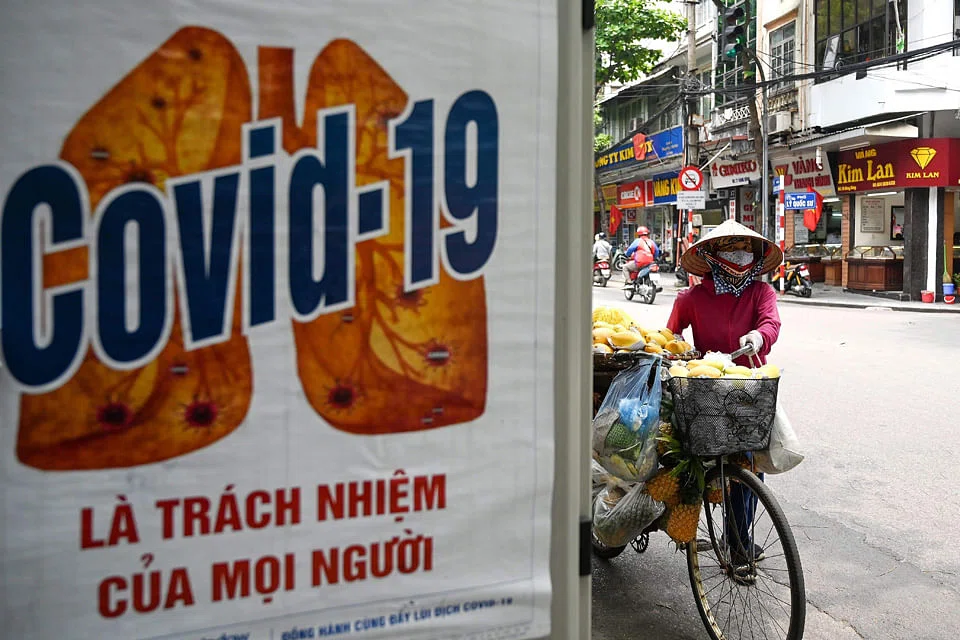
Vietnam, however, has been lauded as the most outstanding for its toned-down authoritarianism and targeted resourcing, a report from Control Risks said.
The report's author Steve Wilford, an Asia-Pacific partner at Control Risks, cited South Korea, Singapore, Taiwan and Hong Kong as the four "most obvious members" of a club he dubbed as the "learners".
These are jurisdictions that are "uniquely Asian", wealthy and have learnt lessons from the Sars crisis 17 years ago, he said.
"I would also bestow this honour on Vietnam which has managed to achieve similar results to its far wealthier neighbours using a clever mix of toned-down Chinese authoritarianism and very targeted resourcing," Mr Wilford said.
Vietnam has bucked the "now-tired trope" that it is just a smaller version of China, he said, by mounting a highly sophisticated, low-cost, low-economic impact campaign of deep quarantine and mobile testing, coupled with blanket but relatively high-touch social distancing measures.
These are then boosted by a very strong focus on keeping the country's export-oriented manufacturing sector open for business.
"This leaves the country arguably even further down the road to recovery than its much-vaunted northern neighbour. Countries with limited resources but a reasonably efficient bureaucracy should be looking to Vietnam rather than China for their pandemic battle plan," he said.
Even so, China remains Asia's poster child for "effective infection suppression", Mr Wilford said.
"Even in the eye of its Covid-19 storm, we and our clients found that China's treatment of foreign manufacturers was for the most part exemplary, and broadly lacked the arbitrary confusion and incoherence that has characterised subsequent attempted lockdowns in other Asian economies like India, Malaysia, and the Philippines," he said.
This is a reminder for company strategists that they cannot close the door on their China supply chain even as they diversify their production sources, he said.
Mr Wilford, however, did not feel the same way for Indonesia, calling it a "somewhat scary control experiment" in terms of how a major economy will be adversely affected by a pandemic that is "left largely uncontained".
While Covid-19 looks to be a public health crisis to many, Mr Wilford said the likely bigger disaster for most Indonesians will be an interruption to normal life due to state measures to curb the spread.
"Poor Indonesians are fatalistically accepting of the fact that Covid-19 is just another disease and disaster that the state will not help them with. The government for its part knows that people expect to be allowed to keep working, for prices to remain stable, and for food distribution to continue," he said.
"Tragic and cynical though it is, it is the government's protection of this trifecta, rather than efforts to curb several hundred thousand deaths, that will keep President Joko Widodo in power and people off the streets," Mr Wilford said.
The silver lining is that while Indonesia was already emerging as one of the world's most wired economies pre-Covid-19, the pandemic could accelerate the usage of those digital platforms, like Gojek, Tokopedia and Ovo, compared to its richer neighbours.
There is one other group of economies that Mr Wilford has called "the possessives", which includes the Philippines.
He said these countries have imposed very effective Chinese-style lockdowns but lack the financial resources to sustain millions of people on the breadline. Thailand and Malaysia also have elements of this format, he said.
"Thailand's agony will be prolonged by its huge exposure to (Chinese) tourism, the global demand impact on its auto sector and by the fact it was suffering from the pre-existing condition of having a polity unfit for the 21st century," he said.
Mr Wilford said it would not be a surprise if Thailand comes out of the pandemic with another round of major anti-establishment civil unrest.
As for Malaysia, Mr Wilford believes that Prime Minister Muhyiddin Yassin will "either be made by this pandemic, or be Malaysia's shortest-lived leader dragged down by his bureaucracy's woeful handling of pandemic responses to date".
TRENDING NOW

He built the Vingroup empire. Now South-east Asia’s richest man is handing some key roles to his sons
32 companies, 6 individuals bag accolades at Singapore Corporate Awards 2026
Can a first-time homebuyer couple earning S$18,000 a month afford a new EC unit?
Floods compound Philippine growth woes from public-works scandal

