



Vietnam expected to lead Asean growth in 2022
Latest ADB data forecasts it to grow 6.5 per cent after lockdowns that hit every single industry caused economic uncertainty
Hanoi
VIETNAM'S economy is expected to have the highest growth rate in South-east Asia in 2022 at 6.5 per cent, latest data from the Asian Development Bank (ADB) shows.
That is good news for a country that, just a few months ago, was gripped in the throes of economic uncertainty as lockdowns ravaged every single industry.
Analysts say the post-Covid recovery, however, will not be applied evenly. Several sectors are already back to normal after just a few months, while others will struggle well into 2022 and even 2023.
Tourism and hospitality
Despite the borders being closed to international tourists, Vietnam still managed to be crowned "Asia's Leading Destination and Asia's Leading Sustainable Tourism Destination" at the World Travel Awards 2021.
But accolades aside, it has - by most accounts - been a year to forget for the tourism and hospitality sector.
In 2020, foreign arrivals dropped by almost 80 per cent; and those that did visit were crammed into the first 3 months of the year before the borders were slammed shut.
Borders have not reopened in 2021, although a handful of tourists have been able to travel to a limited number of locations on pilot programmes aimed at kickstarting the industry in the last 2 months of the year.
Moving forward, while regular international flights are slated to restart in January 2022, a full reopening of the tourism sector is not expected until the middle of the year at the earliest.
Seafood
The Vietnamese seafood industry has been on tenterhooks over a "yellow card" issued by the European Commission (EC) in 2017 for failing to adequately police illegal, unreported and unregulated fishing.
The seafood industry in Vietnam currently accounts for around 4-5 per cent of GDP, and the European market accounted for almost US$1.3 billion worth of sales in 2019. That is down US$200 million since before the warning was issued.
A review by the EC is slated for the first quarter of 2022, the consequences of which could have a huge impact on the world's third largest seafood exporter.
A joint World Bank and Vietnam Association of Seafood Exporters and Producers report released in August estimated that a "red card" from the EC - which would effectively mean a ban on importing seafood from Vietnam - would cost the seafood sector US$387 million a year.
Stronger dong
In April this year, Vietnam was removed from the US Department of the Treasury's list of currency manipulators by the Biden administration.
This was followed, in July, by a joint statement between the Treasury and the State Bank of Vietnam (SBV) in which they announced they had reached an agreement.
The SBV, the statement said, would "avoid manipulating its exchange rate in order to prevent effective balance of payments adjustment or to gain an unfair competitive advantage and will refrain from any competitive devaluation of the Vietnamese dong".
Since July, the dong has strengthened against the greenback. In a Fitch Solutions report in October, the ratings agency predicted that this trend would continue through 2022.
Manufacturing
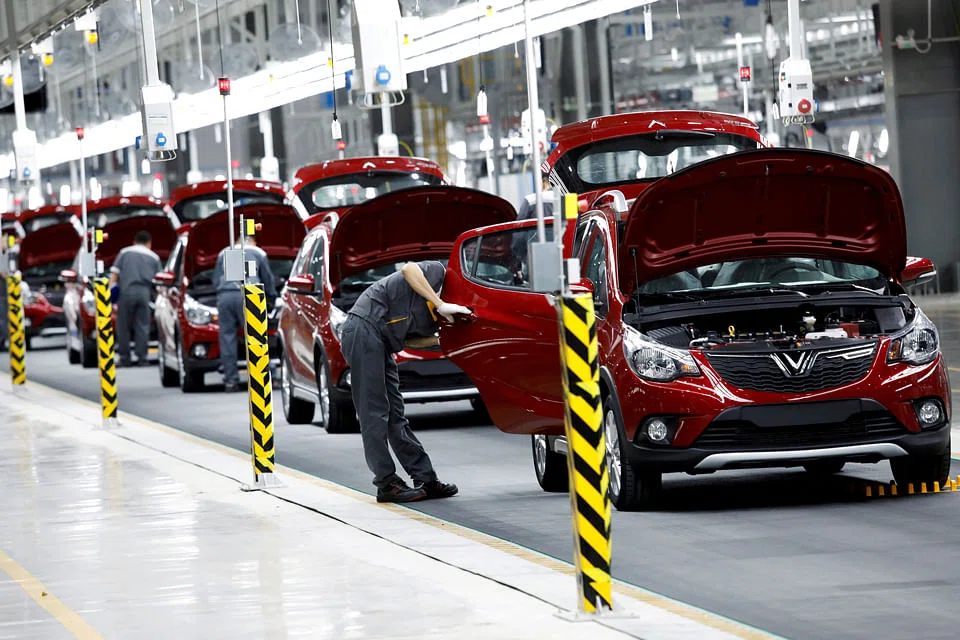
Vietnamese carmaker Vinfast debuted its first electric vehicle in the US in 2021. It also announced plans to spend US$200 million on establishing its US headquarters in California.
With a huge factory in Hai Phong, to the east of the capital Hanoi, Vinfast has the capacity to become a major car maker. If successful, this could be a huge boon for the manufacturing sector, not just in financial terms, but as a point of pride too.
That said, as a new entrant into the auto industry with little experience in making cars, Vinfast has its work cut out for it.
Vietnam's manufacturing sector in 2021, however, will best be remembered for its role in the global supply chain crisis.
Lockdowns around the country saw production slow to a trickle, and a number of key manufacturers began to look elsewhere for cheap labour.
Samsung, for example, announced plans to diversify its supply chain - at least partly - by increasing its operations in India and Indonesia.
Fitch Solutions is predicting that the electronics sector will continue to grow "through a combination of purchasing power, demographic and economic modernisation trends".
This will be helped along by a rapidly expanding middle class that will bring with it a swathe of first-time electronics consumers too, Fitch said in a report.
Digital transformation
Vietnam's digital economy, in contrast to its overall economy, had a bumper year in 2021.
Statistics from the Ministry of Science and Technology put total investment in startups at US$1.3 billion, well ahead of the US$364 million recorded in 2020.
Like many places around the world, lockdowns were a huge stimulant for online economic activity.
The e-Conomy SEA 2021 report, a joint initiative of Google, Temasek, and Bain & Company, clocked a 31 per cent increase in the size of Vietnam's internet economy based on gross merchandise value.
The report predicts that Vietnam's Internet economy will reach as much as US$220 billion by 2030.
Overall, Vietnam's economy has had a choppy year. But as the Covid-19 vaccination rate increases and businesses continue to reopen, there is good reason to be optimistic for 2022. All things considered, the road to recovery will be long and steeped in an abundance of caution.
TRENDING NOW

What role can Japan play in Asean’s future?

IOI Properties and CapitaLand Investment closer to acquiring One Raffles Place in joint bid
AI bubble may burst soon amid financing concentration, rising rates: Ray Dalio

OCBC sheds S$8 billion in value as shares close nearly 6% down; analysts cautious on banks

