Weakened Merkel stokes business uncertainty, though markets stay calm
London
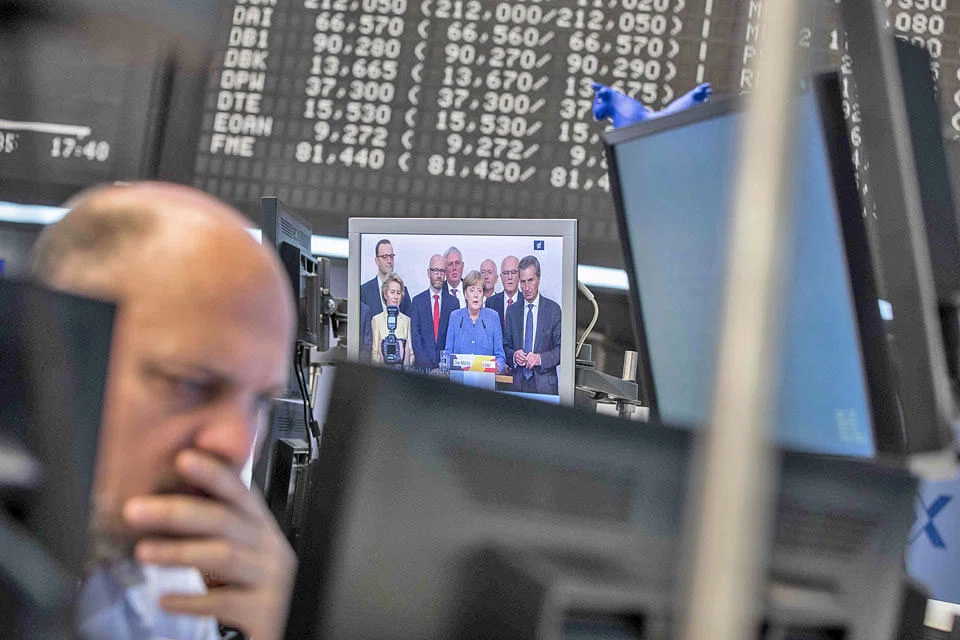
THE euro and European stock markets hardly reacted to the weaker position of German Chancellor Angela Merkel, even though business groups fear a period of uncertainty.
Mrs Merkel achieved a fourth term, an impressive feat in European politics, but her poor results in the country's general election illustrate disenchantment with her policies.
The share of the vote for Mrs Merkel's Christian Democrat Union party and Christian Social Union ally declined by almost 9 per cent to 33 per cent; the Social Democrats, who came second with only 20.5 per cent of the vote, have decided to be the opposition.
Mrs Merkel thus has to form what German commentators believe to be an unstable coalition with the Free Democrats and Greens.
There will be horse-trading for roles in the Cabinet and the choices will affect Germany's policies regarding the European Union (EU), the euro, the European Central Bank, Brexit and the nation's relationship with France.
An unstable government would be bad for Germany's standing as a business location, cautioned Clemens Fuest, head of Munich's Ifo Institute. "The (former) grand coalition represented stability and predictability. Now there is some uncertainty."
"Germany has enacted no major domestic reform for 12 years. The country lags behind in the move to the Internet of Things. Its largest economic sector, the car industry, is mired in crisis after betting on the wrong technology, diesel, for the past generation," wrote Andreas Kluth, editor-in-chief, Handelsblatt.
The most alarming aspect of the elections was the surge of Alternative fuer Deutschland (AfD), which scored 12.6 per cent of the vote and is projected to have 94 members in the 690-seat Bundestag, the German Parliament.
The AfD, which began as a small anti-euro group, gained many more voters because of its populist anti-migration rhetoric.
It has also attracted large numbers of right-wing neo-Nazi, racists and fascists who detest Muslims and want to downplay memories of the Holocaust.
Mrs Merkel and other centrist politicians will have to counter them in Parliament.
"The AfD has plenty of right-wing extremists in its ranks. It has sought to minimise the crimes of the Nazis in World War II and is well-versed in Islamophobic and xenophobic rhetoric," Der Spiegel states.
"The right-wing populists will change the Bundestag just as they have 13 state parliaments already."
"For the first time since Hitler's suicide in that Berlin bunker more than 70 years ago, a nationalistic right-wing party has won dozens of seats in the German Parliament. The Communist Left has done well too," commented Mark Almond, director of the Crisis Research Institute, Oxford.
"Almost a quarter of Germans voted for parties which reject the status quo. That level of alienation hasn't been seen since the last days of the Weimar Republic in the early 1930s."
"Two issues bedevilled this election: mass migration and wage stagnation were the underlying concerns for many Germans who felt 'left behind' in a prosperous nation," he maintained.
The AfD party, however, is divided between its more moderate right wingers and the extremists. Indeed, on Monday, despite the party's triumph, co-leader Frauke Petry said that she would not sit in Parliament with AfD members.
"I think we should be open today that there is a disagreement over content in the AfD and I think we shouldn't hush this up because society is calling for an open debate," Ms Petry told a joint news conference.
"I'll do everything I can to achieve that so the sensible ideas the AfD has been working on since 2013 actually become a political reality."
This indicates that there will be opposition to any Merkel entente with France's President Emmanuel Macron regarding greater centralisation of the EU and bringing in more nations into the eurozone.
READ MORE: