

Key long-term trends in 2021
From sustainability to digitalisation, these trends have gained momentum and will likely continue to increase in importance.
 Add BT as a preferred source



DeeperDive is a beta AI feature. Refer to full articles for the facts.
LAST year turned out to be a great year for equity market investors, in spite of a global pandemic. Several US equity market benchmarks hit new highs, supported by strong earnings growth among tech stocks and pharmaceutical companies, while several other markets around the world also reached new records.
Heading into 2021, however, market watchers are predicting rotation into laggard sectors and geographies. The administration of vaccines in many countries should allow economic activity to recover, while central banks and national governments can be expected to be ready with stimulus initiatives.
At the same time, a few long-term investment trends have gained momentum over the past year - particularly the trends of sustainability and digitalisation - and will likely continue to increase in importance.
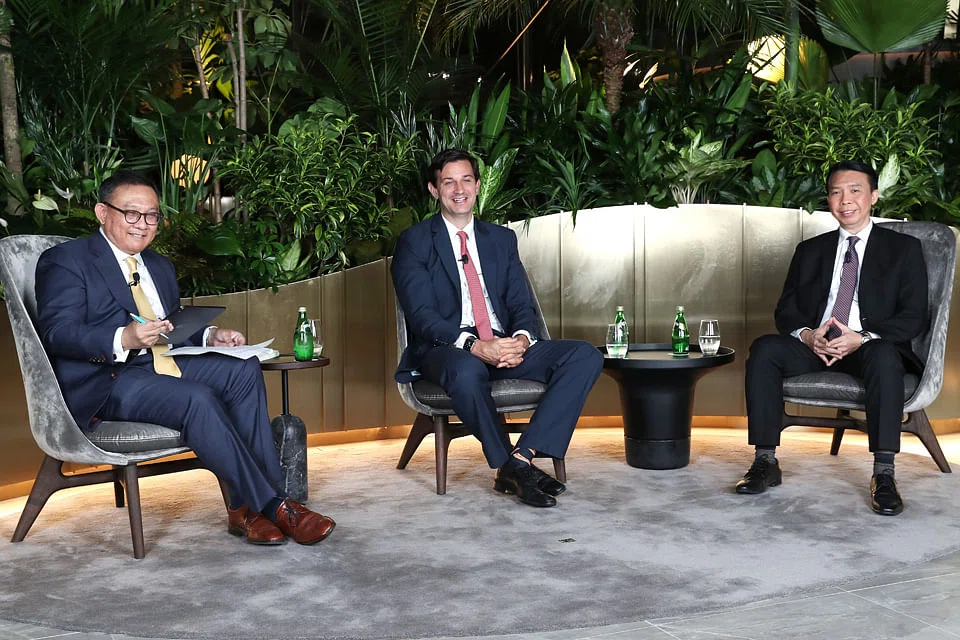
These were some of the views of four speakers at a roundtable discussion at Citi's 2021 Annual Outlook Forum. Held at Citi's wealth hub on Tuesday evening, the session was moderated by The Business Times' senior correspondent Ben Paul.
Robert Jasminski, global head of Citi Investment Management, said while returns were last year led by large cap tech names in the United States, he sees a shift this year to emerging markets in this region.
"When we start looking back and we start seeing where do you have the ability for some upside and, where do you get that leverage to global growth, I think the emerging markets stand out," he said, noting South-east Asia was a potential area for growth, as it goes through the first wave of vaccinations.
Navigate Asia in
a new global order
Get the insights delivered to your inbox.
"You have seen the bounceback clearly in the North Asian markets on how quickly intra-China travel has already kicked back in," he added. "I think that could be a precursor for the rest of South-east Asia."
US stocks had a tremendous run in 2020, with benchmark indices such as the Nasdaq Composite rising over 40 per cent in the year.
Although there is still innovation going on among US companies, and plenty of momentum in the US markets, Mr Jasminski noted that there are tailwinds forming in Asia from population size, innovation and consumption. These could make the region an "unstoppable trend" for investors.
Ben Powell, managing director and chief investment strategist for AsiaPacific at the BlackRock Investment Institute, shared Mr Jasminski's optimism for 2021. His firm has an overweight position in both Asia and US equities.
"Our framing at the BlackRock Investment Institute is we want to have exposure to both the engines of the world," he said, adding that investors do not necessarily have to choose between owning one or the other.
"We are going to be coming through what we term an activity restart, where we go from being locked down to not being locked down," Mr Powell said.
He suggested that 2021 could potentially enjoy the biggest growth in percentage terms globally since the early 1970s, if all goes well with the vaccine roll-out.
At the same time, he expects US-China tensions to persist even with a new administration as the tensions are "structural in their nature".
"It's quite likely over time that to access Chinese growth, one is going to need to own Chinese securities directly, or other assets that are found in this region, because it's going to be harder and harder to get it via the S&P."
Vaccine optimism
Against that optimism, Mr Jasminski cautioned that expectations for the pace of vaccine roll-outs are at risk of being unrealistic.
"What we are seeing today, clearly, whether it's the Moderna or Pfizer (vaccine), it's just the limit of the number of vaccines that can be available in the first place," he said.
"We had a lot of excitement on the first set of news and approvals," he added. "It's really the second half story of how you start getting mass vaccinations through."
Alan Tang, group chief executive officer of Far East Orchard, which owns hospitality assets and purpose-built student accommodations, said the vaccine rollout has provided a ray of hope for the hospitality industry, which was hit by the lockdowns. He expects this to be a key theme for 2021, but acknowledged that there was still uncertainty ahead.
"Until that confidence is returned - because this is a crisis of confidence that people are not travelling - it will still be an uncertain recovery for the travel trade and hospitality," he said.
Meanwhile, Mr Tang said the company has had to look at ways to incorporate technology efficiently to enhance the experience for its guests. This could take the form of shortening check-in times by using mobile check-ins and mobile card keys.
Accelerated digitalisation
The panellists also discussed the adoption of technology and digitalisation, which has been a trend during the pandemic due to various travel and social distancing restrictions.
Mr Powell noted that the Internet is not something new, the Covid-19 pandemic had accelerated trends that might otherwise have taken years to play out.
A case in point was the evening's panel discussion, which was held semi-virtually: Half the panel members were physically present at the Citi Wealth Hub at 268 Orchard Road, while Mr Jasminski and Tobias Levkovich, US equity strategy, head of Americas equity strategy at Citibank, took part virtually.
Acknowledging the digitalisation trends, Mr Levkovich said: "We may have seen a four or five years pull forward of the adoption rates."
In Asia, this digitalisation and take-up of new technology would have created investment opportunities in Japanese companies involved in automation and robotics.
Mr Jasminski noted that the Japanese government is a significant investor in many large-cap Japanese stocks.
"Traditionally, Japan has been lower on returns, with no big incentive to change," he said. "You have seen the government becoming almost an activist shareholder to try to drive better returns."
Elsewhere, however, growth for the technology sector could slow.
Mr Levkovich said this could be a problem for some tech stocks in the near term, as they would be measured against their extraordinary levels of last year.
On the other hand, Covid-impaired businesses facing comparisons from a low base a year ago could enjoy a strong bounceback. There could be near-term shifts in investor sentiment benefiting value and cyclical stocks.
Mr Levkovich also highlighted possible antitrust issues for existing e-commerce winners. This could cause concerns for US stocks at the index level in the near term, as the technology e-commerce plays are heavily-weighted on the S&P 500 and have been the leaders in pulling the index higher.
"If you start to see them weaken a bit, the analogy I keep telling people is to think of a dog sled - that you are removing the huskies and you replace them with cocker spaniels, poodles and chihuahuas. It's going to be harder to pull the dog sled," Mr Levkovich said. "That's where the index is less interesting than the rotation below the index level, which I think is far more important, and probably far more rewarding in 2021."
Greater sustainability considerations
Another trend that gained in importance due to the pandemic was the role of sustainability in investing. Mr Powell said 2020 represented a sea change in sentiment as many investors had previously considered sustainability as more of an add-on to investing.
"Unfortunately, 2020 has been a great example to demonstrate the principle that these risks are not beyond the model," he said. "They are clearly central to investment risks and should be thought of accordingly."
The panel also discussed the increasing focus on clean technologies, with electric vehicles being a current trend popular with investors. Mr Levkovich observed that many traditional automotive companies are also gravitating towards electric vehicles.
But he said the transition would take a while, as vehicle fleets take time to be renewed.
"We shouldn't forget that most people still drive petrol-fuelled cars," he said, adding that people going on vacation are still taking airplanes using jet fuel. "We have to be a little bit careful on the transition."
Active management
As investors think about how to make money from these broad trends, the panellists highlighted the importance of active management in generating outperformance.
Most of the market is focused on the large index weights and big names in growth trends, said Mr Jasminski. This means that second- and third-order derivatives of trends may be forgotten.
Taking the example of electric vehicles as an investment theme, opportunities beyond car makers would include those producing battery technologies or sensors and control modules.
"I think the big opportunity, what we are seeing today, is rolling up your sleeves and looking through these places that havent been appreciated yet," he said. "It's very bottom up, this is one of the stories for active management, and the belief of having boots on the ground and visiting these companies and looking at the trends."
Mr Jasminski said exchange-traded funds (ETFs) or passive funds represent an easy way to get broad-based exposure to first-order names.
"If it's a choice of having no exposure, or having an individual name or ETF, I think people need to have the exposure," he said. "These are long term secular areas that are going to continue to drive growth, and they are going to continue to drive growth in a world of probably slower growth in many other areas."
He added, however, that a broad based ETF would contain all the winners and losers, with the fund also paying the prevailing price for the big names.
He therefore believes active managers are still able to navigate the markets and generate excess returns by understanding the sectors and identifying mispriced opportunities or underappreciated stories.
Mr Levkovich, meanwhile, noted that over 180 constituents of the S&P 500 outperformed the benchmark index by more than 10 percentage points in the fourth quarter.
"Stock picking is actually a very good way to make money, and I don't think people have spent too much time looking at that data," he said.
Minimising cash
The panellists also said it was important for investors to get exposure to markets instead of holding a large portion of their portfolio in cash, in view of possible risks of inflation.
"So many people today are sitting in cash or are waiting," said Mr Jasminski, noting many investors have been overweight cash since 2019 - when the US-China trade tensions started.
People said they would put some of that cash to work in 2020, but then Covid-19 hit, he said.
For Far East Orchard's Mr Tang, the low interest rate environment would also mean that the company is looking for opportunities to put cash to good use.
"Given what we have seen in 2020, it's safe to say there hasn't been any correction in prices, and we are looking very carefully in the next 18 months or so whether that would change, and we are definitely standing ready to deploy some of the capital that we have to good use," he said.
Indeed, for equity investors, last year was not a good year to have been mostly in cash.
Mr Levkovich noted that Citi's Panic/Euphoria model, a sentiment metric, is at its highest level of euphoria ever, exceeding the levels seen during the technology bubble of 1999 to 2000.
"That certainly raises concerns for a pullback of significant size," he said. "We still think the year will be a modest increase, but there might be some turbulence along the way."
He added that investors may also be a little too optimistic about what a Biden administration can deliver, even in terms of stimulus, given that there may also be higher tax rates for corporates and certain individuals.
According to Mr Powell, the world is in a "new investment order".
"We can't just rely on how we invested over the last years and decades," he said, adding that holding cash is risky in a world where inflation might return, with developed market government bonds also not giving what they used to in terms of yield.
"We are going to be having to source for income in different places," Mr Powell added. "Real estate is a great example, Asian bonds, Chinese equities, this kind of new investment order is a reality we are all going to have to adjust to."
Brought to you by Citibank Singapore Limited
Decoding Asia newsletter: your guide to navigating Asia in a new global order. Sign up here to get Decoding Asia newsletter. Delivered to your inbox. Free.
Copyright SPH Media. All rights reserved.
TRENDING NOW

From 1MDB to ‘corporate mafia’: Is Malaysia facing a new governance test?
Higher costs, lower returns: Why are Singaporeans still betting on real estate?
South-east Asian markets account for 8.8% of global capital inflows from 2021 to 2024: report
Richard Eu on how core values, customers keep Singapore’s TCM chain Eu Yan Sang relevant

