Australia showcases its industry strengths
With proven capabilities in the built environment field, its companies can partner Asean countries in their Smart Cities drive.
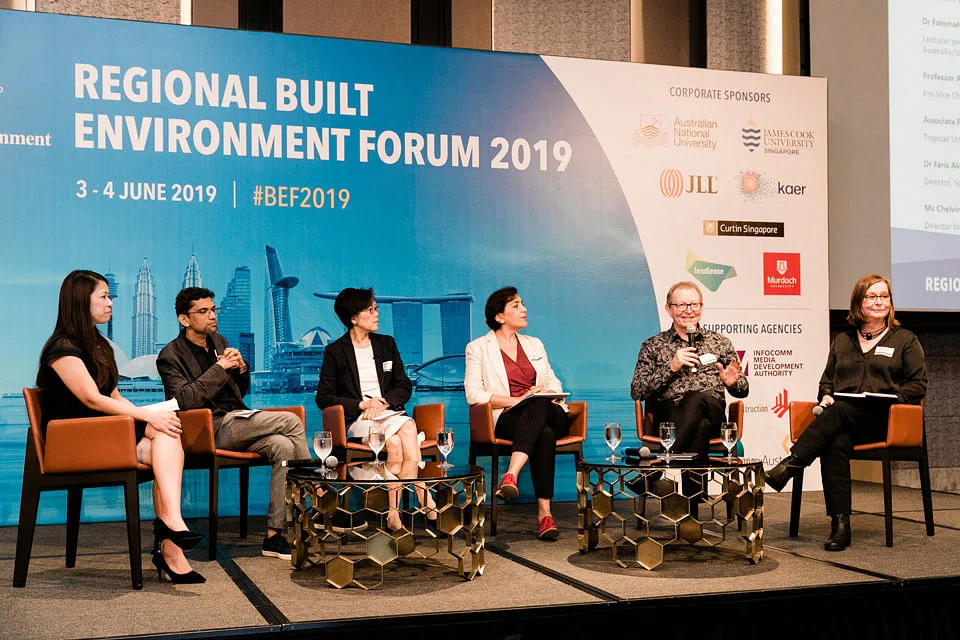
TO showcase Australia's capabilities in the built environment field and highlight how Australian companies and organisations can - and are currently - partnering with countries in the region to support Asean's unfolding urbanisation story, the Australian government organised a Regional Built Environment Forum in Singapore on June 3 and June 4.
The event successfully brought together more than 200 representatives from Australian, Singapore and multinational built environment companies, both governments, NGOs and officials from Asean cities to promote Australia's built environment capability, partnerships, investments and commercial opportunities in the nearly 650 million people-strong Asean region.
Singapore's Building and Construction Authority (BCA) and Infocomm Media Development Authority (IMDA) were supporting agencies. Sim Ann, Senior Minister of State for the Ministry of Communications and Information and Ministry of Culture, Community and Youth, was the guest of honour.
At the forum, IMDA and the Australian government signed a built environment memorandum of understanding and the Australian government launched the Asean Smart Cities Accelerator in Singapore.
Witnessed by Ms Sim and Australia's High Commissioner to Singapore, Bruce Gosper, the MoU signed by IMDA and Austrade focuses on three key areas for smart estates: facilitate business matching and networking opportunities for Singaporean and Australian players in the smart estates cluster in South-east Asia; drive co-innovation technology projects for smart estates as part of digitalisation efforts for both Singapore and Australia; and co-develop a smart estates guidance for the industry in the areas of smart environment and smart living.
IMDA chief executive officer Tan Kiat How says: "As we continue to develop a vibrant smart estates ecosystem in a digital economy, there is a strong need to foster greater collaboration with key players within the built environment cluster. We believe that companies from both Singapore and Australia can complement each other, leverage on each other's strengths and co-develop smart urban solutions for Singapore, Australia and South-east Asia."
Leonie Muldoon, senior trade and investment commissioner of Austrade, said: "Australia has made significant investments in developing smart solutions in the built environment and this agreement will build a platform for collaboration with the Singapore ecosystem. Working together we can deliver better outcomes for both Singapore and Australia, and build a network to respond to opportunities across the region."
The Australian government's second initiative, the Asean Smart Cities Accelerator, is based in Singapore. The regional accelerator, Accelerating Asia, is the provider of the Australian government's Smart Cities Accelerator for Asean.
ASEAN STARTUPS
Launched by Mr Gosper, the Asean-Australia Smart Cities Accelerator is a seed stage accelerator programme that will select, fund and provide a residency programme and a graduate programme for qualified startups in Asean to give them a stronger chance of success through access to regional opportunities, knowledge, networks and resources.
"The Asean Smart Cities Accelerator is a big step in Australia's efforts to make the vision of smart cities into reality," said Mr Gosper. "The Australian High Commission is proud to support the programme and will continue to actively work with Accelerating Asia to leverage all the opportunities this programme offers to regional startups."
The accelerator is now on the lookout for next generation solutions that can be scaled across growing cities that improve livelihoods through new business, career and economic opportunities; improve access to safe and affordable housing, public spaces, infrastructure and transport; consider environmental impact; and enable resources and services in cities to be accessible to all.
Amra Naidoo, co-founder of Accelerating Asia, said: "The accelerator is designed to provide tailored support for early stage startups working on solutions that enable better connected, sustainable and more resilient cities in South-east Asia. We are excited to work collaboratively with cities, government agencies, entrepreneurs and innovators to foster an ecosystem that expedites the development of cities that work for everyone."
Mr Gosper added: "In many ways, the challenges facing our economies and communities, and those of the region, are ones that need the best built environment solutions. Working together and leveraging our respective expertise, Australia and Singapore have the opportunity and capability to collaborate with Asean to build our region's future cities in smart, liveable and sustainable ways, supporting urbanisation and tackling climate and energy challenges."
On why Australia held the Regional Built Environment Forum in Singapore, he said that part of the context is the Australia-Asean summit last year where a Smart Cities Initiative was launched to try "to do more in the region to support the development of cities. Also last year we conducted an Australia-Singapore Infrastructure Investment Forum where we sought to bring people together to talk about investment in infrastructure."
"What we did was - very simply - we looked at the capability of Australian businesses, we looked at demand in the region and, as a High Commission working with our partners like Austrade and CSIRO, we sought to find something we could do that would be of value to business and help them to network and find opportunities that would help the region and that's what we did."
CSIRO stands for Commonwealth Scientific and Industrial Research Organisation, and it is Australia's national research and science organisation.
The highlight of the Regional Built Environment Forum 2019 was an all day conference on June 4, with two keynote speeches and five discussion panels on "Cities of the future in Asia", "Digitalisation of Urban Environments", regional built environment opportunities; the sector's future skills and education needs; sustainability and city resilience; and, platforms and partnerships for commercial opportunities.
The forum included a Built Environment Marketplace (BEM), where corporate sponsors displayed their capabilities in smart cities design, construction, technologies and education. Singtel and Accelerating Asia also had a presence in the BEM.
FUTURE SKILLS
One of the forum's key themes was the built environment sector's future skills needs. Event corporate sponsor James Cook University, Singapore, took the opportunity to promote its new Planning and Urban Design programmes, which - as a discipline - deals with relevant urbanisation issues, challenges and solutions.
In a nutshell, urban planning is a discipline aiming to plan, regulate, and create more sustainable and liveable urban environments, explains Dr Simona Azzali, lecturer and researcher in urban design at James Cook University, Singapore. "In an overpopulated and resources-scarce planet, cities will always need urban planning."
Another key forum theme, sustainability and city resilience, was covered in a discussion panel led by Eco-Business founder and managing editor Jessica Cheam and included experts from The Australian National University, CSIRO, MANN+HUMMEL and the Ministry for National Development's Centre for Liveable Cities. A key finding was the need to reshape how we think about energy systems.