

Celebrating a milestone
Strong Singapore-China bilateral relations enable both countries to work closely together and actively promote trade and investment
THE recently concluded 25th Asia-Pacific Economic Cooperation (Apec) summit hosted by Beijing has been hailed as a stellar showing of China's growing confidence and poise on the international stage. It is evident that China wishes to be an influential power rather than a dormant one, and it is quite clear that its strategy centres on collaboration rather than confrontation. Within the Asia-Pacific region, China - leveraging on its economic prowess - is now seen to be wielding more might in augmenting regional collaboration to effect ubiquitous growth and development. Recently announced measures such as the setting up of the Asia Infrastructure Investment Bank in which Singapore will be co-investing; and the Silk Road Infrastructure Fund, which will focus on the 21st Century Maritime Silk Road initiative, can only be good news for Singapore.
With China determined to build up the 21st Century Maritime Silk Road network, Singapore stands to play a pivotal role as the hub for South-east Asia to connect China and Asean. The strong bilateral ties that Singapore and China enjoy would enable both countries to work closely together and actively promote trade and investments between China and the region.
Although formal diplomatic ties between Singapore and China were first established in 1990, Singapore and China relations go back a long way with century-old ancestral ties and cultural affiliations. Over the years, both countries deepened this relationship with growing trade volume, increased inter-governmental collaborations and regular high-level visits.
SILVER JUBILEE
Next year will mark the 25th anniversary of diplomatic relations between Singapore and China. Over the 25-year period, trade has grown more than 20 times between the two countries, having risen from US$4.2 billion to US$92 billion. In 2013, China became Singapore's largest trading partner, with bilateral trade amounting to US$73.1 billion, a rise of 11 per cent from the previous year.
At the same time, Singapore became China's top foreign investor country, with investments increasing about 16 per cent to exceed US$7.3 billion from the year before. These figures reflect the increased stakeholdership and growing confidence that Singapore and China have in each other's future prospects.
The positive bilateral relations are further strengthened through key inter-governmental projects, namely the iconic Suzhou Industrial Park, which celebrates its 20th anniversary this year; and the forward-looking Tianjin Eco-city. Similar projects backed by the governments, such as Guangzhou Knowledge City, Singapore-Sichuan Hi-Tech Innovation Park and Jilin Food Zone are also testimony to the veritable partnership between Singapore and China.
The success of these projects has instilled confidence and led to discussions about a possible third government-to-government project in the pipeline, to develop China's western region.
COMMUNICATION IS KEY
Such trust and confidence in each other would not be possible without open channels of communication between both countries. The establishment of engagement platforms such as the deputy prime minister-level Singapore-China Joint Council for Bilateral Cooperation (JCBC) and the seven provincial business councils has been instrumental in deepening bilateral relations, establishing trust and friendship across all levels so as to engage in further areas of cooperation between the two countries.
The process of yuan internationalisation is one that Singapore has been privileged to be involved in. During the recent 11th JCBC meeting, the launch of direct currency trading between Singapore and China was announced. With this launch, Singapore companies with businesses in China can enjoy greater efficiency and convenience in business transactions while lowering costs. This move is seen as a "major and significant" development that would greatly boost bilateral trade links.
Effective communication, underpinned by common language and similar cultural background, is one of Singapore's most important edges in the building of close ties with China. Strengthening our bilingual and bicultural capabilities, and aligning our knowledge of China with its most up-to-date development has become one of our key priorities. It was with this vision that Business China was formed seven years ago, and its core mission is to nurture an inclusive bilingual and bicultural group of Singaporeans to develop a cultural and economic bridge linking the world and China.
Since its inauguration in 2007, Business China has developed to become one of the leading platforms to understanding China. Through high-level forums, interactive talks and seminars organised around its three main initiatives - FutureChina, Apex and Go East - Business China strives to engage with all sectors of the Singapore society in a collective effort to embark on its mission.
FUTURECHINA
FutureChina encourages leading organisations in Singapore to equip their employees to be China-ready, China-savvy and connected. The main programmes of the FutureChina initiative include the FutureChina Global Forum (FCGF) and the Future China Advanced Leaders Programme (FC-ALP).
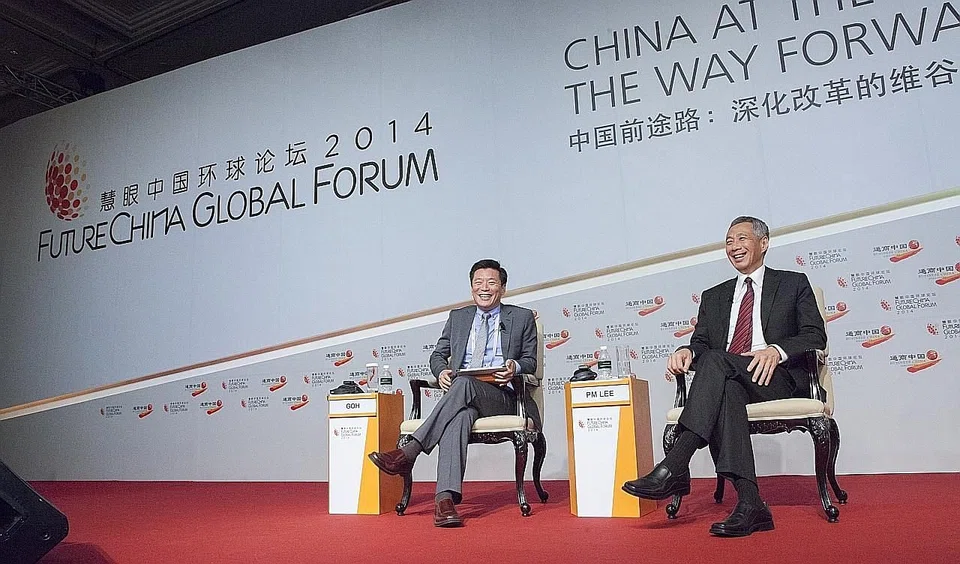
FCGF was created in 2010 to position Singapore at the forefront of China thought leadership and as a significant node in the network of countries connecting with China. Five years on, FCGF has engaged with over 200 leading political figures and esteemed China experts to speak at the Forum. They include Lee Hsien Loong, Business China's Patron and Singapore's Prime Minister; Goh Chok Tong, Singapore's Emeritus Senior Minister; Zeng Peiyan, vice-chairman of Boao Forum for Asia and former vice-premier of China; Liu Changle, chairman & CEO of Phoenix Satellite Television Co Ltd; Clyde Prestowitz, president of the Economic Strategy Institute; and David Shambaugh, director of the China Policy Program, Elliott School of International Affairs, George Washington University.
Ambassador J Stapleton Roy, founding director emeritus of Kissinger Institute on China and the United States, when speaking at the FCGF 2011 Closing Plenary Luncheon, noted: "We are right to be giving attention to the implication of China's rapid rise and how this could affect prospects for China's relationship with the United States." US-China relations remain an international development that the world watches with intense attention.
The FC-ALP was first launched in 2012 and has completed three successful runs of a highly interactive journey to connect with China. Upon completion of this hands-on intensive programme, participants have the opportunity to be inducted into the Future China Advanced Leaders Club, currently a 60-member-strong exclusive club for successful entrepreneurs, second-generation business owners and C-suite executives.
Jube Zhong, assistant CEO & executive director, commercial properties, Yanlord Land (Chengdu) Co Ltd, from the Class of 2013 remarked: "I like the hands-on and very practical experience that we have in the second segment where the whole class went to China for the experiential learning journey. I think these closed-door discussions with government leaders and Sino experts from both Singapore and China gave the whole class a better understanding of China's changing landscape."
These programmes provide participants with a comprehensive analysis of China's latest developments and an intimate understanding of its future trajectory.
APEX
Under the Apex initiative targeted at individual members, public lectures and seminars such as the China Insights Series and Eminent Speakers Series are held regularly. Academics and industry experts offer valuable perspectives on a broad range of topics that would impact China and the world.
Prominent speakers who have been invited to share in Business China's lecture series include Justin Lin Yifu, former chief economist & senior vice-president of the World Bank; and Yao Jingyuan, former chief economist, China Bureau of Statistics, who spoke on broad-based economic issues. Yau Lop Poon, editor-in-chief of Yazhou Zhoukan, and Nan Fangshuo, Taiwan's leading political commentator, have also been invited to deliberate on China's political landscape and governance issues in the earlier years of the setting up of Business China.
Prominent and renown speakers will continue to be engaged to offer their unqiue insight on China, so as to keep Singaporeans abreast of its developments.
GO EAST
Coined from a parody of the Chinese classic Journey to the West, Go East signifies the current shift of pivotal economic activities to the east. Go East mainly engages with Singaporean students, particularly those in institutes of higher learning, by exposing them to the changing faces of Chinese society and helping to prepare them for a future of working and living in China.
Since 2008, more than 10,000 youths have participated in Go East's programme. A selected group of student members with especially strong interests to engage China on a deeper level are further inducted into the Business China Youth Chapter (BCYC), where they will initiate and spearhead youth-centric programmes targeted at increasing Singaporean youths' China quotient. The BCYC has grown from 20 to 99 members in the four years since its formation.
Armed with a strong belief in the importance of upkeeping the Chinese language and engaging a growing China, Chang Zi Qian co-founded BCYC in 2010. Currently a senior officer for innovation and enterprise at the National Research Foundation, Mr Chang was selected to participate in the 2012 Dragon 100 Young Chinese Leaders Forum in Hong Kong. He currently continues his active participation and enthusiasm in building a bilingual and bicultural environment for Singapore Chinese youths in Business China's Go East Committee.
Another BCYC member, Ang Li Shian, an alumni of Peking University, currently works for the Urban Redevelopment Authority. Her bilingual and bicultural capabilies have enabled her to relate to and engage with confidence and ease the Chinese officials who came to study Singapore's Conservation Programme. Her years studying in Beijing also provided her with contextual knowledge of China's unique societal conditions, and enabled her to strike an empathetic chord with the China visitors.
A CHINA-READY FUTURE
Since Business China's inception seven years ago, more than 200 multi-faceted events benefiting some 50,000 Singaporeans have been organised.
The year 2015 will usher in Singapore's Golden Jubilee. At the same time, Singapore and China will commemorate 25 years of diplomatic relations. In this special year, Business China looks forward to exploring new opportunities to connect Singaporeans with a swiftly urbanising and globalising China. It will continue to organise high quality programmes to groom an inclusive group of bilingual and bicultural Singaporeans who are China-ready and China-savvy, and well-poised to engage with China in ways that will benefit the sustained growth of both nations.
TRENDING NOW

Fed hike throws Singapore banks a margin lifeline; UOB most likely to feel impact

He built the Vingroup empire. Now South-east Asia’s richest man is handing some key roles to his sons

Real-estate veteran Desmond Sim quits from CEO roles at Realion, ETC
Chagee, Mixue and Luckin won the market. Sustaining their edge is the harder part

