

China, India demand adds shine to gold
Price up from US$1,182 at end-Dec to US$1,234, but longer-term outlook is lacklustre
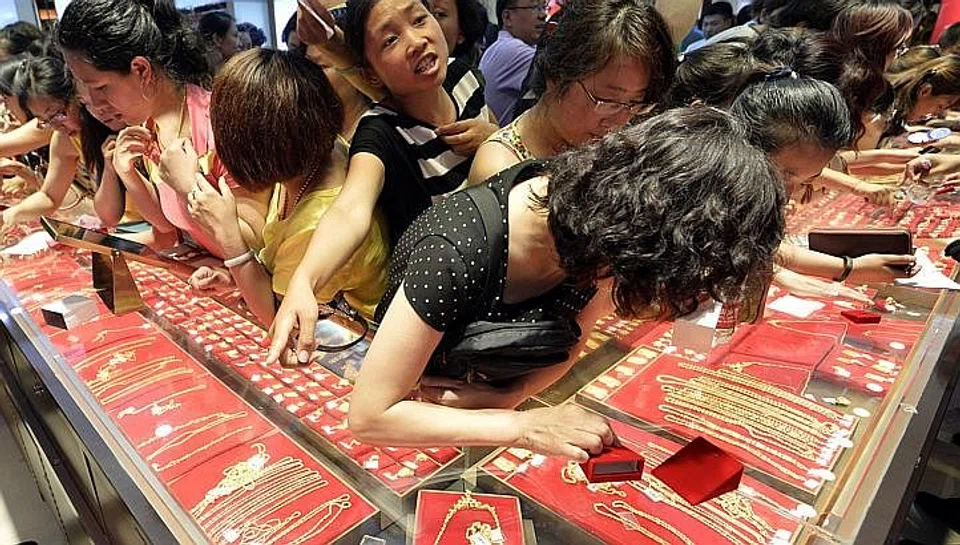
[SINGAPORE] It was all doom and gloom for gold at the end of 2013, but the new year has put a bounce back in gold prices.
Riding on the back of increased physical demand in China ahead of Chinese New Year and news that India may reduce its import duties on the metal later this month, the spot price of gold has climbed from a six-month low of US$1,182 on Dec 31 to US$1,248 late on Monday. It was trading at US$1,234 at 10pm last night.
"There's a lot of news about China, and people queueing up for gold jewellery," said Standard Bank's head of precious metals, Ng Cheng Thye. "That's why it has created a strong demand in the physical market."
The closure of refineries for the holiday season meant that supply has been reduced, pushing up premiums over gold's spot price in China to about US$30 an ounce, compared with between US$8 and US$10 an ounce at the end of last year, Mr Ng noted.
Besides seasonal buying for Chinese New Year, the pick-up in demand in China is due in part to recent weak gold prices.
"It looks like another price opportunistic period where the recent price weakness at the end of the year has triggered an increase in Asian physical demand," said Mark Keenan, head of commodities research at Societe Generale.
At the same time, Reuters reported on Monday that the Indian government could be cutting its import duty on gold later this month.
To reduce a record trade deficit, India had increased the import duty on gold three times last year to a record 10 per cent and tied imports for domestic consumption to exports, which resulted in a rise in smuggling that the government is now trying to curb.
Many, however, remain sceptical about the relaxation of the import restrictions.
"The return of India as a greater importer would be gold-friendly but it is still not clear when, or even if, the authorities will cut the tariffs on gold," said HSBC chief commodities analyst James Steel. "It may also take months for greater physical demand to work thoroughly through the market and support prices."
In the short term, gold prices could go up further to between US$1,275 and US$1,305 an ounce, said head of commodity research Dominic Schnider at UBS's wealth management unit.
A rebalancing of commodity indices at the start of the year could help to support gold prices in this period.
"In the Dow Jones UBS Commodity Index, the second-largest passive commodity index, gold accounts for 10.8 per cent. If you think about the 28 per cent gold drop last year, in order to rebalance, it has to buy gold," he said. Both the Dow Jones index and the S&P GSCI are also giving gold more weight this year.
Another support for gold prices comes from a closing of short positions in gold, or bets that gold prices will go down.
Said Mr Keenan: "As we saw for the whole of last year, (an increase in Chinese demand) does not have the ability to catalyse any meaningful sustained rises. But it certainly catalyses short-covering and the establishment of a short-term price floor, and that's what we're seeing at the moment."
Short futures positions on gold held by hedge funds more than doubled from early November to 82,765 contracts for the week ended Dec 24, according to data from the US Commodity Futures Trading Commission. The week after, it dropped 5 per cent to 78,334 contracts.
The longer-term outlook for gold, however, remains bearish, said analysts.
"The backdrop of a global economic recovery, the winding down of the monetary stimulus that we see coming to an end in the middle of this year - and the side effect of a higher dollar - will weigh significantly on gold prices," said Mr Keenan.
At the same time, nearing the end of this year, "we're going to be talking about rate hikes", said Mr Schnider at UBS.
"I know a lot of people will say this is premature, but it's not premature if we talk about a 12-month forecast."
Gold tumbled 28 per cent last year, the first time since 2000 that it has failed to end the year higher than where it started.
A surge in speculative selling in bullion-backed exchange traded funds (ETF) in April caused gold to fall to a low of US$1,180 a troy ounce, and eventually led to the amount of gold held by ETFs to drop by more than 870 tonnes.
The price plunge stirred up a greater appetite among Asian investors, especially in China, where demand is forecast to have reached 1,000 tonnes last year, helping it overtake India as the world's top gold buyer.
Many analysts foresee the outflow of gold from exchange-traded funds to maintain this year. China will continue to take up the slack - at bargain prices, said Mr Schnider.
"We expect 400-500 tonnes of outflow from ETFs which need to be absorbed. I don't think the central banks will step in in a big way," he said.
"With India being absent still, everything will be shouldered by China. Which it will do, but at a discount."






