Global economy will strengthen over next 2 years: OECD
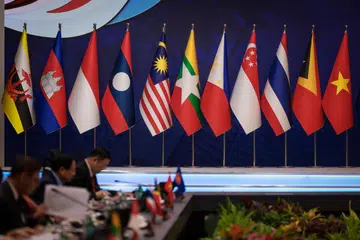
It will launch South- east Asia Regional Programme today
THE Secretary-General of the Organisation for Economic Cooperation and Development (OECD) has predicted that the global economy will strengthen over the coming two years, given that the "once-stalled cylinders of the economic engine like investment trade are starting to fire again".
Angel Gurria, who launched the OECD's latest Economic Outlook at the organisation's annual Ministerial Council meeting and forum in Paris, also announced that the OECD will today launch a South-east Asia Regional Programme to integrate the region more closely with advanced economies.
Meanwhile, Japan's Prime Minister Shinzo Abe declared at the Paris meeting that his country will carry out economic reforms "without fail", and that it was now on the verge of pulling out of deflation.
Economic Outlook projected that gross domestic product (GDP) growth across the 34-member OECD will accelerate to 2.2 per cent this year and to 2.8 per cent next year; the world economy is forecast to grow by 3.4 per cent this year and by 3.9 per cent next year.
The US should grow by 2.6 per cent this year and 3.5 per cent next year, the OECD said, while the euro area will return to growth after three years of contraction, expanding by 1.2 per cent this year and by 1.7 per cent next year.
In Japan, growth will be dented by fiscal consolidation and will hover at 1.2 per cent this year and the next. Meanwhile, China will again grow the fastest among the emerging economies, with rates just below 7.5 per cent this year and the next. BRIICS, a grouping comprising Brazil, China, India, Indonesia, Russia and South Africa, is projected to register GDP growth of 5.3 per cent as a whole this year, and 5.7 per cent next year.
The OECD warned, however, that even as the global economy strengthens, significant risks remain. "Urgent action is still required to further reduce unemployment and address other legacies from the (global economic) crisis."
It said that although investment and trade were both showing signs of picking up, growth would "remain moderate by past standards"; financial conditions are improving in the advanced economies, "but tighter credit and supply side bottlenecks are damping growth in emerging economies".
Mr Gurria described today's planned launch of the South-east Asia Regional Programme as a "critical undertaking" for the OECD, saying that the group's members were convinced that, to continue to be as relevant as it is, the organisation needed stronger links and involvement with South-east Asia.
"We aim not only to identify policies that can continue promoting competitiveness in South-east Asia, but also to support the ongoing efforts to ensure that growth is inclusive and equally shared."
The OECD's engagement with South-east Asia comes at a crucial time, he added. "The economies in the region have benefited from positive growth rates since the early 2000s and have recovered faster than the advanced economies from the effects of the global crisis."
More than half of South-east Asia's growth has been productivity-driven, he noted, and added that this showed how countries there were moving up the global value chain; that the region's competitiveness has improved significantly is reflected in the increased inflows of foreign direct investment to the region, he pointed out.
However, despite the dynamism, South-east Asian countries continued to face important structural challenges that need to be addressed; most of them need to sustain strong productivity growth to close the gap in living standards relative to the more advanced economies.
Mr Gurria added that South-east Asian countries were highly integrated in global value chains, but, to remain competitive, they needed new policies that will sustain trade integration, support the creation of domestic entrepreneurial capacities and internationalise small and medium-sized enterprises.
The region needs to continue its efforts to achieve its goal of regional economic integration by 2015. In this respect, the Asean Economic Community constitutes one of the most ambitious programmes of economic cooperation ever launched, he said.