Global uncertainty delays US hike
But muted inflation is expected to be temporary, says Federal Reserve chair Janet Yellen
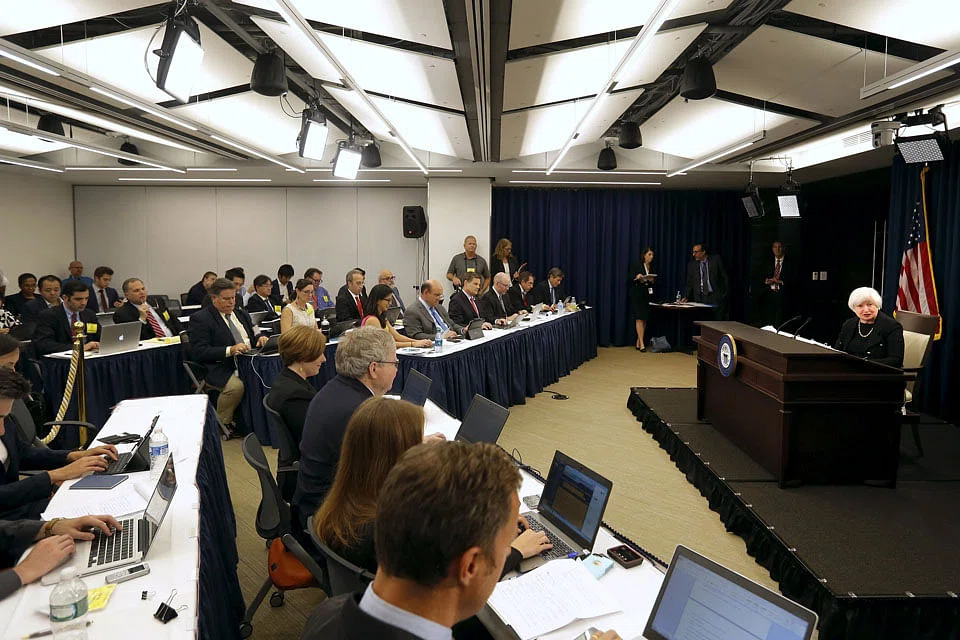
CHAIR YELLEN: "Good afternoon. As you know from our policy statement released a short time ago, the Federal Open Market Committee reaffirmed the current 0 to 0.25 per cent target range for the federal funds rate.
Since the Committee met in July, the pace of job gains has been solid, the unemployment rate has declined, and overall labour market conditions have continued to improve.
Inflation, however, has continued to run below our longer-run objective, partly reflecting declines in energy and import prices.
While we still expect that the downward pressure on inflation from these factors will fade over time, recent global economic and financial developments are likely to put further downward pressure on inflation in the near term.
These developments may also restrain US economic activity somewhat but have not led at this point to a significant change in the Committee's outlook for the US economy.
The Committee continues to anticipate that the first increase in the federal funds rate will be appropriate when it has seen some further improvement in the labour market and is reasonably confident that inflation will move back to its 2 per cent objective over the medium term.
It remains the case that the Committee will determine the timing of the initial increase based on its assessment of the implications of incoming information for the economic outlook.
I will note that the importance of the initial increase should not be overstated: The stance of monetary policy will likely remain highly accommodative for quite some time after the initial increase in the federal funds rate in order to support continued progress toward our objectives of maximum employment and 2 per cent inflation."
Moderate growth in US dragged down by stronger dollar, weak demand
Smoothing through the quarterly volatility, US real gross domestic product (GDP) is estimated to have expanded at a 2.25 per cent pace in the first half of the year, a notably stronger outcome than expected in June, when Committee participants last submitted economic projections.
Continued job gains and increases in real disposable income have supported household spending.
Growth in business fixed investment was moderate, held down in part by a significant contraction in oil drilling activity as a result of the large drop in oil prices over the past year.
Moreover, net exports were a substantial drag on GDP growth during the first half of the year, reflecting the earlier appreciation of the dollar and weaker foreign demand.
The Committee continues to expect a moderate pace of overall GDP growth, even though the restraint from net exports is likely to persist for a time.
The labour market has shown further progress so far this year toward our objective of maximum employment.
Over the past three months, job gains averaged 220,000 per month. The unemployment rate, at 5.1 per cent in August, was down four-tenths of a per cent from the latest reading available at the time of our June meeting, although that decline was accompanied by some reduction in the labour force participation rate over the same period.
A broader measure of unemployment that includes individuals who want and are available to work but have not actively searched recently and people who are working part-time but would rather work full time has continued to improve.
That said, some cyclical weakness likely remains: While the unemployment rate is close to most FOMC participants' estimates of the longer-run normal level, the participation rate is still below estimates of its underlying trend, involuntary part-time employment remains elevated, and wage growth remains subdued.
Inflation still expected to pick up
Inflation has continued to run below our 2 per cent objective, partly reflecting declines in energy and import prices.
My colleagues and I continue to expect that the effects of these factors on inflation will be transitory.
However, the recent additional decline in oil prices and the further appreciation of the dollar mean that it will take a bit more time for these effects to fully dissipate.
Accordingly, the Committee anticipates that inflation will remain quite low in the coming months.
As these temporary effects fade and, importantly, as the labour market improves further, we expect inflation to move gradually back toward our 2 per cent objective.
Uncertainty abroad might dampen US economy
The outlook abroad appears to have become more uncertain of late, and heightened concerns about growth in China and other emerging market economies have led to notable volatility in financial markets.
Developments since our July meeting, including the drop in equity prices, the further appreciation of the dollar, and a widening in risk spreads have tightened overall financial conditions to some extent.
These developments may restrain US economic activity somewhat and are likely to put further downward pressure on inflation in the near term.
Given the significant economic and financial interconnections between the United States and the rest of the world, the situation abroad bears close watching.
All depends on data
Returning to monetary policy, we recognise that there has been a great deal of focus on today's policy decision.
The recovery from the Great Recession has advanced sufficiently far, and domestic spending appears sufficiently robust, that an argument can be made for a rise in interest rates at this time.
We discussed this possibility at our meeting.
However, in light of the heightened uncertainties abroad and a slightly softer expected path for inflation, the Committee judged it appropriate to wait for more evidence, including some further improvement in the labour market, to bolster its confidence that inflation will rise to 2 per cent in the medium term.
Now, I do not want to overplay the implications of these recent developments, which have not fundamentally altered our outlook.
The economy has been performing well, and we expect it to continue to do so.
As I noted earlier, it remains the case that the timing of the initial increase in the federal funds rate will depend on the Committee's assessment of the implications of incoming information for the economic outlook.
To be clear, our decision will not hinge on any particular data release or on day-to-day movements in financial markets.
Instead, the decision will depend on a wide range of economic and financial indicators and our assessment of their cumulative implications for actual and expected progress toward our objectives.
Let me again emphasise that the specific timing of the initial increase in the target range for the federal funds rate is far less important for the economy than the entire expected path of interest rates.
And once we begin to remove policy accommodation, we continue to expect that economic conditions will evolve in a manner that will warrant only gradual increases in the target federal funds rate.
I would like to underscore that the forecasts of the appropriate path of the federal funds rate, as usual, are conditional on participants' individual projections of the most likely outcomes for economic growth, employment, inflation and other factors.
But our actual policy actions over time will depend on how economic conditions evolve, which is quite uncertain.
If the expansion proves to be more vigorous than currently anticipated and inflation moves higher than expected, then the appropriate path would likely follow a steeper and higher trajectory; conversely, if conditions were to prove weaker, then the appropriate trajectory would be lower and less steep."
The above was compiled from Fed chairman Janet Yellen's opening remarks from the Federal Open Market Committee's (FOMC's) Sept 17 press conference
GET STARTED NOW
Be a young investor
Do you aspire to be a successful young investor? Are you keen on taking the first step towards achieving that? The BT-Citibank Young Investors' Forum is no typical page extracted from a financial textbook. This forum will present step-by-step guides on how to start investing, feature stories of peers who have made some headway with their investments, and provide answers to your burning questions on investing. First, we need you to invest - not your money, but your time - in reading The Business Times every Monday. You need not be an armchair reader either - write in to btyif@sph.com.sg now!