

Roche gets honourable mention for Best Practices
 Add BT as a preferred source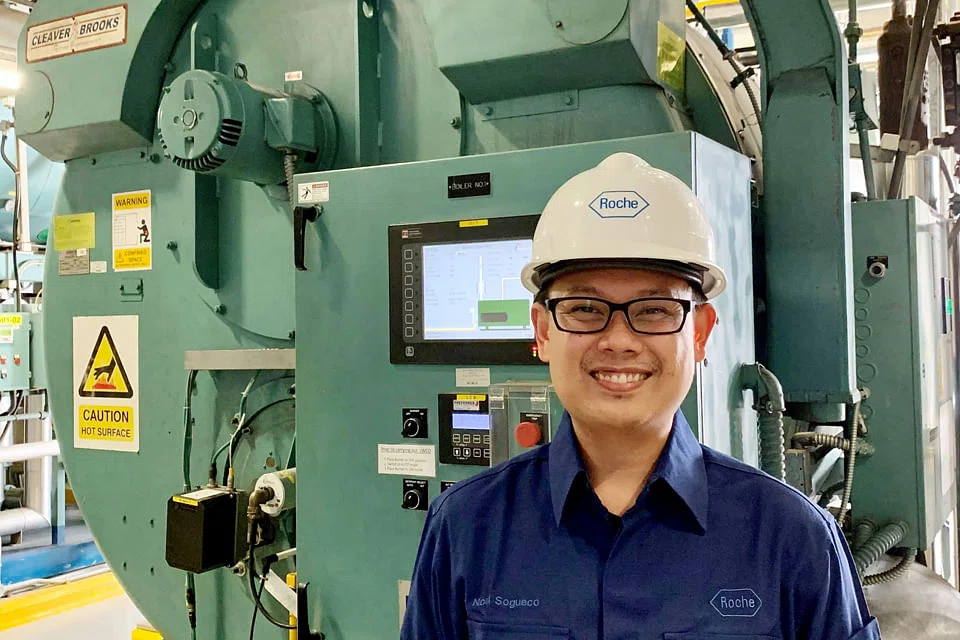
ROCHE Singapore Technical Operations (RSTO) received honourable mention for Best Practices at this year's EENP awards for its project involving boiler controls upgrade. The project was initiated as part of the asset renewal of the company's ageing controls system for its B1 boilers.
The company's evaluation identified several gaps such as poor vendor support for the controls system, inefficient boiler combustion, increasing natural gas (NG) consumption, and breakdowns.
The team looked for a solution that could meet both the asset renewal requirements and the operational gaps, which led them to select a parallel positioning system for boiler combustion linked with a user-friendly controller.
The parallel positioning works with a servo actuator, which provides directly connected and precise modulating control of fuel valves and combustion air control dampers. The precision and repeatability ensure that the boiler combustion stays efficient throughout the fluctuations of the firing rate.
The control system allows RSTO's operator to view input and output status directly from the human machine interface (HMI) and provides alarm details to quickly narrow down on the interlock or limit faults. It also allows the engineers to run trending on boiler parameters, which can aid troubleshooting or understanding the operation's performance.
The project resulted in an annual energy savings of 3.23 TJ of natural gas which is 10 per cent and 2.4 per cent respectively of energy savings at the system and facility levels respectively.
Navigate Asia in
a new global order
Get the insights delivered to your inbox.
"In RSTO, we manufacture biologics drug substance and a key utility is the boiler which produces steam that is used in the heating processes in our manufacturing operations," says Noel Sogueco, senior utilities supervisor, facilities & engineering / utilities, at Roche Singapore Technical Operations Pte Ltd.
As the existing boiler controls system was outdated, the team chose a parallel positioning system for boiler combustion linked with a user-friendly controller.
The precision and repeatability of the servo motor used in parallel positioning helps ensure that the boiler combustion stays efficient. The combustion efficiency was improved by 8 per cent resulting in decrease of natural gas consumption and lower CO emissions.
"RSTO is very committed to reducing energy consumption and in 2019 reduced our energy consumption by 12 per cent, while at the same time increasing production by 25 per cent," says Mr Sogueco.
"I feel excited and at the same time honoured to have led this project; I am fortunate to have a great team and sponsor who supported me all the way until the project execution. The journey was tough but together we were able to achieve far more than what we had expected. This will allow us to provide reliable steam supply in a more cost effective manner in support of delivering quality drug substance to patients."
"As a responsible corporate citizen, one of Roche's commitments is to deliver business growth and value by reducing the environmental impact of our products and operations. Sustainability, including energy efficiency, is an integral part of the way we do business now and will do in the future."
Turning to the benefits of being energy efficient, he says that they include not only financial gains from improvements in running costs from energy consumption, but also reduction in greenhouse gases (GHG) and carbon footprint. This improves the global warming effects that the environment is currently facing.
The intangible benefit also includes an increased awareness of energy efficiency across the site, which enhances the sustainability culture at Roche.
Other energy efficiency improving initiatives taken at the company in recent years include air change reduction where it has reduced the air change rates in the clean room environment while maintaining the environmental quality.
In addition, it completely eliminated ozone-depleting refrigerants (Hydrochlorofluorocarbons or HCFCs) from its refrigeration systems. Besides just changing the refrigeration chiller, energy efficiency of the entire chiller systems also takes into consideration the design. This change will not only reduce energy consumption, it also reduces CO2 emission and its impact on global warming.
Under yet another initiative, the company seeks to drastically reduce global warming refrigerants (hydrofluorocarbons or HFCs) by more than 90 per cent from its refrigerant systems. Besides changing the refrigeration chiller, the energy efficiency of the entire chiller systems is also taken into consideration for the design. This change will not only reduce energy consumption, it also reduces CO2 emission and its impact on global warming, says Mr Sogueco.
Decoding Asia newsletter: your guide to navigating Asia in a new global order. Sign up here to get Decoding Asia newsletter. Delivered to your inbox. Free.
Share with us your feedback on BT's products and services
TRENDING NOW

On the board but frozen out: The Taib family feud tearing Sarawak construction giant apart

Thai and Vietnamese farmers may stop planting rice because of the Iran war. Here’s why

Are Keppel’s dividends truly unsustainable – or just misunderstood?

COEs for large cars up 4.3% at S$126,236, mainstream cars near S$125,000

