

A 'Singapore' within Singapore
T32 Dental Centre aims to have a brand that denotes quality and assurance
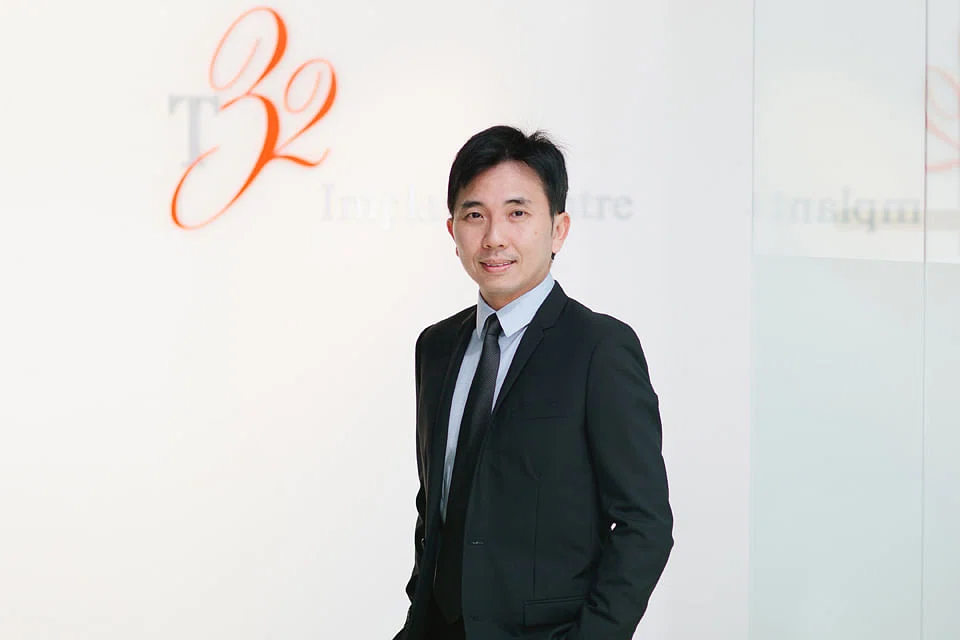
SINGAPORE may be a small market, but that has not gotten in the way of T32 Dental Centre's growth. Like the city-state, the dental group aims to punch above its weight in the region by tapping its strengths. Coming back from the US after 31/2 years of dental education, its founder and managing director Wong Keng Mun realised that the standards of the dentistry field in Singapore had potential to grow and to reach those seen in the US. He therefore started a dental clinic with the aim of providing top-notch dental care and services to local and regional patients.
This, in his view, is not about bringing in new technologies or following new fads in the market, but a "deep-rooted passion" accompanied by the gumption to challenge industry norms, with the purpose of revolutionising the way people view dental treatments.
Today, T32 is a successful business by most measures. Last year, it made about S$27 million in revenue as a group, and has a presence in Singapore, Hong Kong and the Philippines.
The group has distinguished itself from other major dental chains in Singapore with its T32 Junior programme, through which it hopes to familiarise children with dental clinics from young.
Often, the first time young children meet a dentist is when they have to extract a tooth, which leaves them fearful of seeing a dentist, Dr Wong notes. "We have to look into how to invite the younger children to come to dental clinics without that fear - so that they won't treat the dentist like a monster or the devil."
This, T32 does by organising pre-school activities and inviting young children to its premises to familiarise them with the clinic and dental treatment. "If you look around, there are no pictures of bleeding gums, and no medical smell," he says during an interview at the Camden Dental Centre, which has rooms dedicated to the treatment of these juniors, sporting bright colours and cartoon wall decals.
This distinction from the rest of the competition is important given the small size of the Singapore market. "We need to differentiate ourselves, such that the regional countries actually notice us . . . any corporation today must think beyond Singapore." Otherwise, the field can descend into a vicious cycle of undercutting one another in prices, he says.
T32 has tried to do this by providing training for dentists in the region, organising different courses on its Singapore premises and occasionally travelling to territories such as China and Taiwan. In order to be able to provide proper medical training, the level of dentistry here should also be "perceivably different" from those around the region, he adds. Eventually, T32 hopes to open clinics in the region. In these neighbouring countries, it plans to move into areas such as implant services that are more specialised.
The dental group hopes to become a solutions provider rather than a service centre, to share processes and its expertise with regional players. T32 will not reach the same scale that these players might have, but it has expertise that could benefit others, says Dr Wong.
Regional expansion alone, however, is not enough, as the group strives to continue to be at the forefront of the dentistry sector in the region. To this end, T32 is now stepping firmly into the frontier of digital dentistry, being one of the first in South-east Asia to have bought a 3D printer together with CAD-CAM technology, which allows the process of designing a crown to having it manufactured to be reduced from the usual five days to just one.
The group will also open a new flagship centre of excellence for digital dentistry in September. Located at CapitaGreen in Raffles Place, it will reduce waiting and treatment time for time-starved professionals, says Dr Wong. It will also serve as a training centre, drawing regional players - big and small - to come to Singapore.
This investment into cutting-edge technology has been enabled by the government's support. "We're fortunate that the government provided PIC subsidy, so that we can be ahead of others," he says.
T32 has also benefited from the political stability in Singapore, which allows for peace of mind when planning expansions and investments. And while the city-state may be small, its success as a regional medical hub has been critical for the success of many businesses in disparate sectors. Foreign patients who come to Singapore for medical treatment, for example, will also spend on hotels, leisure and shopping.
But costs are increasingly becoming a challenge. "Medical tourism is based on costs, so there will be people who will go to neighbouring countries for treatment," he says. He acknowledged, nonetheless, that Singapore, with its competitive edge in its expertise, aims to draw another group of medical tourists who are not as cost-conscious.
Still, the shortage of manpower and the tight rental market are starting to worry him. "It's a vicious cycle. If things start to get expensive, only the big ones will survive, and the small ones will close." That, however, does not mean bigger players like T32 will benefit, as Singaporean patients - who now make up over 90 per cent of T32's clientele - can also easily travel to neighbouring countries for dental treatments.
"Tourism requires a few things: cheap hotels, recreation, easy commute, and enjoyable food," says Dr Wong. "Singaporeans can choose to go countries such as Bangkok for treatment that is half the price, and have a holiday at the same time. Regional countries are copying our concept. We are still maintaining the edge, but for how long more - nobody knows. The additional help the government gives will be important."
For him, the government's drive for productivity has been a step in the right direction, but not one that is nuanced enough for different industries. "The service industry - there's no way you can do automation. Productivity can only happen if you have certain manpower ratio . . . Different industries may require different attention," he says. "If you don't have enough manpower, it means you can't even serve customers."
While current policies are still "reasonable", the government should eventually start dialogues with individual industries to understand their respective needs and problems, he adds.
To mitigate the shortage of manpower, T32 provides training for staff who may not have had any prior experience in the field. But this has generated its fair share of problems as well. "Because we're doing that, people come and poach our staff. But we have no choice . . . it's also a reputation, because our staff are very well-trained. The only thing we can do is to keep finding new people and provide training."
Moving forward from 50 years of independence, Dr Wong hopes for the Singapore economy to continue to do well, and for the government to retain competitive policies over neighbouring countries, nudging industries in certain directions when necessary.
For example, "the government needs to help people realise how they're trying to decentralise the private healthcare industry - many still think that you have to be in town to command a certain price", he says.
Nevertheless, he is optimistic on the city-state's future. "If we continue to be safe and bring in visitors, and make ourselves a medical hub in terms of expertise, then the opportunities will be huge because we can use our brands overseas."
In fact, T32 aims to be "a small Singapore within Singapore", says Dr Wong, to carry a brand that denotes quality and assurance to its customers. "We want to continue to differentiate ourselves with specialties. If we continue to do that with the government, then the future is bright."
TRENDING NOW

Nvidia reinstates Jensen Huang as CEO; Trump says move poses no national security risk

Beyond the greenback, Vietnam’s big borrowers turn to Asian-currency bonds

Indonesia’s coal tycoon Low Tuck Kwong replaced as Bayan Resources president-director

Six workers file employment claims against Crystal Jade Food Manufacturing

