

1962 Water Agreement is sacrosanct: PM Lee
Mr Lee, Dr M note differing positions on right to review water price; both sides will seek amicable solutions, including possibility of dispute resolution through arbitration
Putrajaya
SINGAPORE and Malaysia have to work together to ensure the Johor River can produce sufficient water for both sides, said Prime Minister Lee Hsien Loong on Tuesday.
He had told Malaysian Prime Minister Mahathir Mohamad about Singapore's concerns about pollution of the Johor River and its long-term yield during the annual Leaders' Retreat.
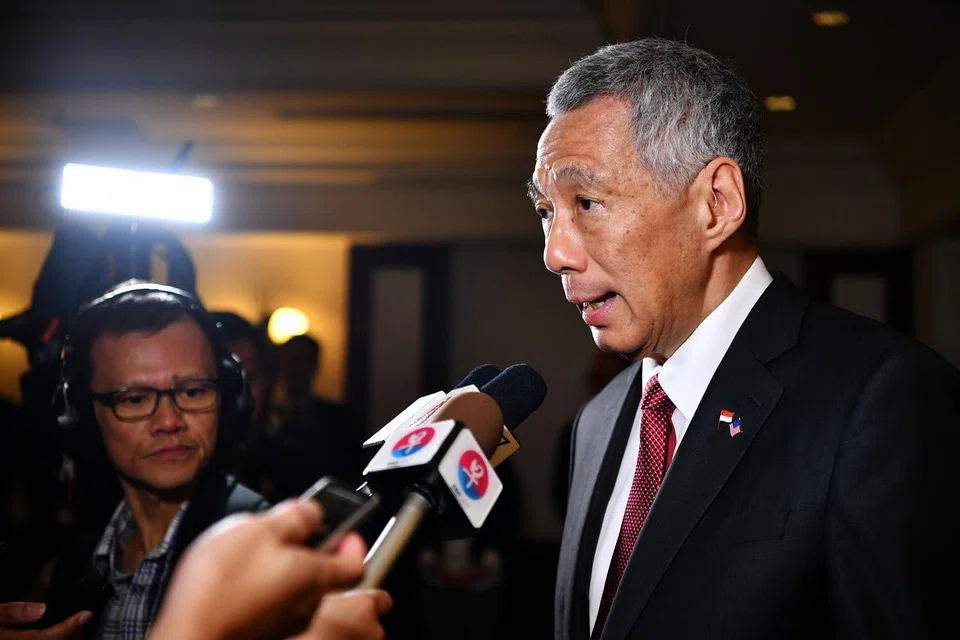
Speaking to Singapore media, Mr Lee said: "It's a serious problem. It's an issue that we've to work at together because if there's not enough water in the Johor River, it's not only a practical problem for both sides - it's also a political problem for both sides."
He noted that some steps have already been taken, citing the Linggiu Dam built in 1991 which created a reservoir that supplements the flow of the Johor River.
"Without that, we'd be in very serious trouble today because it would not be possible for the Malaysians to be drawing water upstream of us at Kota Tinggi and still be able to sustain the operation because the river would have gone dry," he said.
Mr Lee added that Malaysia had agreed to build a barrage at Kota Tinggi a few years ago so as to keep out seawater from intruding upstream and affecting Singapore's waterworks. "That has helped but it's not enough because Johor continues to develop, their population grows, their economy grows. They want more water and we can see the difficulties coming in the future, and therefore we have to work at it again, which we will," he said.
A joint statement issued by Mr Lee and Dr Mahathir after their meeting said the leaders "noted both sides' interest to identify appropriate and timely measures, including schemes, to increase the yield of the Johor River, and to safeguard its environmental conditions and water quality", to the extent required by the 1962 Water Agreement.
The leaders noted their differing positions on the right to review the price of water under the agreement, and have agreed that each country's attorney-general discuss this issue.
"Both sides will seek amicable solutions, including the possibility of dispute resolution through arbitration on a mutually agreed basis," they said.
At an earlier joint press conference, Mr Lee said the water agreement is a "fundamental founding document" for Singapore and Malaysia and both countries have to abide by it.
"It's a basic term on which the two countries decided to manage our relationships," he said. "If you look at it from that point of view, to be able to change it is a very high hurdle."
Mr Lee said he understands the political necessity for Malaysia to press for a revision of the price of water under the 1962 Water Agreement.
"I hope that he'll be able to see Singapore's perspective - why this is such a sacrosanct item," he said. "Let us try to find a way forward which enables us to talk constructively about this issue, and hopefully be able to make some progress."
He added that one of the issues to be discussed is the security of Singapore's water supply from Johor, given concerns over pollution in the Johor River and its long-term yield.
Mr Lee was responding to a question on whether Singapore believes that Malaysia's desire to review the price of water under the 1962 Water Agreement is reasonable.
On ties between Singapore's fourth generation leaders and their Malaysian counterparts in the Pakatan Harapan administration, Mr Lee said that Singapore ministers are developing links and personal ties with the new ministers.
"It's a process of getting to know one another, picking up the threads and taking the relationship forward which continues whoever is in charge on either side. It's a learning journey but it's also an opportunity to develop relations to go on to the next generation," he said.
TRENDING NOW

South-east Asia has lost Nvidia’s best salesman

Demand, tech capabilities position Apac and AI as Skyscanner’s next growth frontiers: CEO Bryan Batista

Peter Kwee’s Ridley Park bungalow on the market with S$100 million asking price

Beyond the greenback, Vietnam’s big borrowers turn to Asian-currency bonds

