

About 75% of industrial emissions from refining, petrochemical sector
Singapore
SINGAPORE generated 52.5 million tonnes of greenhouse gases in 2017, working out to about 0.11 per cent of global emissions, said Koh Poh Koon, Senior Minister of State for Trade and Industry.
Of this, industries contributed about 60 per cent, Dr Koh said in response to a question raised by Nominated MP Anthea Ong.
Ms Ong had wanted to know how much industries - in particular the refinery and petrochemicals sector - were contributing to climate change, and what the government was doing to urge industries to take responsibility for their contributions to the climate crisis.
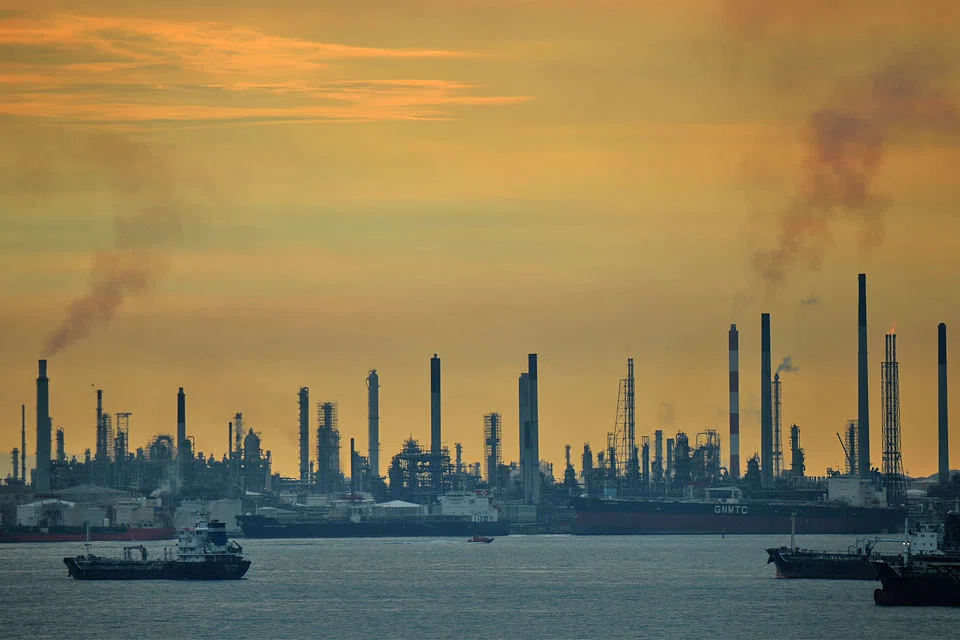
The majority of emissions from the industrial sector are from the combustion of fossil fuels by the refining and petrochemicals sector, with the latter contributing about three-quarters of industries' emissions, said Dr Koh.
A separate report that Singapore submitted in December last year to the United Nations Framework Convention on Climate Change had noted that while Singapore does not produce any oil or gas, the Republic is a major oil refining and petrochemical centre that serves the global market.
In Parliament on Monday, Dr Koh said that in 2017, 190 Mtoe (millions tonnes of oil equivalent) of fossil fuels were imported into Singapore.
About 55 Mtoe were refined into higher-value chemicals and fuels and mostly exported for use in other countries.
The rest was largely for power generation and transportation, he said.
About 95 per cent of Singapore's electricity is generated using natural gas. While it is considered cleaner than coal and oil, natural gas is still a fossil fuel nonetheless.
Human activity such as the combustion of fossil fuels produces greenhouse gases such as carbon dioxide into the atmosphere. These gases trap heat on the planet like a blanket.
The excess heat melts ice sheets and throws the climate system out of whack, causing weather patterns to change and extreme weather events to increase in frequency and intensity.
On how the government is urging existing industries to cut their emissions, Dr Koh pointed to its focus on energy efficiency.
"For existing industries, we are encouraging companies to adopt energy-efficient technologies," he said.
This would essentially mean that firms can produce the same amount or increase their output, with less resources and fossil fuels needed as input.
Dr Koh added that the government had this year implemented an enhanced set of industry energy efficiency schemes.
From January this year, funding support for the adoption of energy-efficient technologies, under the Economic Development Board's Resource Efficiency Grant for Energy and the National Environment Agency's (NEA) Energy Efficiency Fund, has been increased from the previous cap of 30 per cent to 50 per cent of the qualifying costs.
He also said that from 2021, companies regulated under the Energy Conservation Act must establish energy management systems and regularly assess energy efficiency opportunities.
NEA is also planning to launch a new grant to help companies digitalise their energy management systems, Dr Koh said.
Factors to ensure sustainable expansion under the climate targets that Singapore made as part of the Paris Agreement include the Republic pledging to become greener economically, and reducing the amount of greenhouse gases emitted to achieve each dollar of gross domestic product by 36 per cent from 2005 levels, come 2030. It also pledged to stop any further increases to its greenhouse gas emissions by the same timeline.
Ms Ong had asked how Singapore's emissions would grow with an expansion of refinery facilities here.
Dr Koh said that when companies expand or new ones invest in Singapore, the government works with them to ensure a high standard of efficiency.
He cited the Singapore Refining Company upgrading its Jurong Island premises, which led to greater energy efficiency and reduced sulphur oxide emissions.
ExxonMobil, too, had recently expanded its manufacturing complex in Singapore, which is one of the most efficient refineries globally, he added.
Dr Koh said the government is urging other sectors, not just the refineries and petrochemicals sector, to be energy-efficient.
Facebook's first data centre in Singapore, for example, will be energy-efficient and also have features to minimise its use of land and water, he said.
"Beyond industries, all of us have a responsibility to mitigate climate change. Saving electricity, using public transport and reducing waste are good ways to cut carbon emissions. As a country, we will do our part to help address global climate challenges."
TRENDING NOW

Simba admits exceeding spectrum limits amid failed M1 deal; full-year profits surge 277%

Temasek’s Wan Chee Foong to helm PIL, Lars Kastrup to be board adviser

He built the Vingroup empire. Now South-east Asia’s richest man is handing some key roles to his sons

One-third of Singapore-listed firms at risk in severe AI downturn: MAS

