

Absence of 1MDB debt lets Malaysia lower 2024 budget deficit
 Add BT as a preferred source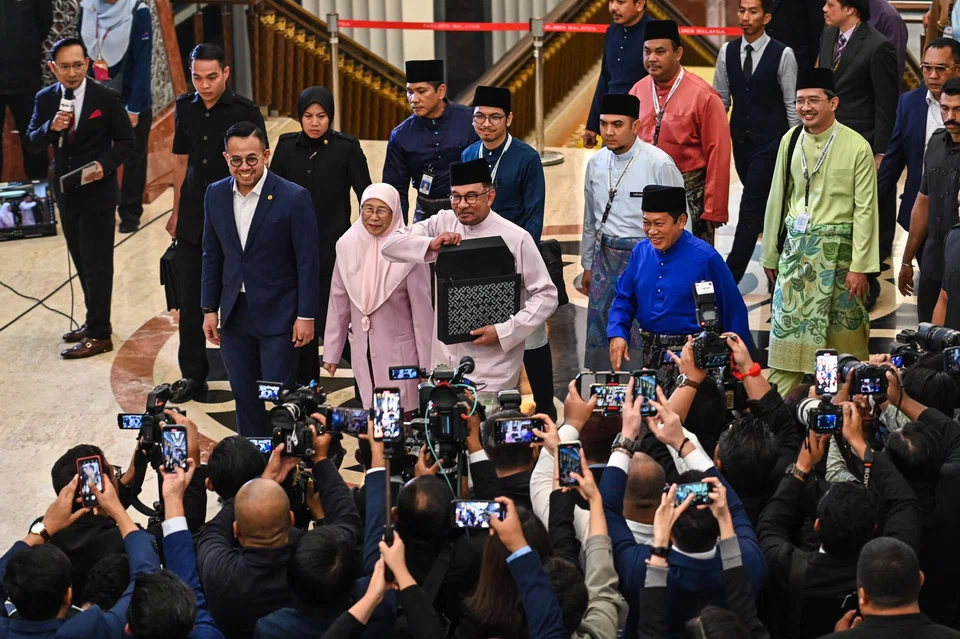
MALAYSIA’S government plans to reduce its budget deficit in 2024 through a combination of spending cuts, new taxes and reduced debt payments, as Prime Minister Anwar Ibrahim steps up efforts to convince investors that he’s serious about fiscal discipline.
The government proposes to lower spending to 393.8 billion ringgit (S$114.1 billion) next year from a revised 397.1 billion ringgit in the current year, according to the annual budget presented by Anwar, who doubles as the finance minister. That reduction is thanks to the absence of debt obligations related to state fund 1Malaysia Development Berhad (1MDB) in 2024, which in turn helps narrow fiscal deficit – the gap between revenue and expenditure – to 4.3 per cent of gross domestic product from a 5 per cent shortfall this year, a Finance Ministry report showed.
The deficit is in line with the median level predicted in a Bloomberg survey of economists.
The government will also trim spending on subsidies and social assistance next year by around 11.5 billion ringgit to a total 52.8 billion ringgit, as it moves toward targeted assistance instead of blanket subsidies. An example of that will be the continuing of electricity rebates for the poor, while phasing out diesel subsidies.
“Economic policy should be directed toward growth and economic equality,” Anwar said as he presented the spending plan for 2024. “However, what happens is a large amount of subsidies is benefiting the rich. It is expected that by improving subsidy leakages, revenue can be distributed to the people including wage increases for workers.”
Restoring fiscal health is key for Malaysia to retain emerging Southeast Asia’s highest credit score, and keep investors’ faith at a time when higher US rates have pushed them to ditch emerging-market assets. Foreign funds remain net sellers of about US$682 million of Malaysian stocks this year, while they have withdrawn a net US$114.3 million from the nation’s bonds so far this month, according to data compiled by Bloomberg.
Malaysia expects revenue to grow 1.5 per cent next year on better economic prospects coupled with measures to broaden the tax base and improve compliance and transparency. The government plans to impose a previously-announced capital gains tax for the disposal of unlisted shares by companies from Mar 1, as well as raise the rate on services tax to 8 per cent from the current 6 per cent. It also will formulate a tax on luxury goods at the rate of 5 per cent to 10 per cent.
“Budget 2024 cemented PM Anwar’s commitment to credibly strengthening Malaysia’s fiscal position in the medium-term,” said Lavanya Venkateswaran, economist at Oversea-Chinese Banking Corp. The spending plan “walked the talk in terms of establishing the government’s path to better fiscal health,” she added.
Anwar’s government eventually aims to reduce fiscal deficit to 3.5 per cent of GDP in the medium term, which will pave the way for the government to lower the debt to GDP ratio to 60 per cent. Malaysia sees federal government debt at 64 per cent of GDP by end-2024, with borrowings to be funded entirely onshore, according to the report.


Malaysian parliamentarians on Wednesday approved a bill to impose limits to its fiscal gap, debt levels, and government guarantees. Once gazetted, Malaysia will have to reduce its budget gap to 3 per cent of GDP as well as lower its debt levels to 60 per cent of GDP within three to five years. Anwar’s fiscal plans are part of a broader goal to make the Southeast Asian economy attractive to international investors, while trying to turn it into a high-income nation within this decade.
The government sees the economy expanding at a pace of 4 per cent to 5 per cent next year, after an expected 4 per cent growth this year. It expects inflation to cool to between 2.1 per cent to 3.6 per cent in 2024 from an estimated 2.5 per cent 3 per cent this year.
Expectations of slowing price-growth encouraged Anwar’s administration to stick with a plan to end price controls on eggs and chickens that were introduced at the time of high inflation to buffer citizens from rising costs.
He proposed to set aside about 90 billion ringgit for development spending in 2024, which will include 2,000 new projects such as the construction of additional lanes for the so-called PLUS highway as well as upgrading roads, according to the report. That outlay will be lower than the 97 billion ringgit earmarked for development expenses this year.
On the ringgit, Malaysia said its good economic fundamentals, expectations of the US Federal Reserve reaching the end of its rate hiking cycle and China’s economic recovery may provide support for the local currency. The ringgit has remained near the bottom of Asia’s leaderboard so far this month, and Malaysia said Friday the currency would continue to be market-determined. BLOOMBERG
Decoding Asia newsletter: your guide to navigating Asia in a new global order. Sign up here to get Decoding Asia newsletter. Delivered to your inbox. Free.
Share with us your feedback on BT's products and services
TRENDING NOW

When every phone becomes a satellite phone, what happens to Asia’s telcos?

Lily Ler to step down as CEO of Mapletree Industrial Trust manager

Jardine C&C selling Singapore, Malaysia dealerships to Indonesia’s Chandra Asri for US$221 million gain

Digital Realty, STT GDC among data centre operators awarded 50 MW of new capacity in Singapore

