

Adidas gets running lift from two sub-2 hour marathons
The German sportsgear-maker has been rebuilding its franchise, looking to capitalise on distance-running’s booming popularity
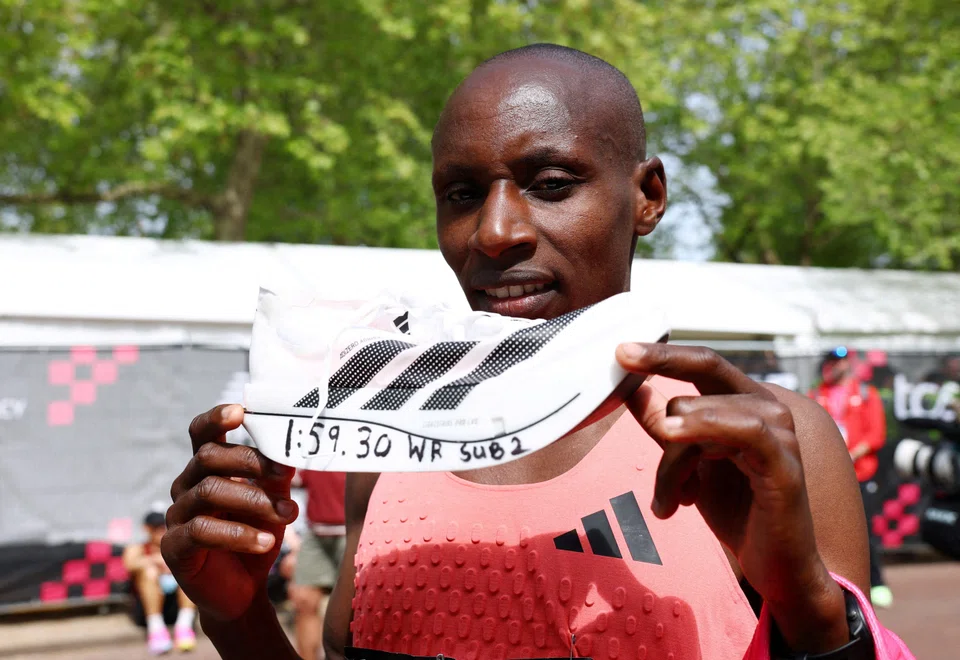
[MUNICH] As athletes and spectators marvel at, not one, but two men smashing the once-thinkable two-hour barrier in this year’s London Marathon, German sportsgear-maker Adidas also has reason to celebrate.
Kenya’s Sabastian Sawe and Ethiopia’s Yomif Kejelcha were both clad in the brand’s new and ultra-light US$500 racing shoe as they crossed the finishing line on Sunday (Apr 26).
Sawe pulled away from Kejelcha in the final moments of the race to achieve a stunning world-record time of one hour 59 minutes and 30 seconds, more than a minute faster than the previous best for the event.
Kejelcha finished just 11 seconds behind, a remarkable feat in his first competition at the 42.2-kilometre distance.
In the women’s race, Ethiopia’s Tigst Assefa pulled away from Kenya’s Hellen Obiri in the last mile to win in a time of two hours 15 minutes and 41 seconds, slightly faster than last year, when she broke the women’s-only world record.
For all three, the common denominator was Adidas’s Adizero Adios Pro Evo 3, a shoe the company debuted on Apr 23 that weighs just 97 g in a standard size.
That is the lightest version of the sort of running sneaker that has transformed the sport of distance-running in the past decade.
Patrick Nava, general manager of running at Adidas, said: “This is a testament to the years of hard work and dedication they have made, alongside our innovation team, who have built a supershoe (that) breaks new ground.”
Obiri was wearing On’s LightSpray Cloudboom Strike, a US$330 laceless racing shoe that is produced by robots. She smashed her own personal best in the process, taking second place in the women’s race behind Assefa.


Sawe even surpassed the time of Eliud Kipchoge, who in 2019 ran the distance in a time of 1:59.40 during a Nike-organised event in Vienna that was not eligible for world-record status. That event included a host of people pacing Kipchoge for most of the run.
In London, Sawe and Kejelcha pushed each other in the final miles of the race, long after leaving the official pacers behind.
For brands, having a high-profile winner in their latest shoes adds a stamp of legitimacy. And running shoes are a booming business, with the US market expanding 13 per cent in the year till February to US$8.1 billion, said market researcher Circana.
It is a major piece of the broader performance-shoe category, which may reach US$104 billion in global sales by 2030, based on data from Euromonitor.
Adidas has been rebuilding its running franchise in recent years, looking to capitalise on the booming popularity of a sport that has helped support the rise of challenger brands including Hoka, On and Brooks.
The German company has benefited from strong demand for its comfy US$150 Adizero Evo SL sneaker, which is a less intense take on the marathon-racing shoe worn by Sawe and others.
The running push is part of chief executive officer Bjorn Gulden’s efforts to derive more profits from performance sports gear, and reduce the brand’s dependence on fashion items such as the Samba and Gazelle shoes. BLOOMBERG
Decoding Asia newsletter: your guide to navigating Asia in a new global order. Sign up here to get Decoding Asia newsletter. Delivered to your inbox. Free.
Share with us your feedback on BT's products and services
TRENDING NOW

LTA proposes combining car COE categories, adding rebate-surcharge system

StarHub to acquire MyRepublic’s mobile business amid ongoing telco consolidation

DBS, OCBC, UOB rout lops billions off STI as inflation, rate concerns spook investors

Grab CEO’s wife Chloe Tong on life with Anthony Tan and finding her purpose

