

After veto on North Korea, China says 'let's see' on UN action over a nuclear test
 Add BT as a preferred source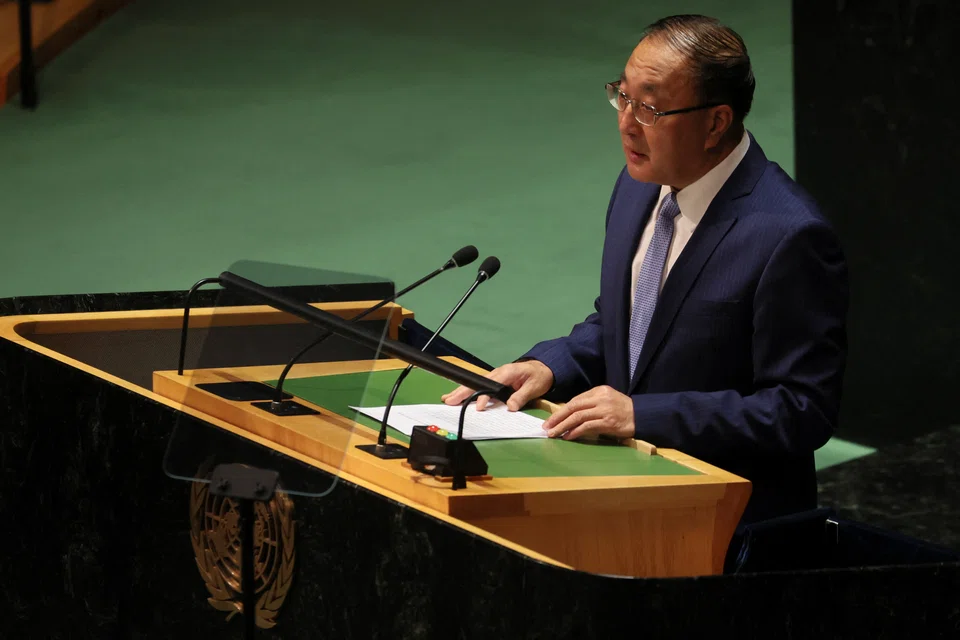
DeeperDive is a beta AI feature. Refer to full articles for the facts.
CHINA’S UN envoy said on Thursday (Jun 9) that Beijing does not want to see North Korea carry out a new nuclear test, which is partly why China vetoed a US-led bid to impose new UN sanctions on Pyongyang over renewed ballistic missiles launches.
But Ambassador Zhang Jun warned against making presumptions on how Beijing might react at the United Nations (UN) if North Korea goes ahead with its first nuclear test since 2017. Washington has warned such a test could happen at "any time" and it would again push for more UN sanctions.
"Let's see what will happen, but I think we should not prejudge what will happen with a nuclear test," Zhang told Reuters, 2 weeks after China and Russia vetoed imposing more UN Security Council sanctions on North Korea.
"The denuclearisation is one of the key goals of China," Zhang said. "We do not want to see another test."
The double veto publicly split the 15-member Security Council for the first time since it started punishing Pyongyang in 2006. The body has steadily - and unanimously - ratcheted up sanctions over the years in a bid to cut off funding for North Korea's nuclear weapons and ballistic missile programmes.
However, in recent years China and Russia have been pushing for an easing of sanctions on humanitarian grounds - and in the hope that North Korea can be convinced to return to negotiations with the United States on giving up its nuclear weapons.
Navigate Asia in
a new global order
Get the insights delivered to your inbox.
"Only with dialogue we see the improvement in the situation. With sanctions, we see the further deterioration," Zhang said. "Our basic position is very clear - sanctions don't solve the problems."
North Korea has carried out dozens of missile launches this year, including intercontinental ballistic missiles, breaking a test moratorium it self-imposed after North Korean leader Kim Jong Un met then-US President Donald Trump in 2018 for the first of 3 meetings. The talks failed to make any progress.
Zhang has urged Washington to ease unilateral sanctions on North Korea and end joint military exercises with South Korea in a bid to revive talks with Pyongyang. The United States says it has repeatedly reached out to North Korea, but received no response to its offer of talks without preconditions.
"To the US we are telling them to take concrete actions and to be engaged in dialogue. We are also telling our DPRK friends to really be engaged in serious dialogue with the United States," Zhang said, referring to North Korea's formal name - the Democratic People's Republic of Korea (DPRK).
Zhang said it was not "mission impossible" to restart talks between North Korea and the United States.
"The United States is the number one superpower in the world. If the United States wants to engage in dialogue with anyone in the world, it's not a difficult thing," he said. "It's up to DPRK to make their decision, but definitely our willingness is there." REUTERS
Decoding Asia newsletter: your guide to navigating Asia in a new global order. Sign up here to get Decoding Asia newsletter. Delivered to your inbox. Free.
Share with us your feedback on BT's products and services
TRENDING NOW

From 1MDB to ‘corporate mafia’: Is Malaysia facing a new governance test?

Middle East-linked energy supply shocks put Asean Power Grid back in focus

Beijing’s calculated silence on the Iran war
DPM Gan warns of 3 structural shifts to the global system that will bring greater challenges – and opportunities

