

Aftershocks cause more terror as Nepal quake toll tops 2,400
Tremors trigger fresh avalanches at Everest base camp; country's hospitals are overwhelmed with victims
Kathmandu
POWERFUL aftershocks rocked Nepal on Sunday, further rattling survivors of a quake that killed more than 2,400 and triggering fresh avalanches at Everest base camp, as rescuers dug through rubble in the devastated capital Kathmandu.
Terrified residents, many forced to camp out in the capital after Saturday's quake reduced buildings to rubble, were jolted by a 6.7-magnitude aftershock that compounded the worst disaster to hit the impoverished Himalayan nation in more than 80 years.
At overstretched hospitals, where medics were also treating patients in hastily erected tents, staff were forced to flee buildings for fear of further collapses.
"Electricity has been cut off, communication systems are congested and hospitals are crowded and are running out of room for storing corpses," Oxfam Australia chief executive Helen Szoke told AFP.
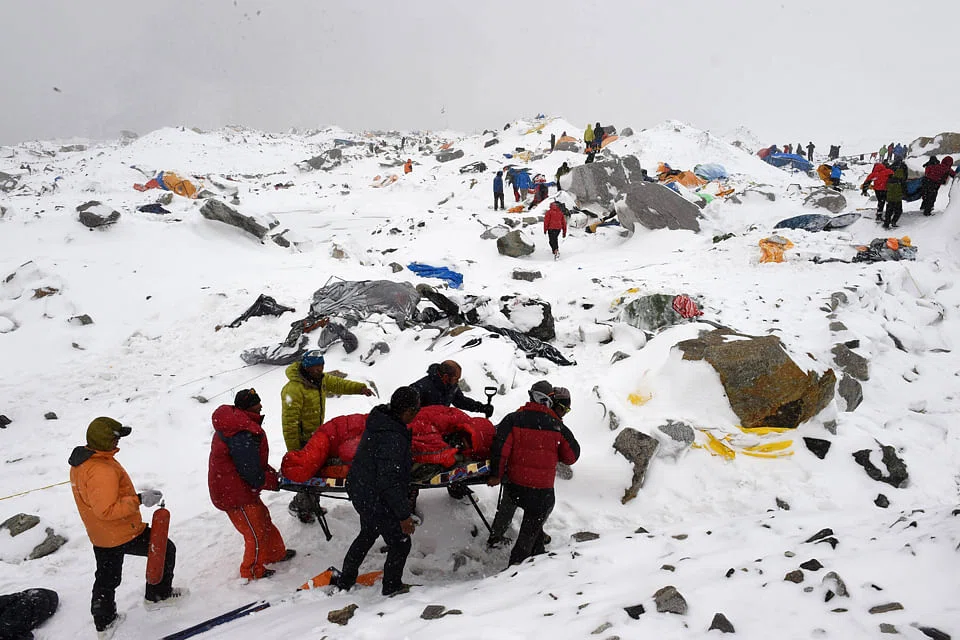
Climbers reported that the aftershock caused more avalanches at Mount Everest, just after helicopters airlifted to safety those injured when a wall of snow hit base camp on Saturday, killing at least 18 people.
The deadliest disaster in Everest's history comes almost exactly a year after an avalanche killed 16 sherpa guides, forcing the season to be cancelled, and as around 800 mountaineers were gathered at the start of the new season.
Offers of help poured in from around the world, with dozens of nations or aid groups volunteering everything from sniffer dogs to an inflatable hospital.
The Kathmandu-based National Emergency Operation Centre put the toll in Nepal at 2,352 and said a further 6,239 had been injured.
"We have deployed all our resources for search and rescue," police spokesman Kamal Singh Bam told AFP. "Helicopters have been sent to remote areas. We are sifting through the rubble where buildings have collapsed to see if we can find anyone."
The fresh aftershocks forced Kathmandu airport to close for around an hour as air traffic controllers evacuated their centre. Several flights had to be diverted in mid-air.
The country's cellphone network was working only sporadically, while large parts of the capital were without electricity.
Residents in Kathmandu reported that tremors were felt throughout on Sunday, including one strong aftershock at dawn before the 6.7-magnitude follow-up quake that struck in the afternoon.
The historic nine-storey Dharahara tower, a major tourist attraction, was among the buildings brought down in Kathmandu on Saturday.
Police said around 150 people were thought to have been in the tower at the time of the disaster, based on ticket sales.
"At least 30 dead bodies have been pulled out. We don't have a number on the rescued but over 20 injured were helped out," Bishwa Raj Pokharel, a local police official, told AFP.
"We haven't finished our work there, rescue work is still continuing. Right now, we are not in a position to estimate how many might be trapped."
As rescuers sifted through the huge mounds of rubble in the capital and beyond, some using bare hands, hospitals were overwhelmed with victims who suffered multiple fractures and trauma.
At the city's oldest Bir Hospital, an AFP correspondent saw grieving relatives trying to swat away flies from around a dozen bodies placed on the floor of the mortuary after storage space ran out.
Experienced mountaineers said panic erupted on Saturday at Everest base camp, which has been severely damaged, while one described the avalanche as "huge".
"We have airlifted 52 from the base camp so far, 35 have been brought to Kathmandu," said Tulsi Gautam of Nepal's tourism department which issues permits to climb the world's highest mountain. "Those who are able are walking down. Others are being airlifted."
George Foulsham, a Singapore-based marine biologist, described the moment disaster struck. "I was outside, saw a white 50-storey building of white come at me. I ran and it just flattened me," he told AFP.
"I tried to get up and it flattened me again. I couldn't breathe, I thought I was dead. When I finally stood up, I couldn't believe it passed me over and I was almost untouched. I saved for years to climb Everest. It feels like the mountain is saying it's not meant to be climbed for now." AFP
TRENDING NOW
Motoring tycoon Peter Kwee is back in court: Here are his previous legal battles

Demand, tech capabilities position Apac and AI as Skyscanner’s next growth frontiers: CEO Bryan Batista
Beyond the greenback, Vietnam’s big borrowers turn to Asian-currency bonds

Nvidia’s outlook cut to stable by Moody’s on governance concerns

