

Ageing Japan turns to its youth as teens set to vote
Politicians wary of huge voting power of older people, despite shrinking tax base
Tokyo
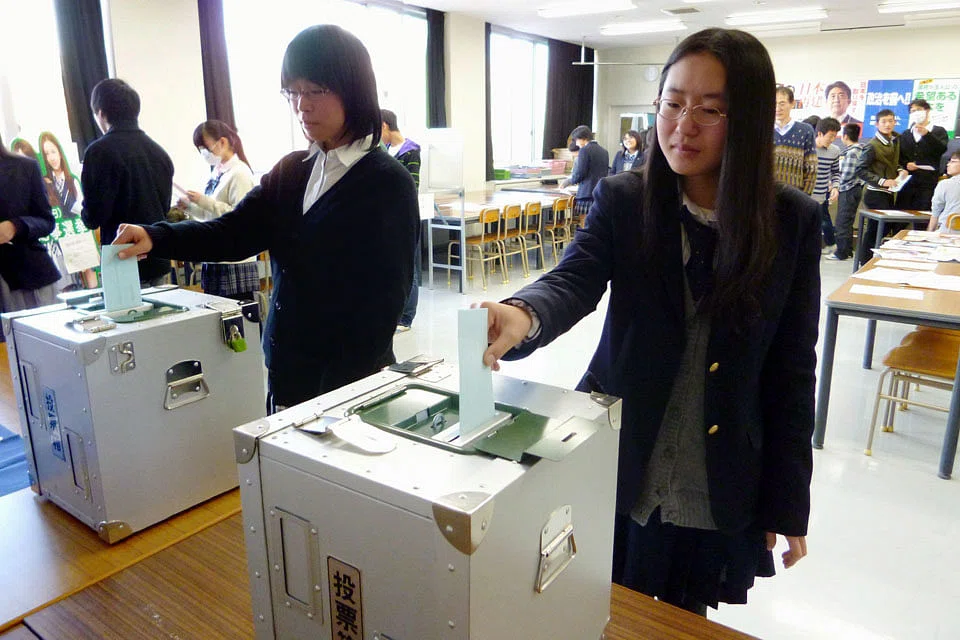
JAPAN is set to take a baby step towards rebalancing the age scales when lawmakers lower the voting age to 18 from its current 20, allowing teenagers into polling booths for the first time.
The move will bring Japan - where political power resides firmly with the grey of hair - in line with other developed countries and will extend the franchise to an extra 2.4 million 18 and 19-year-olds.
And not before time, say teenagers. "Age 18 is not too young," said 17-year-old high school student Shiori Toshima of the rule change, expected during the current parliament session ending in June. "I will definitely go to vote," she said. "I'd be happy to see my opinion affect politics, even just a little." Japan last changed its voting rules in the punch-drunk months after its 1945 surrender in World War II, altering the age at which citizens could cast their ballot from 25 to 20.
"Japan was one lap behind but is eventually catching up" with global standards, said Ryohei Takahashi, who teaches at Chuo University in Tokyo and runs a nonprofit group that promotes youth participation.
"In Japan, politics has excessively reflected elderly people's voices, which we call silver democracy," Mr Takahashi said.
Around a quarter of Japan's 127-million population is aged 65 or over, a result of low birth rates over the last few decades and no significant immigration. The proportion is expected to grow to around 40 per cent in a few decades.
The inverted age pyramid that this represents has combined with a Confucian respect for elders and left Japan a country primarily run by, and for the benefit of, old people.
Welfare costs Japan a whopping 31.5 trillion yen (S$348.4 billion) a year, a third of its entire national budget. As the number of pensioners increases, so will the cost of paying for them, at a time when the workforce is shrinking.
Despite the diminishing tax base, politicians wary of the huge voting power of older people continue to pander to their desires.
"Old people vote for those who think of pensions, but for us it's a good chance to express what society we would like to create when we grow up," 17-year-old Kumiko Ozawa said.
The Liberal Democratic Party (LDP) of Prime Minister Shinzo Abe, which has ruled Japan for most of the last 60 years, is seen as being particularly preoccupied by the grey vote - its power base is the countryside, where average ages are higher than in the cities.
"The LDP had been reluctant to lower the voting age as its lawmakers have put the emphasis on elderly and stable voters," said Tomoaki Iwai, professor of politics at Nihon University in Tokyo. "The LDP has traditionally believed that young people are liberal" and therefore likely to oppose its conservatism, he said. "But its allergy to younger generations is gradually disappearing." In fact, says Mr Takahashi, a mock election among young people held just ahead of the last national poll, with the result showing Mr Abe's LDP actually did better than in the vote that counted.
While Japan is playing catch-up on the age of majority with its rich-country colleagues - it is the only member of the Organisation for Economic Cooperation and Development where someone becomes an adult at 20 - Austria has already struck a blow for youth. In 2007, Vienna lowered the voting age to 16, giving a voice to an extra 140,000 people - 2.4 per cent of the electorate. AFP
TRENDING NOW

Nvidia reinstates Jensen Huang as CEO; Trump says move poses no national security risk

Indonesia’s coal tycoon Low Tuck Kwong replaced as Bayan Resources president-director

Nvidia surges 33% after reinstating Jensen Huang, reviving AI trade; stocks soar in US and Europe

Consider lowering homeownership barriers for some non-resident foreigners

