All HDB car parks to have 3 EV charging points by 2025; Cat A COE for more EV models

Singapore
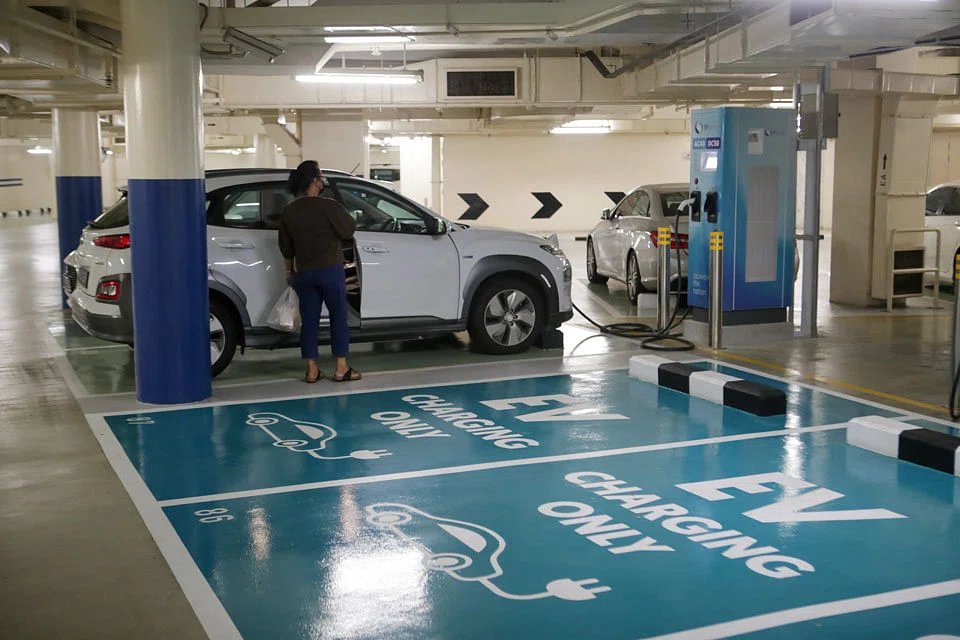
FROM 2025, all Housing Board car parks will have at least 3 charging points for electric vehicles (EV), while more EV models will qualify for Category A Certificates of Entitlement (COE) in a nationwide push to cut land transport emissions by mid-century, Transport Minister S Iswaran said on Tuesday (Mar 8).
The Ministry of Transport (MOT) will install these charging points in nearly 2,000 HDB car parks over the next 3 to 4 years, which means every HDB town will be "EV-Ready" by 2025, Iswaran said in Parliament during the joint segment on the Singapore Green Plan 2030.
The Land Transport Authority (LTA) will launch a large-scale tender for charging points at HDB car parks in the first half of 2022.
This is as MOT plans to cut land transport emissions by 80 per cent by 2050, from its 2016 peak of 7.7 million tonnes. Land transport is Singapore's third largest source of greenhouse gases, accounting for 15 per cent of national emissions.
"It is an ambitious goal that will require policy moves, new technologies and behavioural shifts across our land transport system. Along with the decarbonisation of the power grid, electrification of vehicles is a key initiative that will have a material impact," he said.
New electric car registrations rose from 100 in 2020 to 1,800 in 2021, forming almost 4 per cent of new car registrations.
However, 80 per cent of electric car users currently live in private residences, including condominiums and private apartments.
"Range anxiety" remains a commonly cited impediment to EV ownership, he said, even though average drivers in Singapore may need to fully charge an EV only once every 5 to 7 days, as most have a range of at least 300 kilometres.
To address this, chargers must be widely available, he said.
For a start, there will be at least 3 charging points per car park, with more where there is demand and adequate electrical capacity.
The charging points will mostly provide low-powered, overnight charging and would meet the needs of car owners, while minimising the load on the electrical grid.
At the same time, the National EV Centre at LTA will take the lead to upgrade supporting electrical infrastructure.
To fund these infrastructure upgrades, LTA will be issuing green bonds. The bond repayment obligations will be met through a tariff on EV charging operators and users, which will be phased in at a later date, Iswaran said.
MOT will also increase the Maximum Power Output (MPO) threshold for Category A COE for EVs from 97 kW to 110 kW from the next COE quarter in May. This means 20 EV models will fall within Category A, up from 10 now.
Mass-market EVs tend to have an MPO of 110 kW or lower, and more models with an MPO above 97 kW have been introduced locally in the last year, noted Iswaran.
Meanwhile, the government is also working on strengthening regulations surrounding EV adoption and safety, including revising the national EV charging standard Technical Reference 25.
"As they are still relatively nascent, we will focus on safety regulations, while monitoring industry and technology developments to assess their applicability to our overall charging network," he said.
As for other vehicle segments, the statutory lifespan of electric taxis will be extended to 10 years, up from 8 now, since EV batteries need to be replaced around the 5-year mark, Iswaran said.
The aim is also for half of public buses, or 3,000, to be electric by 2030 up from 60 now. To achieve this, bus buys from now till 2030 will primarily be electric, said Iswaran, adding that LTA will replace over 400 diesel buses with electric buses by 2025.
LTA will also call a tender later this month to deploy more solar panels on public transport infrastructure, helping to reduce both emissions and energy costs. This includes rail and bus depots, the upcoming Integrated Train Testing Centre, covered linkways and pedestrian overhead bridges.