
Amid greater digitalisation, SMEs must contend with issues such as cyber attacks and finding talent: panel

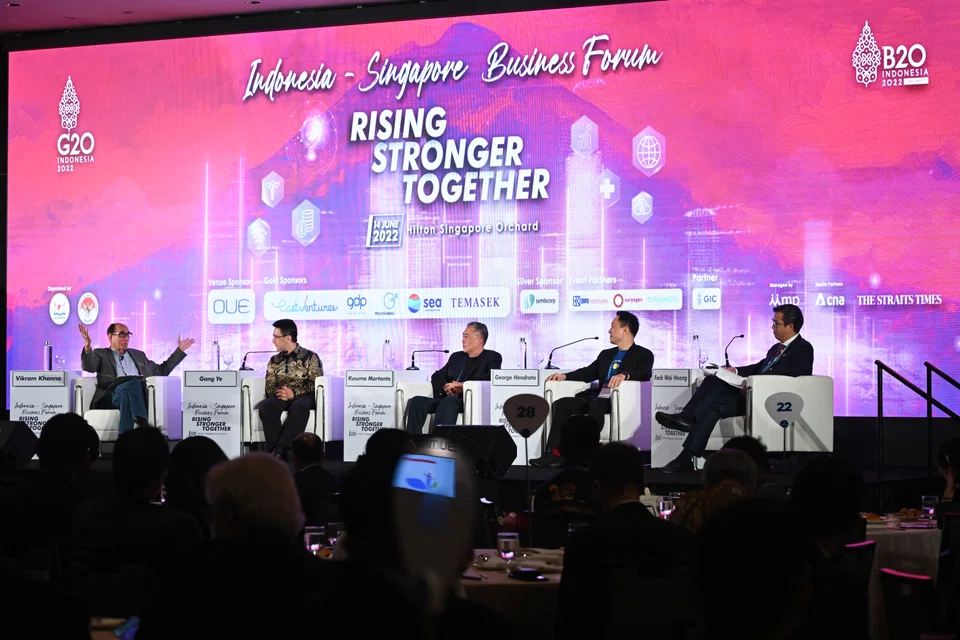
EVEN as South-east Asia’s small and medium-sized enterprises (SMEs) and their customers stand to benefit from increased digitalisation, businesses today continue to face key challenges like talent acquisition, digital literacy gaps and cyber attacks, panellists said at a forum on Tuesday (June 14).
A recent study by Bain and Company, Google and Temasek projects that the digital economy in South-east Asia will more than double its size from some US$170 billion in 2021 to US$360 billion by 2025, and then grow exponentially to about US$1 trillion by 2030.
Citing this report, Temasek’s deputy head of South-east Asia Fock Wai Hoong said that while challenges in payments, consumer trust, digital infrastructure, logistics and funding have seen “good progress”, skilled talent continues to be a major challenge.
“(Companies shoud) focus on reskilling and upskilling our labour population to be ready to participate in the labour economy,” he noted at the Indonesia-Singapore Business Forum.
Many e-commerce players are raising their productivity or creating a new market for the countries they operate in, said Sea’s co-founder and group chief operating officer Ye Gang. The Singapore-headquartered Sea owns e-commerce platform Shopee.
On the importance of creating jobs, Ye said this was “one of the biggest contributions” by the company, both during and after the Covid-19 pandemic.
The 30-minute session on digital transformation for SMEs and investment in Asean also featured Blibli.com chief Kusumo Martanto and Tiket.com chief George Hendrata.
Sixty per cent of Indonesia’s gross domestic product (GDP) is contributed by SMEs, with various digital payments solutions established years before the pandemic going a long way to help the country over the last few years, said Martanto.helped the country tide through the past few years, Martanto noted.
But as digitalisation becomes ingrained in daily life, there is also the pertinent issue of cybersecurity that companies have to grapple with.

“According to Indonesia’s National Cybersecurity Agency, last year alone there were more than 1.6 billion cyberattacks,” Martanto said. “I’m sure this is not only (the case) for Indonesia, but also across the world.”
Cybersecurity complications are damaging to economies, and he stressed the need for collaborations between companies and governments in this space.
Turning to the issue of digital literacy gaps, Sea’s Ye highlighted that technology should also benefit the less privileged in society and not just the well-off.
“We have Shopee digital centres in many villages in Indonesia,” Ye said. “We teach people how to access and do business online, and how to use digital financial services online.”
Hendrata shared with the audience that his business focuses on people putting consumers at the top of the list - working with various partners back-end to avoid customer confusion.
“The (pandemic) recovery is a big relief, but I will say it’s both a challenge and an opportunity - because we have a lot of small operators, good operators, that are not digitalised yet.” he said.
Helping merchants digitalise, making applications as simple as possible for merchants to adopt them, and training local talent - are some of the gaps that need to be filled in SMEs, Hendrata added.
Decoding Asia newsletter: your guide to navigating Asia in a new global order. Sign up here to get Decoding Asia newsletter. Delivered to your inbox. Free.
Copyright SPH Media. All rights reserved.

