NEWS ANALYSIS

Andy Burnham’s new Cabinet reflects his focus on UK economic growth

A sweeping overhaul signals a new financial direction for the country, but markets remain cautious
Summarise
    • New PM Andy Burnham has said he wants to end what he describes as four decades of “neoliberalism” in the UK.
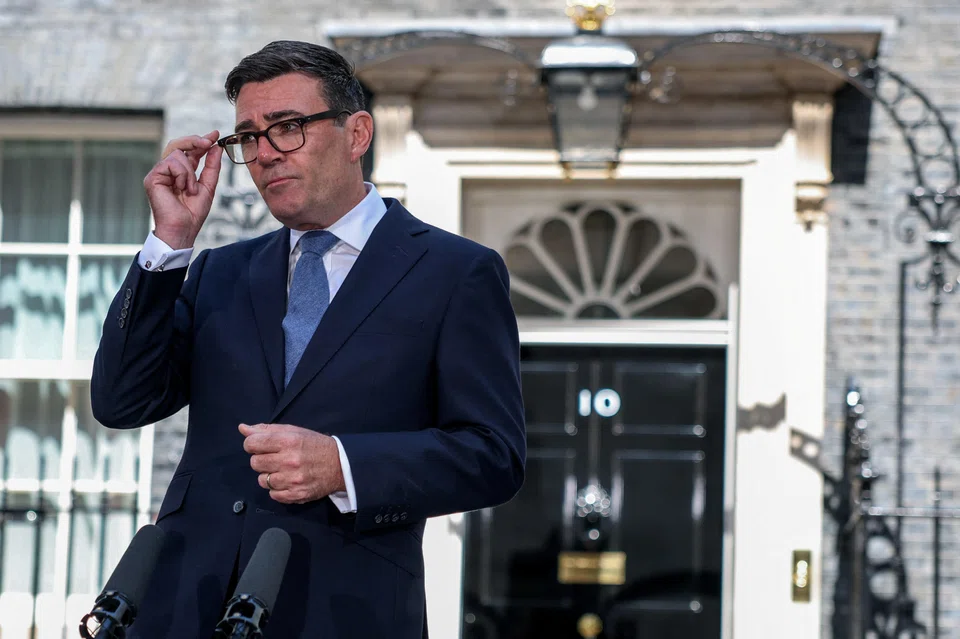
    • New PM Andy Burnham has said he wants to end what he describes as four decades of “neoliberalism” in the UK. PHOTO: REUTERS
    Published Wed, Jul 22, 2026 · 04:30 PM

    [LONDON] Andy Burnham assumed the role of the UK’s new prime minister on Monday (Jul 20).

    Going into office, one of his key agendas is reigniting economic growth. By the end of 2023, UK gross domestic product per capita, in real terms, was estimated to be around 28 per cent below the post-war trend growth from 1955 to 2008.

    His pick of advisers and Cabinet appointments reflects his attempt at correcting that course.

    One of them is Jim O’Neill, who has a close relationship with Burnham. O’Neill previously served as a finance minister under former prime ministers David Cameron and Theresa May as the commercial secretary to the UK Treasury.

    Back then, a major responsibility for him had been to reinvigorate trade with China and other emerging market giants.

    It was a fitting task for the originator of the term Brics, which he coined while working for Goldman Sachs in 2001, referring to countries experiencing rapid economic growth: Brazil, Russia, India, China and South Africa.

    O’Neill’s ostensible influence over Burnham could mean that the UK might double down on establishing trade and investment ties with other countries.

    To that end, Ed Miliband, who formerly led the Labour Party from 2010 to 2015 when it was not in power, was Burnham’s choice for foreign secretary.

    Appointing Ed Miliband as foreign secretary means that PM Burnham can potentially spend less time abroad than his predecessor. PHOTO: REUTERS

    Miliband’s responsibilities would include taking charge of the UK’s preparations to host the Group of 20 summit in 2027, to be held in Manchester, and the Group of Seven summit in 2028.

    These events will further the country’s engagement with emerging markets such as China, India and Brazil, relationships that are crucial to rejuvenating the UK’s economy.

    Appointing Miliband also means that Burnham can potentially spend less time abroad than his predecessor, Keir Starmer.

    Starmer was overseas more than any recent prime minister, making some 48 trips to 33 countries during his two years in office.

    This led to criticism that he was neglecting domestic issues such as cost of living and a sluggish economy. It would appear that the new prime minister wants to avoid that accusation.

    Securing more money

    The other appointment Burnham made on Monday was that of ex-defence secretary John Healey as the chancellor of the exchequer, the chief finance minister. 

    In his Treasury role, one of Healey’s mandates is to secure more money to meet the Nato commitment of spending 3 per cent of GDP on defence by 2030.

    The appointment of John Healey as the chancellor of the exchequer was the biggest surprise. PHOTO: REUTERS

    When he left the Starmer government, he asserted in his resignation letter that the Treasury had been “unwilling” to “commit the resources that the nation needs to defend the country at this time of rising threats”.

    The appointment of Healey, who also served as a finance minister in Tony Blair’s government, was the biggest surprise on Monday, given the widespread speculation that Shabana Mahmood – who kept her role as home secretary – would succeed the former chief finance minister, Rachel Reeves.

    After Healey was announced as chancellor, and Burnham stating that he would use “any flexibility” he could find within existing fiscal rules, markets grew nervous. Government borrowing costs rose, and the pound depreciated.

    Prior to Burnham’s appointment as the prime minister, markets were already on edge.

    He has said he wants to end what he describes as four decades of “neoliberalism” in the UK, inaugurated by former prime minister Margaret Thatcher.

    But it is not yet clear how Burnham will realise that rhetoric in what he called “the biggest change moment in 40 years of British politics”.

    Aside from Cabinet appointments, he announced changes to government machinery. For instance, he created the Office of the Prime Minister and Cabinet to act as the “dominant driver of the UK economy”.

    Additionally, the Department for Business absorbed the functions of other authorities, and was accordingly renamed the Department for Business, Innovation, Science and Trade, reflecting a new focus on taking a holistic approach to boosting the country’s fortunes.

    Beyond the emphasis on economic growth, what is also striking about Burnham’s ministerial picks is the people he shut out of government.

    The new prime minister decided to fire more than 10 of Starmer’s most loyal supporters, including Reeves, signalling a break from the previous government’s policies.

    Even as the dust settles on his Cabinet reshuffle, more changes are under way.

    Businesses and market participants are still reserving judgment on his government and its goal of restarting the UK’s economic engine, until they can scrutinise his 10-year plan for the country and its upcoming Budget, to be unveiled later this year.

    The writer is an associate at LSE IDEAS at the London School of Economics