

Asean must build collective resilience to brace for a world of more disruptions and shocks: PM Wong
Asia will be ‘hardest hit’, given its dependence on energy and other supplies from the Gulf, he says

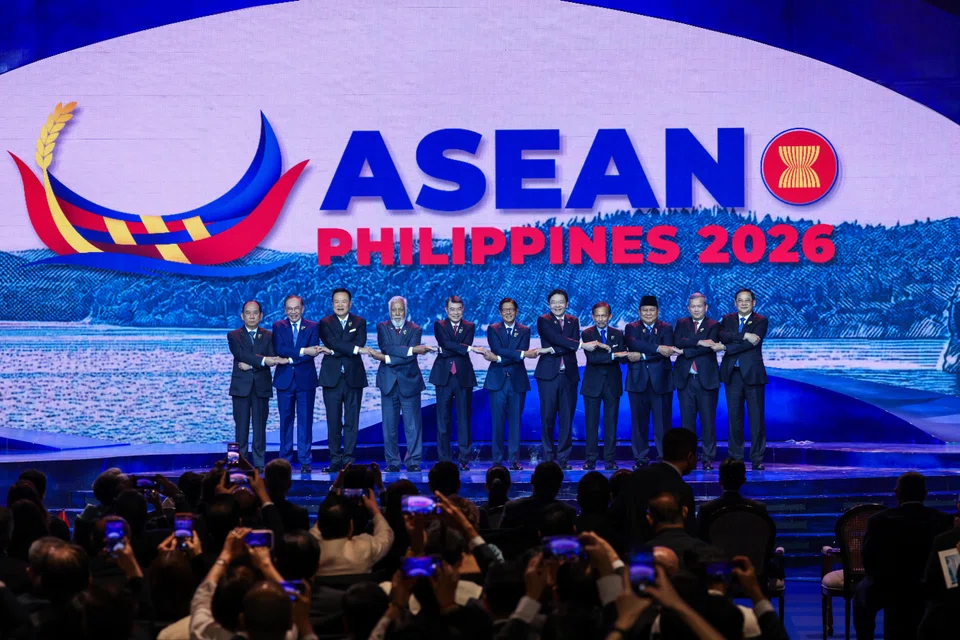
[CEBU] Asean nations must strengthen their collective resilience in the face of a world that will see more disruptions, shocks and volatility, said Singapore Prime Minister Lawrence Wong on Friday (May 8).
“The realities of the global economy going forward are that there will be more disruptions, more shocks, and more volatility. That will be the new normal in our economic landscape,” he said during a plenary session at the 48th Asean Summit in Cebu.
He outlined three areas for action: deepening Asean integration, reinforcing collective energy security and strengthening intra-Asean supply chains.
On integration, PM Wong called for the swift ratification of the upgraded Asean Trade in Goods Agreement (Atiga), ideally within the year, citing its crisis-related provisions and commitments on trade in essential goods.
This follows a commitment made by the region’s economic ministers at the 27th Asean Economic Community Council meeting on Thursday, where they took forward recommendations to expedite Atiga’s entry-into-force within the year.
PM Wong said that Atiga should be treated as a base, and urged like-minded member states to go further by agreeing to keep markets open and refrain from imposing export restrictions even during shortages. “I believe working on Atiga, and going even beyond Atiga, will give our people and investors confidence that Asean is integrated,” he said.
On energy security, PM Wong welcomed the signing of the Asean Petroleum Security Agreement and similarly called for its swift ratification.
He again urged members to go beyond the agreement to explore additional measures, including the possibility of a regional fuel stockpile.
The prime minister also called for the accelerated realisation of the Asean Power Grid, which would allow member states to trade surplus electricity and share reserve capacities.
On supply chains, PM Wong highlighted Asean’s position as a major agricultural producer, accounting for almost 10 per cent of global agricultural exports, and said the bloc should better leverage this strength.
He noted that the upgraded Atiga’s provisions on reducing non-tariff barriers to food trade and encouraging the exchange of food safety information would complement existing mechanisms, such as the Asean Plus Three Emergency Rice Reserve and the Asean Food Security Information System.
Amid the ongoing Middle East crisis, PM Wong noted that Asia would be especially affected. “Across the global economy, the reality is that Asia will be hardest hit because of our high dependence on energy and other critical supplies from the Gulf,” he said.
Even if the Strait of Hormuz were to reopen tomorrow, he added, it would take months for damaged infrastructure to be repaired, the strait to be demined and goods to flow again.
Staying “strong and united”
At a separate session on Thursday, PM Wong told his fellow Asean leaders that it was vital that the bloc remains “strong and united”, as this would demonstrate the ability to resolve issues within themselves “peacefully and constructively”. “If we let disputes divide us, then we diminish our credibility and our relevance on the international stage,” he said.
PM Wong flagged two issues that Singapore would like to see resolved: the border tensions between Cambodia and Thailand, as well as the situation in Myanmar.
On the former, he noted that both Cambodia and Thailand are “valued members” of the Asean family and that the tensions could have an impact on regional stability.
“We are glad that both sides are continuing to engage one another, and we would encourage both sides to exercise restraint, avoid escalation, and resolve differences through peaceful dialogue and established mechanisms,” he said.
As for Myanmar, PM Wong pointed out that while there have been some encouraging steps taken, including the recent release of prisoners and the reduction of prison sentences, these “still fall short” of what Asean had agreed to under the Five Point Consensus (5PC).
“That includes a full cessation of violence and hostilities – that means no more violence. It includes constructive dialogue with all parties involved. And while some progress may have been made, we have not arrived at what we set out to do under the 5PC,” he said.
“Given such a scenario, Singapore’s view is there is no reason for us to deviate from the 5PC at this juncture,” he added. “That also means that we continue to maintain our current position on Myanmar’s non-political representation at the Asean Summits and at the foreign ministers’ meetings.”
A “defining moment” for Asean
Earlier on Friday, in his opening remarks at the summit, Philippine President Ferdinand Marcos Jr said the gathering was taking place at “a defining moment” for the region, and the increasingly volatile situation in the Middle East had challenged member states to remain agile. He added that the Middle East crisis is a reminder of how vulnerable economies are to sudden shifts in the international order.
Marcos stressed the need for Asean member states to ensure regional energy security, resilience and food security in the face of external shocks.
He noted that the Philippines had recalibrated its chairmanship hosting in response to the conflict, scaling down non-essential activities and shifting some meetings to virtual platforms, while reaffirming the bloc’s commitment to its community-building agenda.
Decoding Asia newsletter: your guide to navigating Asia in a new global order. Sign up here to get Decoding Asia newsletter. Delivered to your inbox. Free.
Copyright SPH Media. All rights reserved.
TRENDING NOW

LTA proposes combining car COE categories, adding rebate-surcharge system

StarHub to acquire MyRepublic’s mobile business amid ongoing telco consolidation

DBS, OCBC, UOB rout lops billions off STI as inflation, rate concerns spook investors

Grab CEO’s wife Chloe Tong on life with Anthony Tan and finding her purpose

