



ADB sees modest growth impact on Asia if Middle East conflict lasts about a month
A prolonged crisis could spill into other sectors such as air travel and cargo shipping

[MANILA] The Asian Development Bank’s chief economist said on Friday (Mar 6) that if the Middle East conflict and closure of the Strait of Hormuz last only about a month, as some US projections suggest, the impact on growth in developing Asia would be modest, with only a slight and temporary “downward blip” in annual gross domestic product (GDP).
“Most of the scenarios … suggest that the impacts will be, of course, negative, but relatively modest,” ADB chief economist Albert Park told Reuters in an interview, adding that even under pessimistic assumptions, the shock would not reduce regional growth by a full percentage point.
Developing Asia consists of 46 economies ranging from China and India to Georgia and Samoa, but excluding Japan, Australia and New Zealand.
Park said the risks would rise sharply if the conflict drags on, warning that it could drive up energy prices, cause greater disruptions to shipping and trade, weaken global demand, and bring more volatility to the financial markets.
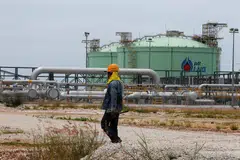
He noted that 80 per cent of the oil and gas passing through Hormuz are bound for Asia, underscoring the region’s vulnerability to extended supply disruptions.
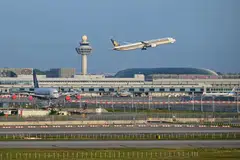
A prolonged crisis could also spill into air travel and cargo routes, on top of existing restrictions over Russian airspace, adding strain to tourism-reliant and trade-dependent economies, the ADB official pointed out.
Before the conflict, the ADB had projected the region to slow to 4.6 per cent this year from the 5.1 per cent growth expected in 2025. It also forecast a slight acceleration in inflation to 2.1 per cent this year, from last year’s 1.6 per cent estimate.
But Park said that the outlook remains uncertain, particularly if financial conditions deteriorate.
Heightened uncertainty has already triggered a “flight to safety” into US dollar assets, pushing the greenback higher and putting downward pressure on Asian currencies, which could further raise the cost of imported oil.
SEE ALSO
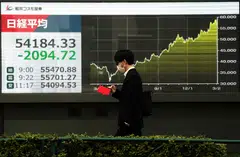


If flows become disruptive, policymakers may have to step in, he noted. “If financial disruption becomes disorderly, then our advice is for central banks to think about stabilising markets,” Park pointed out.
“Not trying to target prices on exchange rates or anything like that, but certainly to try to stabilise both exchange rate markets and also possibly inject some liquidity if the financial conditions change quickly and create certain credit pressures,” he added. REUTERS
Decoding Asia newsletter: your guide to navigating Asia in a new global order. Sign up here to get Decoding Asia newsletter. Delivered to your inbox. Free.
Share with us your feedback on BT's products and services
TRENDING NOW

Once staunchly pro-China, Malaysian Chinese businesses are now distancing themselves from Beijing
The middle power moment arrives in South-east Asia – but not for Asean

DBS, OCBC, UOB face rate hike reality check

Vietnam’s northern provinces, not Hanoi or Ho Chi Minh City, are powering near 10% GDP growth

