After a decade at the helm, Jokowi leaves behind a legacy of taking bold decisions
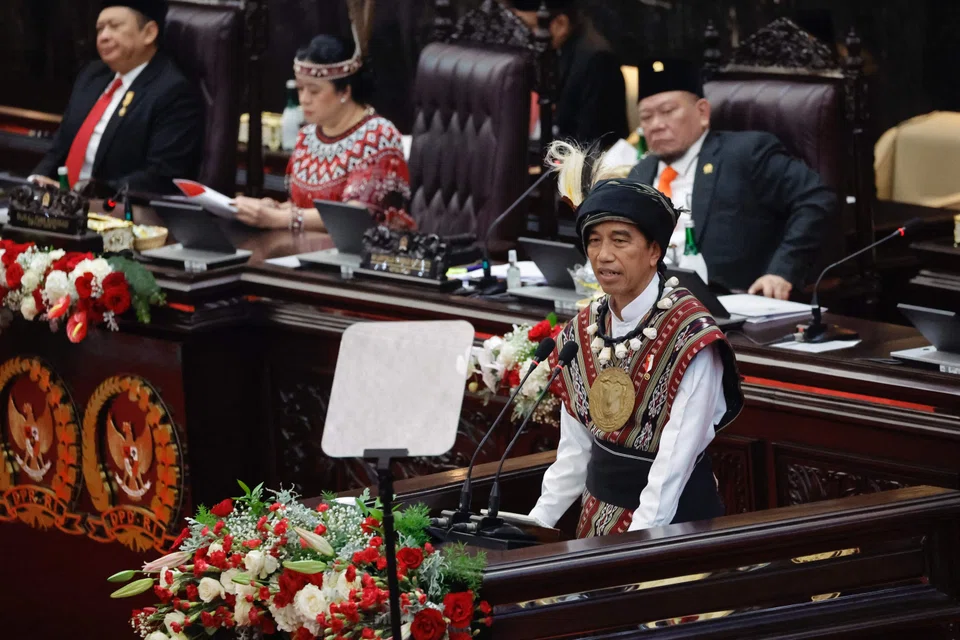
[JAKARTA] Indonesian President Joko Widodo arrived for his State of the Nation address on Wednesday (Aug 16) dressed in the attire of the Tanimbar people of south-east Maluku.
As he has done in the past, the 62-year-old Jokowi – as he is popularly known – chose to don traditional attire rather than a western suit to emphasise Indonesia’s rich cultural heritage.
By doing so, he was continuing a message he first espoused when taking office in 2014, that Indonesians must have self-belief and confidence in themselves if the nation is to progress. He termed the movement his “mental revolution” where the nation will be bold and think big in all segments of public life.
Among the goals he laid out when campaigning for his first term were food self-sufficiency, building infrastructure, promoting value-added exports, developing the country’s poorer eastern provinces, and uplifting the lives of millions of his citizens who hovered above the poverty line.
The mental revolution that he launched has, in many ways, transformed the nation of 270 million people over the past decade. Domestically, the country has seen an impressive infrastructure development push by building numerous ports, airports, highways and reservoirs.
According to a PWC report, during the first nine years of Jokowi’s leadership, more than 1,700 km of toll roads were built, including the massive trans-Java toll road.
These massive projects have been a result of Jokowi’s boldness to increase funding allocation for infrastructure from the state budget, despite criticism and concern from some quarters.
He continued this trend in his latest budget proposal tabled in parliament on Wednesday, by increasing spending by 6 per cent from the current budget.
The 2024 budget also assumes 5.2 per cent growth next year for South-east Asia’s largest economy, which is slightly above this year’s 5.1 per cent forecast, with inflation running at 2.8 per cent in 2024.
The president remarked that the government had set the foundation for the increase through improving connectivity which, in turn, had improved Indonesia’s economic competitiveness. According to the Switzerland-based International Institute for Management Development, Indonesia’s global competitiveness ranking improved from 44 in 2021 to 34 last year.
Jokowi’s penchant for thinking big was also displayed when he banned the export of raw minerals, forcing mining companies to build smelters onshore, thereby developing higher value-added industries.
Such policies have more than doubled Indonesia’s per capita income over the past 10 years to 71 million rupiah (S$6,287). If the economy can grow at its current pace, per capita income is projected to reach as much as 217 million rupiah in 15 years, firmly establishing Indonesia as an upper middle-income economy.
The president also talked about his other favourite topic in his annual address: equitable growth. In the past, most of the country’s economic and industrial heft has been centred on Java and Sumatra, with Kalimantan and Sulawesi acting as major sources of natural resources.
Indonesia, however, consists of 17,000 islands stretching over 5,000 km from west to east, with many regions barely surviving over subsistence levels.
Jokowi’s government sought to spread the economic pie more equitably by disbursing village funds and developing peripheral and outermost regions to the tune of 539 trillion rupiah.
To cut red tape and improve the investment climate, Jokowi pushed through the landmark Omnibus Law which harmonised thousands of overlapping regulations, making it much easier for foreign investors to enter sectors once closed to them.
The new law also reduces the obligations of employers with regard to paying compensation to workers either laid-off or dismissed.
On the international stage, Indonesia made its mark by successfully staging the Group of 20 summit in Bali last year, a historic event that saw US President Joe Biden and Chinese President Xi Jinping hold their first face-to-face meeting as leaders.
This year, as Indonesia chairs the Association of Southeast Asian Nations, Jokowi held the first Asean Summit in Labuan Bajo in May, and he will welcome the bloc’s leaders and those of its strategic partners in Jakarta next month.
In 2018, Jakarta and Palembang were the twin cities that hosted the Asian Games with large turnouts as Indonesians flocked to watch the events.
As he prepares to leave the international stage in 2024, Jokowi will undoubtedly cast a long shadow over his successor. Over the past 10 years, he has injected plenty of self-belief into his people and given them the confidence to aim high.
Of course, not all of his decisions and policies were successful and it remains to be seen how his biggest bet yet – the relocation of the capital city to Nusantara – will pan out, but he certainly leaves the country in a far better shape than when he first took office.