After historic Riyadh summit, Asean and Gulf Cooperation Council eager to boost trade links

Goh Ruoxue
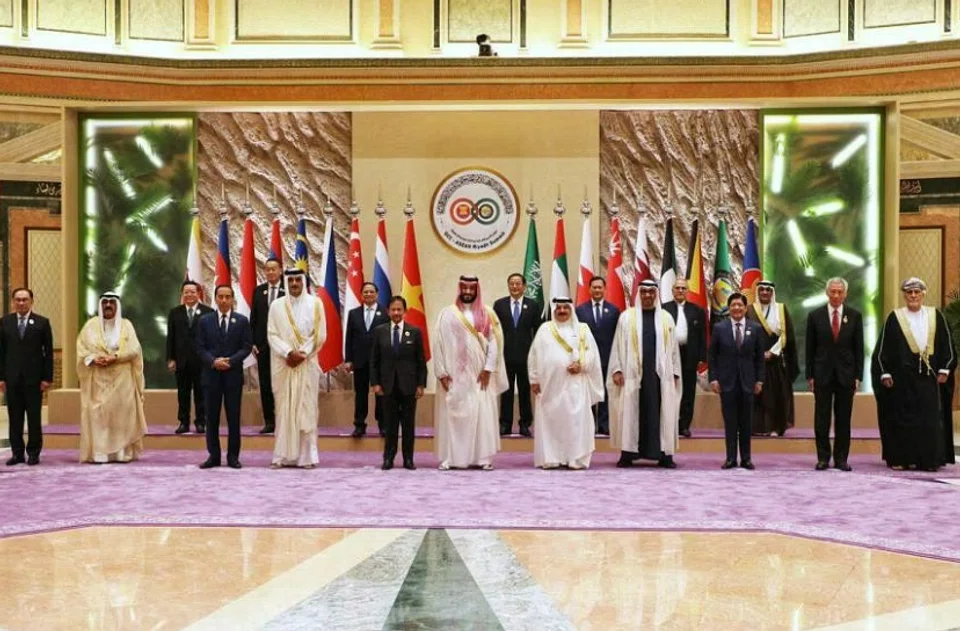
A MONTH after the Association of South-east Asian Nations (Asean) and the Gulf Cooperation Council (GCC) held their first-ever joint summit, relations between the two blocs are poised to grow, especially on the trade front.
According to figures from think tank Asia House, Asean-Gulf trade reached US$138 billion last year – up from US$85.2 billion in 2021 and US$65.3 billion in 2020.
Data from the International Monetary Fund shows that the United Arab Emirates (UAE) is Asean’s largest trading partner from the GCC. Meanwhile, Singapore is the GCC’s largest trading partner from South-east Asia.
Asean’s member states are Brunei, Cambodia, Indonesia, Laos, Malaysia, Myanmar, the Philippines, Singapore, Thailand and Vietnam. The GCC – a political and economic alliance established in 1981 – has six members, namely Bahrain, Kuwait, Oman, Qatar, Saudi Arabia and the UAE.
Crude oil, plastic polymers and aluminium products are Asean’s top imports from the Gulf members. The main exports from Asean to the GCC include food, electronics and vehicles.
Aisha Al-Sarihi, a research fellow at the National University of Singapore’s Middle East Institute, noted that food security will remain an issue for the Gulf countries.
“(They) secure nearly 50 per cent to 90 per cent of their food from imports, and they grapple with emerging challenges brought (about) by climate change and the disruption to supply chains,” she said.
As for countries in South-east Asia, securing their future energy needs remains a priority even in the current carbon-constrained world, she added.
As a whole, the Asean bloc is currently the world’s fourth largest energy consumer and imports more than 40 per cent of the energy it uses.
New cooperation framework
The historic Asean-GCC Summit, held in the Saudi Arabian capital Riyadh in October, took place more than three decades after both sides had first established relations, and 14 years after the first ministerial-level meeting took place in Bahrain.
At this inaugural summit, Asean and the GCC adopted a new framework of cooperation for the 2024-2028 period, which is expected to speed up the level of engagement and cooperation on multiple fronts such as trade and investment, tourism, people-to-people exchanges and education.
Mustafa Izzuddin, a senior international affairs analyst at consultancy firm Solaris Strategies Singapore, said he expects the engagement needle to “move from benign neglect to a constructive partnership”.
He said the two blocs can cooperate on areas of mutual interest such as clean energy, artificial intelligence and the halal food sector.
He added that Asean could benefit from the Gulf nations’ vast oil and gas reserves, while the GCC stands to gain from Asean’s standing as an economic powerhouse and its global network of relationships.
Dr Aisha also anticipates greater cooperation in sectors such as emerging low-carbon technologies, carbon markets and climate finance.
She said: “As the two groupings are now charting pathways towards achieving their net-zero emission goals, and are projected to be among the worst hit by climate change, they have natural synergies in the green energy field.”
Free trade deal
At the Riyadh meeting, Malaysia – the host of the next Asean-GCC summit in 2025 – proposed to create a free trade agreement (FTA) between both blocs.
“This agreement is crucial in advancing progressive, inclusive and sustainable growth especially as we recover from the Covid-19 pandemic and face geopolitical uncertainties,” said Malaysia Prime Minister Anwar Ibrahim in a speech at the summit.
The idea of such a mega free trade pact has, in fact, been on the table for some time now, said Dr Mustafa. The idea was floated at the second Asean-GCC ministerial meeting in Singapore back in 2010.
Currently, only Singapore has ratified an FTA with the GCC, making it the first country from outside the Middle East to do so. The agreement entered into force in 2013.
In 2019, Singapore also signed a comprehensive partnership agreement with the UAE to deepen bilateral cooperation in areas like trade and investment. This preceded a slew of other bilateral agreements in October, covering areas including the green economy and climate change.
Also in October this year, Singapore and Saudi Arabia elevated ties to a strategic partnership.
From the GCC, the UAE is the only one to have signed a Comprehensive Economic Partnership Agreement (Cepa) with countries in South-east Asia – Indonesia and Cambodia.
For now, though, observers said the path to a multilateral FTA remains an uncertain one.
Dr Aisha believes that enhancing intra-bloc integration is a prerequisite for any deal to be reached.
“The two blocs will need to strengthen their contacts and establish trust over time before they embark on a bloc-to-bloc FTA,” she said.
Sharon Seah, senior fellow and coordinator of the Asean Studies Centre at the Iseas-Yusof Ishak Institute, said it will take time for such an FTA to be realised.
“As they see more opportunities and how FTAs or Cepas work in this region, more Gulf countries will be motivated to engage,” she said.
Said Dr Mustafa: “Singapore could play a leading role on the Asean (side), and Saudi Arabia on the GCC side to bring the GCC-Asean FTA into fruition.”
Shift towards regionalism
Against a backdrop of growing tensions and major power rivalry in South-east Asia and the Middle East, Seah said that being flexible and aligning with parties that best serve national interests is important.
“For the GCC, multilateral cooperation is a means to leapfrog their immediate troubled neighbourhood and to seek new economic opportunities as they transition themselves out of carbon-intensive economies,” she said.
In this case, Asean stands out as a natural partner, being a highly connected region that offers different convening platforms, she said.
“The strategic imperative is great right now because small states are navigating an increasingly fragmented global order. Region-to-region cooperation has the effect of creating more breathing room and strategic space to manoeuvre in,” said Seah.
Similarly, Dr Mustafa believes the GCC members are “keen to diversify their partnerships beyond the traditional preoccupation with the US and China”.
“Regionalism stimulates countries to cooperate and become more interdependent and by doing so, minimise regional geopolitical competition. A much stronger regionalism can also serve as a bulwark against superpower rivalry,” he said.