AI race in Vietnam heats up as more tech giants join the bandwagon
The country’s biggest firms including FPT, VNG and Vingroup are betting big on AI technologies
Jamille Tran
[HO CHI MINH CITY] Almost everyone around the world has heard of ChatGPT, the artificial intelligence (AI) language model developed by US-based OpenAI that can generate human-like text based on the input it is fed.
Over in Vietnam, a new generative model series called PhoGPT is making waves. Named after the traditional noodle dish, it is pre-trained specifically for the Vietnamese language.
PhoGPT – introduced on Nov 7 by VinAI, the AI research arm of Vietnam’s largest private conglomerate VinGroup – is the latest example of how Vietnamese companies are riding the global AI bandwagon.
Earlier this year, VinBrain – an AI healthcare software company also funded by Vingroup – announced partnerships with Stanford University and Microsoft to train and cross-validate AI models to increase the accuracy of diagnostic imaging for patients.
IT services provider FPT, consumer conglomerate Masan Group and tech unicorn VNG are among those also betting big on AI.
In February, Masan announced an investment of up to US$105 million in Trust IQ, a Singapore-based tech company that owns the credit scoring platform Trusting Social. The investment is part of Masan’s goal to expedite its application of AI in the retail and consumer space.
As for VNG, a representative said the company is building large language models specifically for Vietnamese users, based on open-source codes from US technology firms.
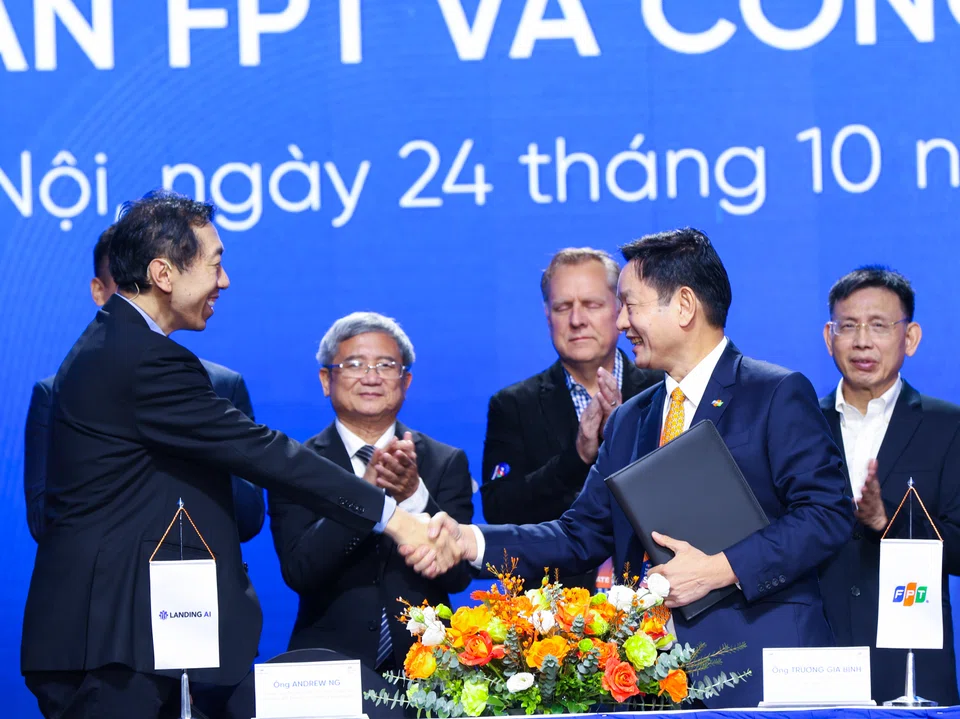
FPT Software, meanwhile, has been working with US computer vision platform and software firm Landing AI since 2022 to create models that can implement domain-specific solutions for industries such as manufacturing and automotive. Just last month, FPT and Landing AI announced a new strategic relationship that aims to drive the application and education of AI.
Capital-intensive industry
The AI race in Vietnam is one analysts believe only a handful of companies can realistically compete in, given how it requires extremely deep pockets and the ability to handle large amounts of data.
VNG, for instance, owns the popular messaging app Zalo, which is used by about 75 million people in the country, more than Facebook Messenger. VNG has about 150 million users across its range of services and products including game publishing, music sharing and mobile payments.
Even with this advantage in large data sources and user bases, VNG chief executive Le Hong Minh said last month that AI projects are costly endeavours and carry “significant financial risk”.
In May, a report in Analytics India Magazine noted that OpenAI’s losses roughly doubled to US$540 million in 2022 as it developed ChatGPT and hired key employees from Google.
Speaking at the FPT Techday event in Vietnam last month, Landing AI founder and chief executive Andrew Ng said the lowest levels of specialised computer hardware and infrastructure are the most capital intensive parts of AI technology.
Ng, who co-founded both Coursera and Google Brain, said tech giants such as Intel and AMD are dominating the hardware market with their advanced chips that are optimised for training AI algorithms. This makes it difficult for startups to break into the space, he added.
The opportunities lie in developer tools, which Landing AI is already focusing on, and applications, where Ng said the competition is less intense.
Open-source is key
Industry players whom The Business Times spoke to said open-source projects are the future of innovative AI solutions, as developers do not have to build from scratch to create new products or adopt AI in existing applications.
While such public source codes might not perform as well as the closed-source ones developed by global tech giants, they said the gap is gradually shrinking.
FPT Software’s chief AI officer Nguyen Xuan Phong said the growth of a global AI community, with companies and developers extensively open-sourcing their pre-trained AI models, will significantly drive down the costs of pursuing the latest AI technological advancements.
“We can reuse and adopt those open-source models into the smaller data sets that we have for the enterprise use. It’s much cheaper that way,” he said.