



Amid concerns of a Chinese debt trap, Indonesia’s first high-speed railway to finally open

[JAKARTA] After enduring delays of more than four years, the first high-speed railway in South-east Asia – a 142 km project linking Indonesia’s capital Jakarta and Bandung, the capital of West Java province – will finally commence commercial operations on Oct 1.
The Kereta Cepat Jakarta Bandung (KCJB), as it is called, is part of China’s ambitious Belt and Road Initiative. The made-in-China trains will reduce the commuting time between the two cities to around 40 minutes, from three hours by a regular train.
Beijing regards the railway as an enduring symbol of the close relations between the two countries, with the KCJB a major part of China’s expanding footprint in the region.
There are concerns in some quarters, however, that Indonesia could become entangled in a Chinese debt trap, especially after the budget ballooned to US$7.3 billion, from its initial projection of around US$6.07 billion, since construction began in 2016.
The Business Times took a ride during the trial run recently, and here is the lowdown on this modern bullet train and what it means for connectivity in the region.
Why is Indonesia so bullish on the project?
The KCJB is implemented by PT Kereta Api Indonesia China (KCIC), a joint venture between the China Railway Engineering Corporation and a consortium of Indonesia’s state-owned enterprises.
The Indonesian government has stated that the project could promote economic development and enhance connectivity between Jakarta and the bustling city of Bandung, with the latter home to some 2.5 million residents and known for being a centre for education, culture and technology.
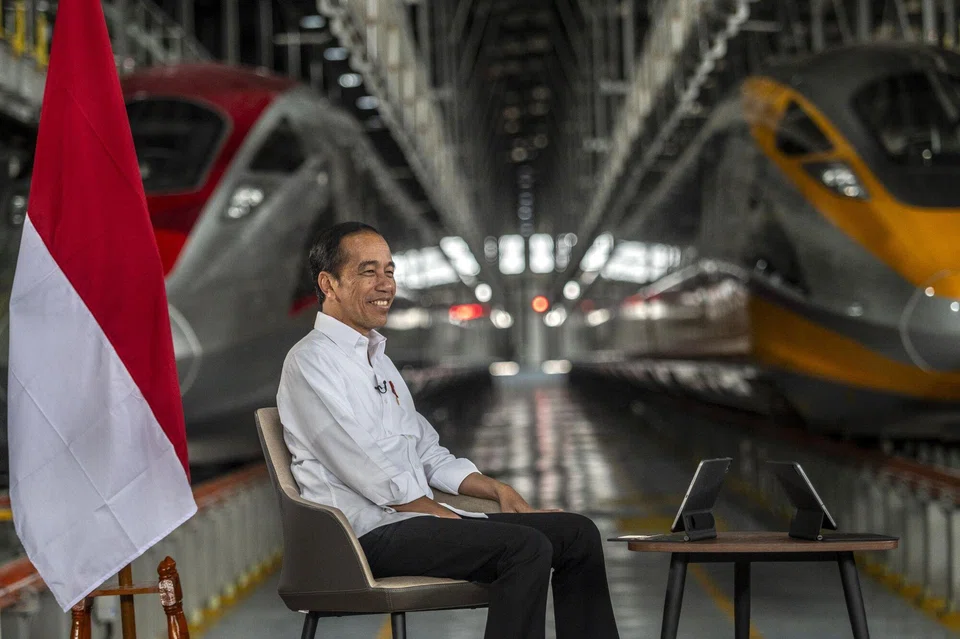
President Joko Widodo, who rode on the train earlier this month, noted that over 100 trillion rupiah (S$8.86 billion) is lost due to severe traffic jams in the Greater Jakarta area and Bandung. He hopes that the KCJB will serve as a faster and more convenient mode of transport and reduce congestion and pollution.
How fast can the train go?
Each train comprises eight cars and can carry up to 600 passengers. It can reach a top speed of 350 km per hour. With the end-to-end journey taking around 40 minutes or so, it is a significant improvement from a car journey that typically takes about three hours, even under favourable traffic conditions.
During the public trial, BT observed that even at its top speed, the train does not have much vibration or noise. Passengers in the cabin cheered as the train whizzed by scenic views of the countryside and rice fields, making stops at Padalarang and Tegalluar in West Java.
The trains, which were fully booked for the trial period, are equipped with power outlets, LCD screens, and seats with spacious legroom. The stations have modern designs and plenty of waiting areas, although some sections were still in the final stages of construction.
Why did Indonesia decide to partner China for this?
Indonesia had originally planned to adopt Japan’s Shinkansen bullet train technology, but in 2015, Widodo’s government made an eleventh-hour decision to adopt the proposal put forward by China, as doing so would not place any financial burden on the state budget.
While Japan proposed a budget of US$6.3 billion, China’s proposal for the project was set at US$5.13 billion. It did not include any government guarantee, financing from the state budget, or tariff subsidies, stressing that any cost overruns are the responsibility of the joint venture company.
The project faced significant resistance from Indonesia’s then-minister of transportation Ignasius Jonan, who argued that a high-speed train was unnecessary for the relatively short distance between Jakarta and Bandung.
As the authority responsible for the railway sector, the minister declined to grant construction permits, citing concerns that several regulations, particularly those related to the concession period, had not been met.
China ultimately secured the KCJB development project despite Japan having previously conducted a feasibility study. China subsequently adjusted the project cost to US$6.07 billion, with a commitment to commence work in 2016 and a target for project completion in 2019.
Why did the project go over budget?
The project was financed through a loan provided by the China Development Bank (CDB) which covered 75 per cent of the expenses. The remainder was funded by Indonesian and Chinese shareholders.
As construction began, an extra US$1.2 billion was needed to accommodate rising expenses and land compensation requirements.
The government’s rationale was that construction of the high-speed railway had to be halted to prioritise the management of the Covid-19 pandemic, which struck in early 2020. The escalation in project costs also resulted from increasing prices of essential materials such as iron and steel, coupled with disruptions in the global supply chain.
From that amount, the project would need to get US$560 million in additional loans from CDB based on calculations of the portion that needed to be covered by debt, with the rest to be funded by equity in KCIC.
At that time, Widodo said that the project’s funding would exclusively come from consortium funds, without utilising the state budget.
However, the government recently issued a regulation that now permits the use of state funds as a loan guarantee to sustain the KCJB project.
The regulation, which took effect on Sep 11, stipulates that the guarantee will cover all financial liabilities, including the loan principal, interest and other additional costs that may be incurred through state-owned railway company PT Kereta Api Indonesia.
The guarantee would come from the government, along with PT Penjaminan Infrastruktur Indonesia, a state-owned infrastructure project guarantor.
Is Indonesia at risk of falling into a Chinese debt trap?
The Indonesian government’s decision to guarantee the project through the state budget has been criticised for putting a heavy burden on the taxpayer. Experts had previously warned that the policy could lead to a bad precedent as companies would become reliant on government funding to save over-budget state projects.
The Jakarta-based economic think tank Institute For Development of Economics and Finance stated there is concern that Indonesia’s participation in the Belt and Road Initiative, a project planned by China since 2013, involving numerous infrastructure projects worth tens of billions of US dollars, could potentially lead to a debt trap, posing significant future problems.
Indonesia is currently ranked among the top countries involved in the initiative, known as China’s New Silk Road, with an estimated project value of 312.4 trillion rupiah, according to AidData records from 2021.
Chinese investment in Indonesia has also been on the rise over the past years, although the number dropped in 2021.
Government data shows China invested US$8.2 billion in Indonesia in 2022, a huge jump from the US$3 billion in the previous year. Indonesia also attracted US$4.8 billion in Chinese investment in 2020.
TRENDING NOW

Britain’s mansion tax shows the difficulty of targeting wealth

Once staunchly pro-China, Malaysian Chinese businesses are now distancing themselves from Beijing

The only common thing in S-E Asia is that we all eat rice: Cisco’s Asean president

Singapore data centre operator DayOne opts for US IPO at likely US$20 billion valuation

