



Anutin’s short-lived government banks on quick fixes amid Thailand’s economic strain
The measures and reforms offered fall short of addressing deeper structural issues, say economists
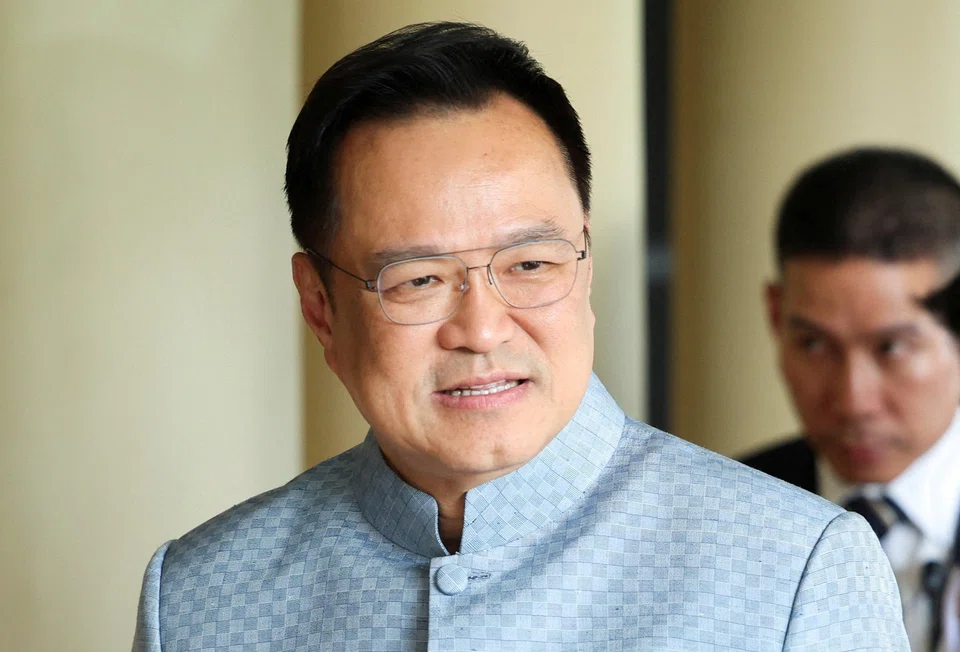
[BANGKOK] Thailand’s new Prime Minister Anutin Charnvirakul has outlined a mix of quick relief measures and longer-term reforms as he seeks to steady the economy during what may be a short-lived administration.
Among the immediate steps is the revival of the “half-half” subsidy scheme, first introduced under former prime minister Prayut Chan-o-cha during the Covid-19 years.
The government plans to spend 25 billion baht (S$995.84 million) on the programme, which will see some 30 million people pay half-price for food and small items for up to 150 baht a day, with the balance covered by the state.
The scheme was widely credited with boosting spending and helping small vendors, many of whom were brought into the formal tax system.
But while such measures may ease short-term strains, economists say they fall short of addressing Thailand’s deeper structural issues.
Those challenges include limp domestic demand, household debt at 89 per cent of gross domestic product, public debt at 64.5 per cent, an ageing population, an overvalued baht, slowing tourist arrivals and nearly a decade of growth averaging about 2 per cent.
Rating agencies Fitch and Moody’s recently downgraded the country’s outlook to “negative”.
Economists also highlight political uncertainty. Maybank’s Erica Tay and Chua Hak Bin pointed out that while the interim government is pushing through a stimulus for consumption subsidies and debt relief, the scheduled dissolution of parliament in January and elections in March cloud the longer-term policy outlook, dampening investment sentiment.
“Regulatory guillotine”
Anutin, 59, took office in September under an agreement with the People’s Party, which has 143 MPs. The leader of the Bhumjaithai Party – which has 68 MPs – was voted in as Thailand’s 32nd prime minister – and the third in just two years – following the dismissal of former prime minister Paetongtarn Shinawatra by the Constitutional Court on Aug 29.
Anutin has signalled awareness of the need for deeper reforms. He has pledged to press ahead with a long-discussed “regulatory guillotine” – the cancellation of outdated laws and regulations – to facilitate private investment and ease companies’ bureaucratic burdens.
First mooted in 2019 under Prayut, the plan gained little traction then due to bureaucratic resistance and weak ministerial backing. This time, observers say, there may be more momentum, especially in technocrat-led ministries.
“At the Ministry of Commerce there are so many low-hanging fruits… Regulations that don’t need to go to parliament can be changed by ministerial orders,” said Dr Kirida Bhaopichitr, former research director at the Thailand Development Research Institute, who has joined the commerce ministry as a “vice-minister”, an advisory appointment.
“I think on the regulatory guillotine, it’s doable (in four months),” Dr Kirida told The Business Times.
“Even if we can do away with 20 regulations, I think that would be great. By doing this, Anutin will win popularity with the private sector, especially the SMEs (small and medium-sized enterprises).”
Anutin’s pact with the People’s Party limits his term to 120 days, after which he must call fresh elections and hold a referendum on amending the current Constitution, written and promulgated in 2017 when Thailand was under the coup-installed regime of Prayut, which lasted from 2014 to 2023.
“There will be no Day 121,” he has promised. But political watchers remain sceptical.
“Anutin will be tempted to stay longer,” predicted Dr Thitinan Pongsudhirak, professor of political science at Chulalongkorn University. “Being in power brings prestige, pork and patronage. They need power and pork-barrelling to spend on the constituencies to pave the way for the next election.”
Anutin has retained his post as interior minister, which plays a key role in organising elections. While the majority of his Cabinet appointees are fellow Bhumjaithai members or political allies, he has named at least four technocrats and professionals to run Thailand’s key economic ministries:
- Finance Minister Ekniti Nitithanprapas, a career bureaucrat at the Ministry of Finance who last headed the revenue department;
- Deputy Finance Minister Vorapak Tanyawong, former CEO of Krung Thai Bank;
- Commerce Minister Suphajee Suthumpun, former CEO of the Dusit International hotel group and former CEO of IBM Thailand; and
- Energy Minister Auttapol Rerkpiboon, former president of PTT, the national oil company.
Importantly for Thailand’s challenges in the geopolitical arena, Sihasak Phuangketkeow, a career diplomat, has been appointed foreign minister, and persuasively presented Thailand’s stance on the Cambodian-Thai border conflict at the United Nations General Assembly on Sep 27.
While Anutin’s relief measures may buy him goodwill, the question is whether his government will do more than tinker at the edges.
In addition, given the mixed ministerial portfolios, there is still plenty of room for the reformist People’s Party to benefit politically from Anutin’s four-month term.
For the People’s Party, staying outside the government could yet prove advantageous. “This actually could be a blessing in disguise,” said Prof Thitinan. “Anutin’s government is likely to end up with corruption scandals, so (the party) could actually gain political capital and voter support.”
He continued: “In fact, in Thailand, you get more political capital and voter support by not being in government.”






