



Asean companies turning to debt capital markets, as equity nervousness reigns

Tan Nai Lun

GLOBAL activity for mergers and acquisitions and initial public offerings (IPOs) is down in the first nine months of 2022, but industry players said bond markets in South-east Asia are looking like a resilient source of liquidity as the region reopens.
Fund managers and financial sponsors are expected to soon deploy their high levels of cash, industry watchers said, although they will likely look for opportunities among the more defensive plays.
“With the reopening of economies in the region, the Asean markets continue to require financing to fund growth and investment,” said Edmund Leong, head of group investment banking at UOB.
He noted that amid the current market volatility, high-grade issuers in the region have had occasional windows of opportunity for private placements and public debt.
The syndicated loan market in South-east Asia is also resilient as it is a safe haven of sorts for established companies, state-owned corporates and financial institutions.
Equity markets, on the other hand, have been volatile, and fundraising has been challenging as investors turn more selective.
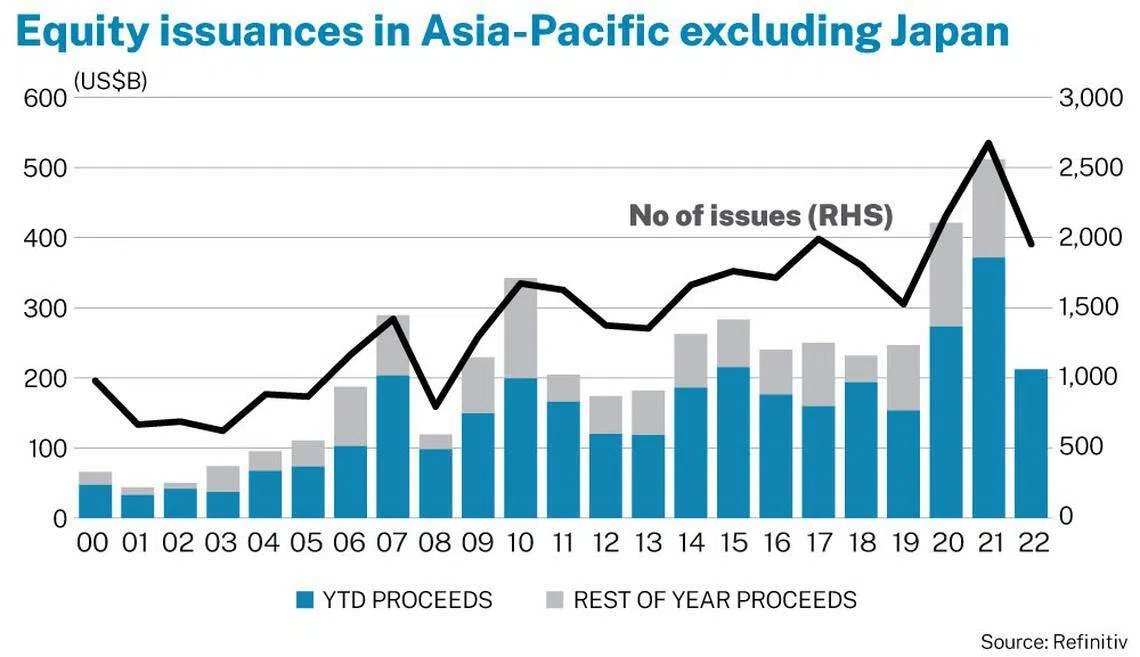
Equity and equity-related issuance in Asia-Pacific ex-Japan (APxJ) fell to a three-year low in the first nine months of this year, according to data from Refinitiv.
Primary bond offerings from APxJ-domiciled issuers, however, saw the strongest first-nine-months period since records began in 1980, raising US$3 trillion.
Andrew Wong, a credit research analyst at OCBC, said that given current market uncertainty, completed deals were mostly “very purposeful transactions”, such as private placements in the Singapore dollar space and primary issuances with implicit or explicit external credit support in the Asia dollar space.
“The hardest ones appear to be the ones that are needed the most – the ones that fill a liquidity shortfall, which may indicate a weaker credit and liquidity position,” he said.
Clifford Lee, global head of fixed income at DBS, said that most local currency bond markets across the Asean region have so far been more resilient than the G3 markets, which are bonds denominated in US dollars, yen or euros.
He expects bonds will see an uptick in investor interest once the interest rate outlook stabilises, given that they are a more defensive asset class, although he noted that non-investment grade bond trades and bond issuances in the longer tenors are facing greater headwinds.
“Notwithstanding current nervous and uncertain sentiments, the market is still flushed with liquidity and ongoing inflationary pressures will make it more punitive to sit on cash,” he said.
Data from both EY and Refinitiv show equity capital market activity and the pace of deal making have taken a significant hit.
Deal-making activity involving APxJ entities came in at US$748.5 billion in the first nine months of 2022, down 34 per cent year-on-year, according to Refinitv.
As for IPOs, a total of 992 IPOs raised US$146 billion in the first nine months of 2022. Global volumes fell 44 per cent from the same period a year ago, with proceeds down by 57 per cent, according to data from EY.
EY noted that in the third quarter of 2022, global IPO proceeds of special purpose acquisition companies (SPACs) were the lowest since Q3 2016.
Eng-Kwok Seat Moey, group head of capital markets at DBS, said SPAC issuance would naturally be more affected given the increased opportunity cost of capital, compared with higher returns offered by alternative yield products and fixed deposits.
EY pointed out, however, that IPO activity in the Americas is at its lowest in 20 years, whereas exchanges in the Asia-Pacific region performed relatively better as the region was less impacted by inflation and geopolitical issues.
In Asean, 96 IPOs raised US$3.8 billion in the first nine months. The deal numbers rose 4 per cent, although proceeds fell 57 per cent from the same period a year ago.
Addressing the overall market activity, Eng-Kwok said any deals will have to come at a more attractive valuation, be supported by a large percentage of cornerstone investors, and have some flexibility to adjust offering sizes down if needed.
Martin Siah, head of global corporate and investment banking for South-east Asia at Bank of America, said IPOs and private capital raising activity have been sluggish due to a significant valuation disconnect between issuers and investors’ expectations.
The gap between public and private market valuations may also lead to a spike in delisting or privatisation activities, he added.
Nevertheless, he expects capital markets will stabilise and activities resume, as uncertainties around rate hike cycles end.
“We also expect a recovery in the appetite of the bank financing markets, which will naturally drive further activities from financial sponsors who are sitting on the largest war-chest ever assembled to deploy on deals,” he said.
TRENDING NOW

Once staunchly pro-China, Malaysian Chinese businesses are now distancing themselves from Beijing

Cliff Tan has 7 million followers and a 4-month waitlist. Why won’t he expand his business?

Could stablecoins be the future of money?

Grab CEO’s wife Chloe Tong on life with Anthony Tan and finding her purpose

