Asean currencies hammered again as rosy data lifts US dollar further
Vietnamese dong falls to historic low against greenback; Indonesian rupiah hits four-year low

CURRENCIES across Asean began the first month of the second quarter by sliding even further against the US dollar, with some slumping to the nadir and others dropping to multi-year lows, as recent data signalled bright prospects for the world’s largest economy.
The US dollar index – which measures its value against a basket of six major currencies: the euro, yen, pound, Canadian dollar, Swedish krona and Swiss franc – climbed about 50 basis points to 105 on Monday (Apr 1).
Confidence in the greenback stirred following Monday’s release of manufacturing data, which showed that US factory activity expanded for the first time since September 2022, after 16 consecutive months of contraction.
This, however, spells trouble for South-east Asian currencies – even the export-oriented ones – which were already facing the heat from the US dollar’s fiery start to the new year.
HSBC head of Asia foreign exchange research Joey Chew explained that the upside surprise means that the market is now contemplating a “no landing” scenario for the US economy. This, in turn, translates to a continuing hawkish repricing of the Fed, and the resultant strengthening of the greenback. Additionally, the “rising tide lifts all boats” phenomenon does not apply in this case, Chew wrote in an Apr 2 research note. Asia’s manufacturing indices for March were mixed, and regional currencies may actually feel heat from the competition.
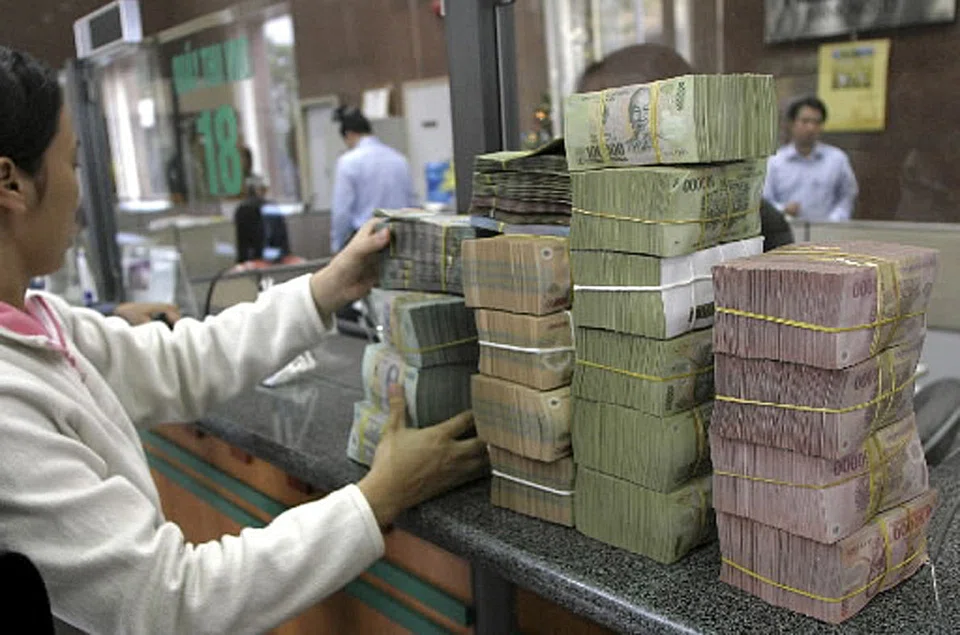
Currently, the Vietnamese dong is teetering at the top of the biggest losers list. One of the most stable currencies of Asia last year, the dong has registered a year-to-date drop of about 3 per cent to a record-low of 25,010 against the US dollar on Thursday as at 5.30 pm.
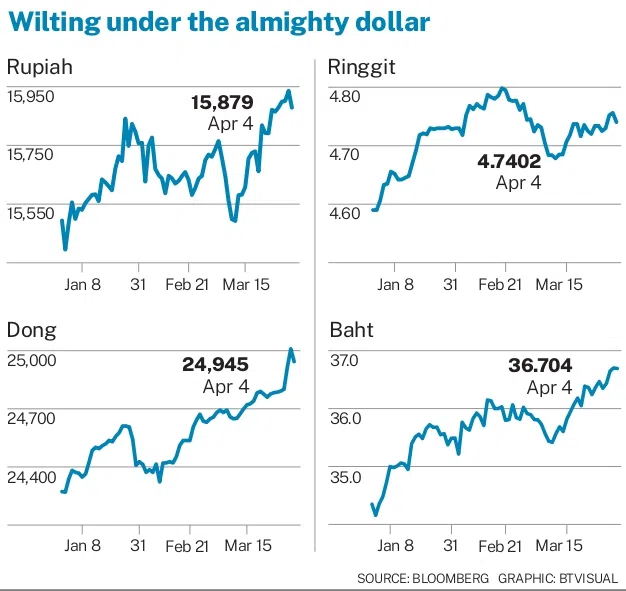
Similarly, the rupiah – among Asia’s best-performing currencies last year – sank to a four-year low, dipping to 15,879 against the US dollar as at 5.30 pm on Thursday and charting a year-to-date decline of 2.5 per cent.
This triggered the nation’s central bank to intervene in its spot currency and domestic non-deliverable forward markets. Bank Indonesia also stands ready to step into the bond market.
The Thai baht – last quarter’s worst-performing South-east Asian currency – has been sliding since the year began. It fell further to 36.704 as at 5.30 pm on Thursday, marking a 6.9 per cent year-to-date drop.
The ringgit is no better. Dubbed the worst-performing currency in emerging Asia in 2023, it has slipped about 3.3 per cent in the year to date to stand at 4.7402 against the US dollar as at 5.30 pm on Thursday.
Sunshine in the clouds
In spite of the doom and gloom, analysts suggest that blue skies lie ahead for South-east Asian currencies.
UOB’s senior foreign exchange strategist Peter Chia believes the rebound in the US dollar may be short-lived.
“Despite weakness in Q1 2024, we keep to our view of an Asia foreign exchange recovery this year driven by renewed USD weakness from the Fed beginning its rate cut cycle, while we expect Asian central banks to largely hold rates steady,” he told The Business Times.