Asean Business logo
SPONSORED BYUOB logo

Asean currencies at the mercy of Trump’s tariff twists – here is how they stack up 

But analysts say the units are expected to catch a breather in the second half of the year

Summarise
Goh Ruoxue
Published Fri, Feb 7, 2025 · 12:37 PM
    • South-east Asian currencies initially weakened as the US dollar gained but have strengthened against the greenback in recent days.
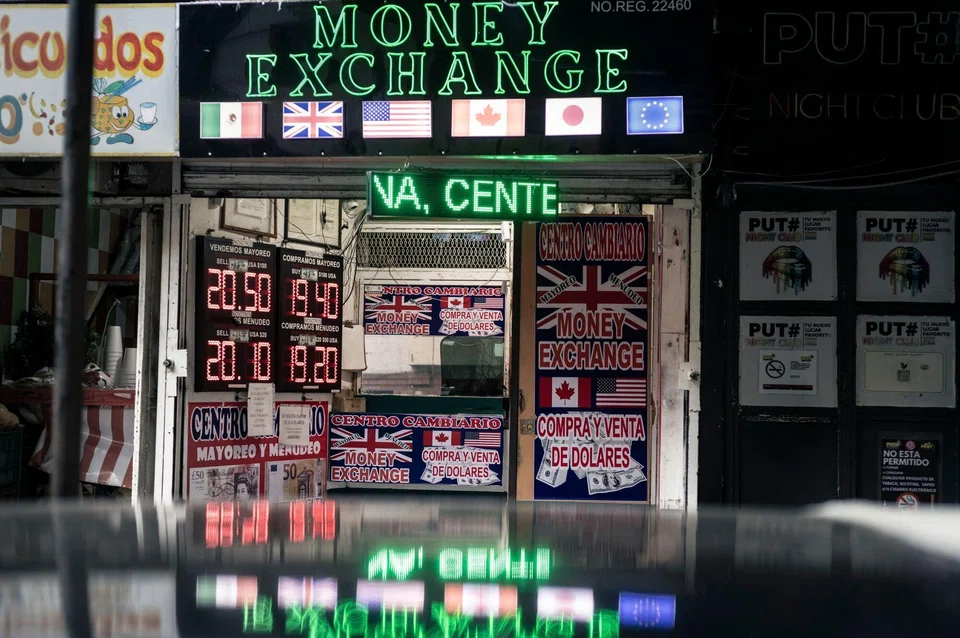
    • South-east Asian currencies initially weakened as the US dollar gained but have strengthened against the greenback in recent days. PHOTO: BLOOMBERG

    THE world found itself on the brink of a trade war last week as US President Donald Trump’s on-again, off-again stance on tariffs came to a head, sending South-east Asian currencies into a spin.

    The US dollar index, which measures the greenback’s value against a basket of six major currencies – the euro, yen, pound, Canadian dollar, krona, and franc – rose some 1 per cent ahead of Feb 1, the day that earlier threatened tariffs on Canada, Mexico and China were supposed to kick in.
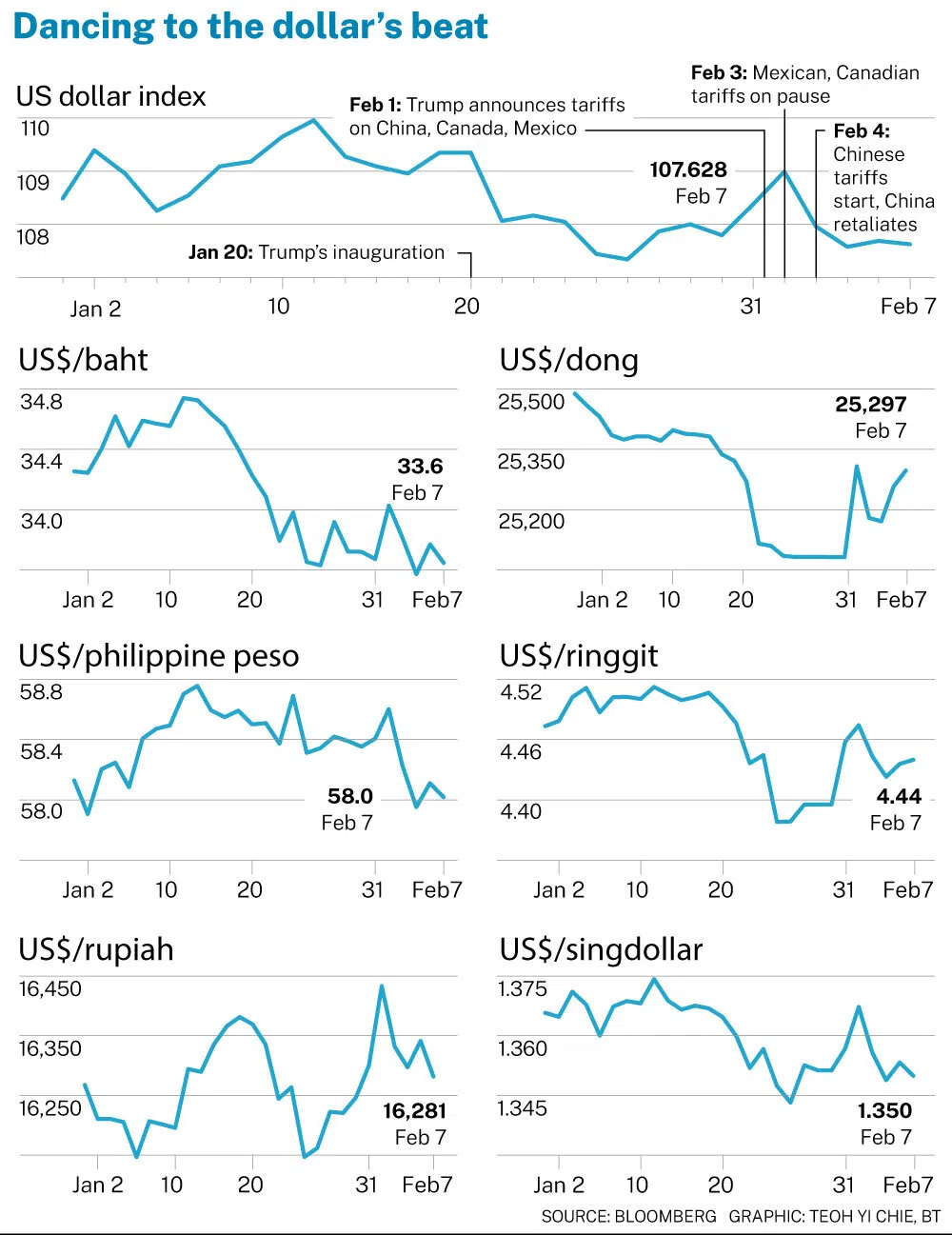
    The index climbed to a relative peak of 109.874 around noon on Feb 3, and then eased to about 107.746 as at 2 pm on Thursday (Feb 6), as investor concerns eased amid expectations that the tariffs would be delayed or softened.


    In turn, South-east Asian currencies initially weakened as the US dollar gained, but have strengthened against the greenback in recent days.

    What’s happened so far?

    Campaign trail: Trump threatens tariffs on Canada, Mexico and China, to come on day one of his presidency

    Jan 20: He takes office, threatens tariffs from Feb 1 instead

    Feb 1: Trump announces a 25 per cent additional tariffs on Canadian and Mexican imports, and 10 per cent tariff on Chinese goods, set to kick in on Feb 4. Mexican President Claudia Sheinbaum vows retaliation 

    Feb 2: Canadian PM Justin Trudeau responds with 25 per cent tariffs on some US goods from Feb 4

    Feb 3: US tariffs on Canada and Mexico on pause for a month after talks

    Feb 4, 1.01 pm (Singapore time): Chinese tariffs take effect

    Feb 4, minutes later: Chinese finance ministry hits back with 15 per cent levies on US coal and LNG, 10 per cent on crude oil, farm equipment, autos – to start on Feb 10

    Economies that are highly trade-dependent, deeply integrated into global supply chains, and running large surpluses with the US, are generally more vulnerable to currency fluctuations, said Abhay Gupta, forex and rates strategist at Bank of America Securities.

    However, a softer US dollar in the second half of 2025 could bolster Asian currencies, particularly if economic growth in the region surpasses that of the US, he added.

    Based on insights from foreign-exchange strategists, The Business Times ranked the currencies of Asean’s six largest economies by their vulnerability to current market conditions, factoring in trade dependency, exposure to US tariffs, sensitivity to the Chinese yuan and domestic economic challenges.

    1. Singdollar: A safe haven

    Pundits across the board ranked the Singapore dollar among the three least vulnerable Asean currencies, with Darren Tay, head of Asia-Pacific country risk at BMI, naming it his top pick due to its resilience against shocks from American tariffs.

    The Singdollar benefits from Singapore’s strong forex reserves and the Monetary Authority of Singapore’s management of the exchange rate, he said.

    However, the city-state’s heavy reliance on trade could also be a potential weakness, with a trade-to-gross-domestic-product ratio of over 300 per cent – among the highest in the world.

    BofA Securities’ Gupta cautioned that in a scenario where the yuan depreciates by 10 per cent and tariffs rise by the same margin, the Singdollar would be badly hit. He noted that a 10 per cent depreciation in the yuan would likely result in a 6.7 per cent decline in the Singdollar.

    2. Peso: Pressure from within

    When it comes to US tariffs, the Philippines is largely less exposed relative to its Asean peers; any currency vulnerability is likely fuelled by domestic factors.

    BMI’s Tay noted that the Philippines runs twin deficits in its current and fiscal accounts, which have long been a key factor driving greater volatility in the currency.

    “But the central bank’s clear communication of its monetary policy trajectory has helped reduce that volatility in the peso, and that will help to blunt the impact from tariffs,” he said.

    Remittances from overseas workers make up a key pillar of the Philippine economy; such inflows also help to stabilise and strengthen the local currency.

    That said, inflation remains a flashpoint for the archipelago, where price pressures are among Asia’s highest due to its dependence on imports, especially food.

    Moderation in inflationary forces will support growth in the Philippines, where price pressures are among Asia’s highest due to its dependence on imports, especially food. PHOTO: EPA-EFE

    Though the numbers have steadied, January’s inflation print released on Wednesday was still “worse than expected”, said Jojo Gonzales, a research analyst at Philippine Equity Partners in a BofA Securities report on the recent data.

    Another BMI consumer outlook report issued on the same day said inflation could rise slightly in 2025 from last year.

    The house forecasts the Philippine peso to depreciate against the US dollar, from an average of 57.5 per dollar in 2024 to 58 this year.

    3. Ringgit: Resilient, but tied to the yuan

    As is the case with Singapore’s central bank, Bank Negara Malaysia’s credibility will benefit the ringgit, said BMI’s Tay.

    “A decent growth outlook will allow the central bank to remain on hold throughout 2025 in our view, instead of easing like the rest of its Asian peers,” he added. “The interest rate differential will therefore move in the ringgit’s favour and allow it to better withstand tariff shocks.”

    However, the ringgit is also relatively sensitive to the yuan. BofA Securities’ Gupta noted that a 10 per cent depreciation of the yuan would result in a depreciation of 4.8 per cent in the ringgit, larger than the impact on the won, rupiah, rupee, baht or Philippine peso.

    Parisha Saimbi, foreign exchange and local markets strategist for Asia at BNP Paribas Global Markets, noted that the semiconductor industry is the sector most at risk in Malaysia from Trump’s tariff threats, which also span the metals, pharmaceuticals and cars sectors.

    4. Rupiah: Prabowo’s policy gamble

    BMI’s Tay ranked the rupiah as the most vulnerable among the six Asean currencies, citing heightened policy uncertainty, driven largely by President Prabowo Subianto’s agenda.

    “While the government has committed to rationalising spending in the latest budget, Prabowo’s constant calls to expand spending… mean the markets remain concerned about fiscal sustainability over the long run,” said Tay.

    He added that Bank Indonesia “appears to be taking an easier stance on monetary policy, even at the expense of rupiah weakness”, to support Prabowo’s growth target.

    As it happens, the government’s recent tightening of forex controls highlights the rupiah’s vulnerability, he said.

    5. Baht: Under pressure

    Like its Vietnamese and Malaysian counterparts, Thailand’s open economy and significant trade exposure to the US make the baht more sensitive to global trade dynamics and risk sentiment. BNP Paribas’ Saimbi ranks it as the second-most vulnerable among the six Asean currencies.

    The baht is among the top two currencies the house recommends shorting in Asia, alongside the won.

    “This reflects their vulnerability to US tariff policies, their high-beta nature and hence sensitivity to broad risk-sentiment, weaker domestic fundamentals compared to peers and, as low-yielders, this backdrop makes these currencies attractive funding ones,” said Saimbi.

    BMI’s Tay added that while the baht has the advantage of strong forex reserves bolstering it, there is some uncertainty surrounding the Bank of Thailand due to clashes with the government on monetary policy. This would in turn amplify any volatility induced by tariffs on the baht.

    6. Dong: Riding the wave

    Vietnam is the country to watch.

    The export-reliant nation’s trade surplus with the US that soared beyond US$110 billion in the first 11 months of 2024 puts it smack in the crosshairs of Trump’s wrath.

    “But while direct tariff threats would probably jolt the dong in the immediate term, we think the government will be able to negotiate with the Trump administration and eventually avoid actual tariff hikes,” said BMI’s Tay.

    He noted that, more generally, Vietnam’s thin forex reserves that cover less than three months of imports limit its central bank’s ability to support the dong.

    Nevertheless, a Feb 3 BMI report on the dong noted that the currency is expected to gradually appreciate to an average of 24,000 per US dollar this year from 25,386 last year. Over the long term, the house expects the dong to appreciate further to about 23,700 in 2026.

    This is because its analysts expect the US Federal Reserve to cut interest rates while Vietnam’s central bank holds them this year, before hiking them in 2026.

    Besides a stronger interest rate advantage, the house also expects a stronger growth outlook and a wider trade surplus to bolster the dong.