With Asean on the rise, European businesses cannot risk playing catch-up
MORE than any other country or region in the world – think China, India, and Europe – European business leaders continue to regard South-east Asia as a market that has become indispensable in terms of global revenues over the past two years, with many expecting a boom in profit for their operations in the region.
This rings true especially after Asean’s spike in domestic demand as most, if not all, economies fully reopen after the Covid-19 pandemic.
Against the backdrop of ongoing geopolitical tensions, rising inflation and global supply chain disruptions, a recent poll of European companies found that the majority of them are bullish on Asean’s prospects, citing the region’s strong economic recovery from the pandemic and an improvement in infrastructure across the region as key reasons.
In fact, Asean markets could even benefit from the very challenges faced by the European Union (EU). For instance, the burgeoning demand for Indonesia’s energy exports as a result of the ongoing war between Ukraine and Russia has further positioned Indonesia as the largest producer of biofuels.
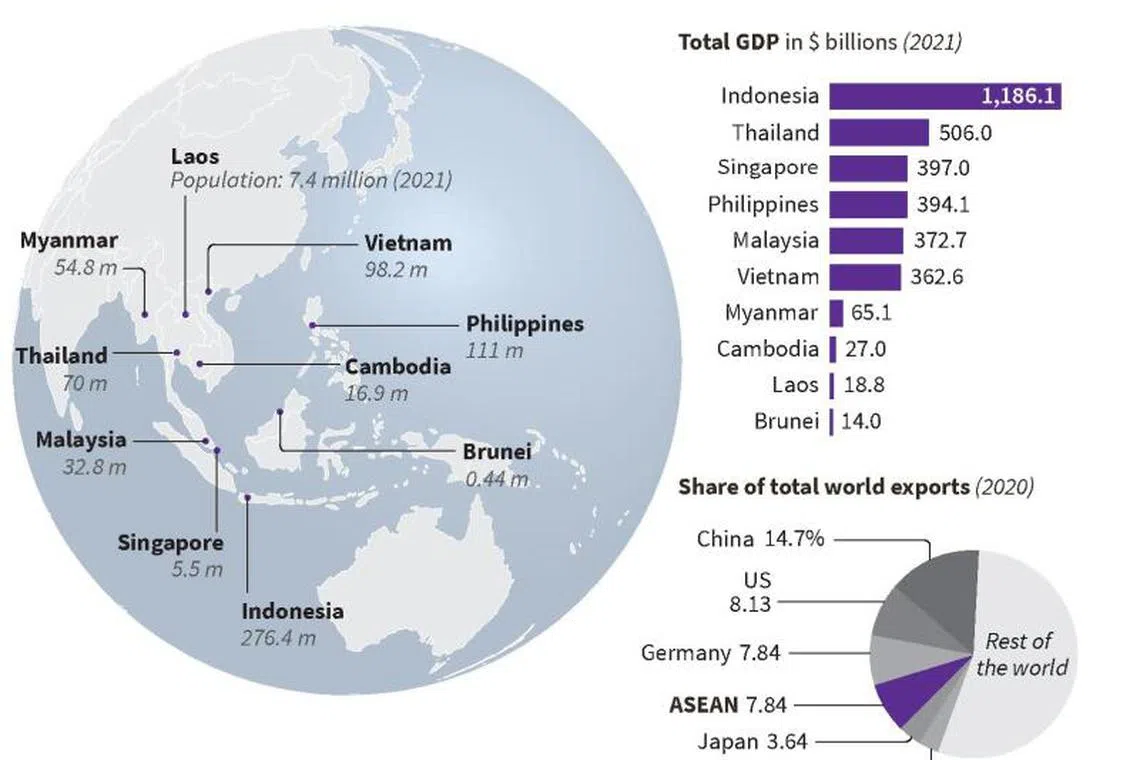
The results of the latest EU-Asean Business Sentiment Survey may be a litmus test for the business relationships between Europe and Asean. One thing remains certain – Asean is on track to become the fourth-largest economy in the world, and EU businesses cannot risk playing catch-up.
But things are not all that rosy. For all that Asean member states are doing to achieve their goal of becoming a single economic community, many European firms do not regard regional economic integration as a dealmaker for their businesses. Less than a third of those polled have business strategies based on the Asean Economic Community (AEC), with a significant number indicating there was not enough progress on the AEC to warrant such a regional strategy.
For Asean, this may be an important area to focus on in the coming years if Europe’s interest in the region is to have a more widespread impact. That said, the number of European companies who believe the AEC has had a positive impact on their business activity has grown year on year.
What they hope to see from Asean is more progress in harmonising standards and regulations; the removal of non-tariff barriers to trade; and simplified customs procedures for seamless flow of goods across borders. Such moves will deepen engagement between the two regions and lead to more economic opportunities.
These wishes were also raised in businesses’ responses as to what should be included in the upgrade of the Asean Trade in Goods Agreement (Atiga), along with a chapter on e-commerce. The main instrument driving the region’s economic integration efforts, Atiga is being reviewed to ensure Asean remains relevant and responsive to regional and global developments.
More trade deals
As with the last two years, European companies maintained their view that the EU should be accelerating negotiations on trade deals with Asean member states. There was also an overwhelming increase in those who thought that a comprehensive region-to-region free trade agreement (FTA) between the EU and Asean should commence now.
Businesses believe such an FTA would deliver more benefits than a series of bilateral deals, although it must be said that such a deal will be very difficult to achieve. Additionally, eight out of 10 respondents felt that more trade deals would help their businesses. As for which country the EU should next begin FTA negotiations with, Thailand topped the list yet again, as it did in 2021.
According to a report by McKinsey, emerging Asean economies have a higher chance of attracting new investment in labour-intensive manufacturing. As a whole, Asean has remained an attractive investment destination despite the decline in foreign direct investment (FDI) during the pandemic. In 2021, Asean attracted record levels of FDI from external sources.
Taking action on climate change
Given that the EU prides itself on being the world’s climate leader, it comes as no surprise that firms see sustainability issues as the area in which the EU has the most influence on Asean.
In recent years, the EU has increasingly tightened its climate change policies, some of which have caused rifts in diplomatic relations with its partners in Asean. Most recently, the European Parliament voted to widen a legislation to restrict the import of goods that come from supply chains associated with deforestation.
There is also a proposal to require companies to conduct human rights and environmental due diligence across the whole of their business. Even though these developments could upend business as usual, firms surveyed felt that overall, the EU’s sustainability policies would have a positive impact on Asean.
In fact, Bain & Co reports that developing South-east Asia’s green economy could provide up to US$1 trillion in annual economic opportunities by 2030.
On the other hand, most respondents in the EU-Asean Business Sentiment Survey felt that Asean as a region was not serious enough about meeting sustainability goals, and that the goals themselves were not ambitious enough. Among Asean countries, Singapore leads the list with an 86 per cent approval rating on meeting sustainability goals and was the only country with a positive rating for the ambition of its goals.
Only a fifth of respondents felt that ESG principles were sufficiently well-incorporated into sustainability initiatives in Asean. Asked to assess how well the region is doing on climate action issues, respondents gave Asean a mere 4.2 out of 10. This suggests European businesses feel strongly that the region needs to be doing much more. In a similar vein, the report by Bain & Co noted that no Asean nations were among the top 40 in the rankings for attaining Sustainable Development Goals.
Green supply chains are a clear and tangible climate issue. Asean has ambitions to attract a greater share of global supply chains, but just 3 per cent of respondents felt that the region is doing enough to attain this goal. A common sentiment was that there is a discrepancy between climate target-setting and the follow-up actions taken, if any. The same sentiment applies to the concept of the circular economy, with only 9 per cent saying they had confidence in Asean’s ability to deliver on it.
Climate action must be taken more seriously, not just for economic benefits, but because every region needs to play its part in the global fight against climate change.
European businesses continue to see Asean as the region with the best business prospects over the next five years, but there is continued doubt about regional integration, non-tariff barriers and trade. It is imperative that both the EU and Asean do not fall prey to complacency, and instead focus on these strategic aspects of change. Equally important, if not more so, is the region’s sustainability agenda and its ability to do its part in the fight against climate change.
The writer is the executive director of the EU-Asean Business Council.