Asean’s China trade play: buy less, sell more amid US tensions
The country is ramping up efforts to strengthen economic ties with South-east Asia, as shifting trade dynamics and geopolitical pressures reshape regional supply chains
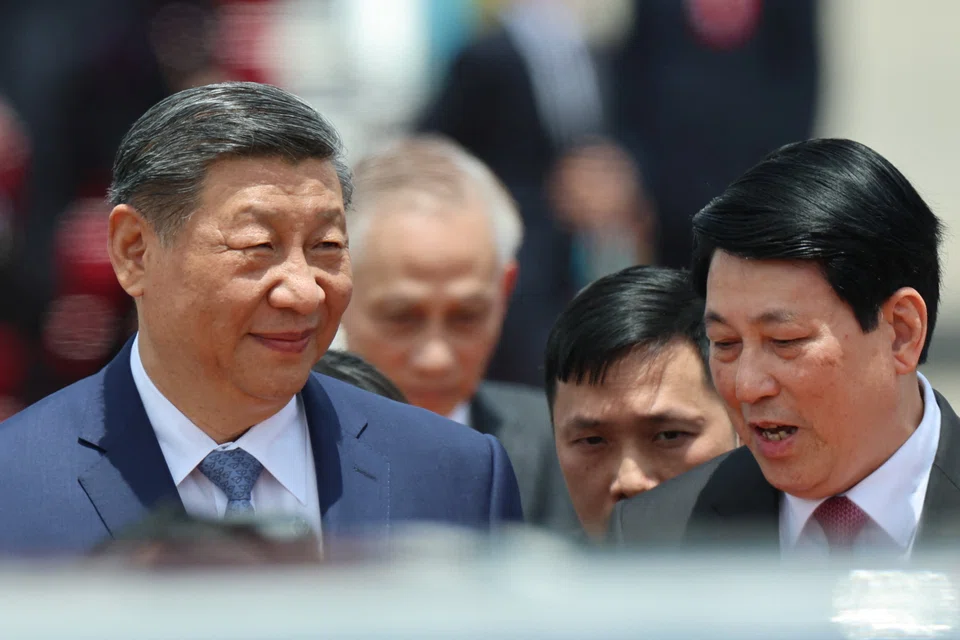
[HO CHI MINH CITY] Chinese President Xi Jinping’s visits to Vietnam, Malaysia and Cambodia this week signal a push by Beijing to deepen supply chain and trade ties with South-east Asia. This comes as the region is navigating rising US tariff threats and scrutiny over its role in global transhipment routes.
Amid rising geopolitical tensions, China is extending its offer as a major import market and key regional supply chain node for Asean’s 10 member states. Meanwhile, some countries in the bloc – under pressure to address the US’ concerns over origin fraud – are weighing barriers on some Chinese trade.
The shifting dynamics are putting Asean in a delicate position. It is caught between its two largest trading partners – the US and China – while trying to preserve its appeal as a stable, open trade hub.
“Beijing is likely to expand imports from Asean markets, driven by both strategic and economic imperatives,” said Chiew Le Xuan, research manager at global technology advisory group Omdia.
He added that deeper regional integration helps China expand its influence, diversify supply chains, and boost market access via production and re-export hubs in Asean.
“This also allows them to stay price-competitive while meeting rising global demand, especially as origin-based tariff rules incentivise localised sourcing and production within the region,” Chiew noted.
While Vietnam, Malaysia and Cambodia have gained from the “China plus one” supply chain shift, they remain under US scrutiny for allegedly serving as transhipment points for China-US trade.
Vietnam recently said it will crack down on trade fraud, while Malaysia cautioned Chinese companies not to use it as a base to “rebadge” products.
On Apr 2, the White House imposed reciprocal tariffs on about 90 countries, including nine Asean members, then paused them for 90 days for most countries – excluding China, whose duties rose to 125 per cent.
Vietnam is especially exposed to the tariffs, with a US$123.5 billion trade surplus with the US last year. It is the world’s third largest, surpassing the combined surpluses of all other Asean nations.
While Hanoi is holding talks with Washington for a separate trade deal in the hopes of reducing the tariff hike in the coming months, it signed dozens of other agreements with Beijing on Monday (Apr 14), including on production, supply chains and railways.
US President Donald Trump described the meeting between Vietnam and China on Monday as an attempt to hurt the US.
“When the trade war intensifies, there are pressures from both sides to force Vietnam to pick a side,” Nguyen Khac Giang, a visiting fellow at the Iseas-Yusof Ishak Institute, said during a recent webinar, adding that wiggle room is narrowing very quickly.
“There would be a need for Vietnam to work with Asean as a group in order to secure strategic autonomy, both in terms of economic cooperation and political alignment,” he added.
Asean economic ministers last week released a joint statement underlining their common intention to engage in dialogue with Washington to address trade-related concerns, as well as not to impose retaliatory measures in response to US tariffs.
China gap widens, US surplus grows
In recent years, China has redirected exports from the US and Europe towards Asean, making the two each other’s largest trading partners.
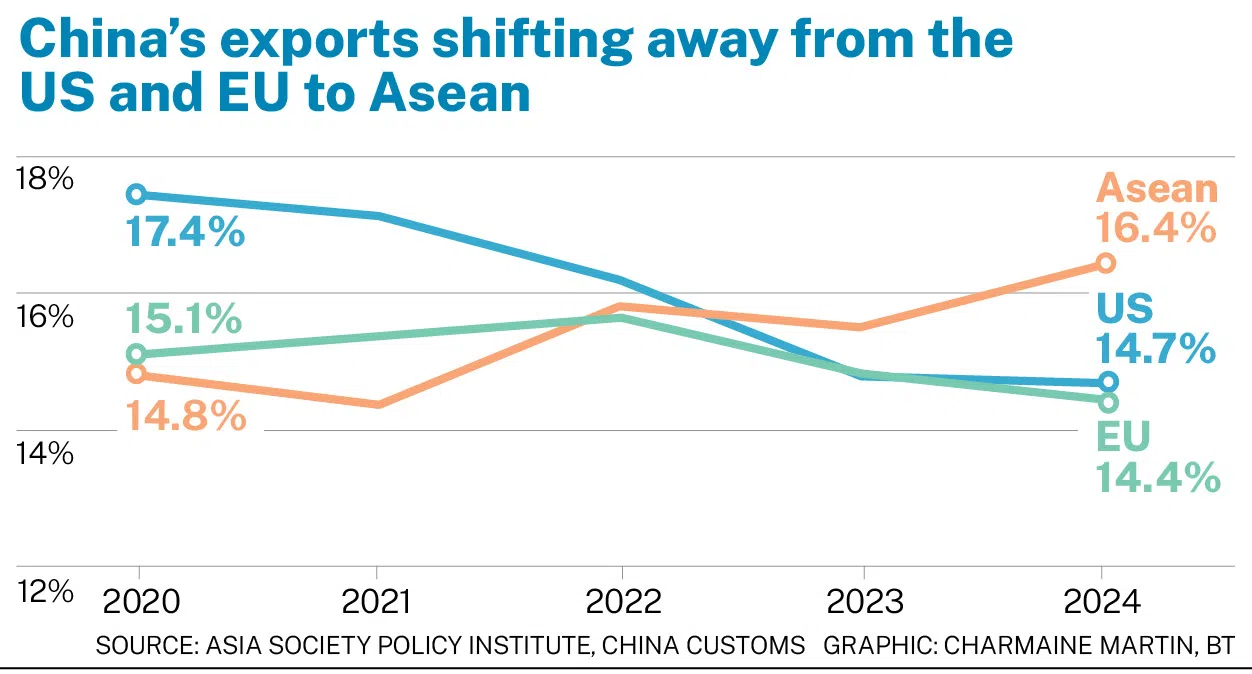
Although China is now Asean’s top export market, shipments to China grew just 2 per cent in 2024, while Chinese exports to the region – mainly intermediate goods – rose 12 per cent.
The bloc’s deficit with China doubled to more than US$190 billion during the 2018-2024 period, in stark contrast with Asean’s sizeable surplus with the US that rose nearly three times to US$228 billion.
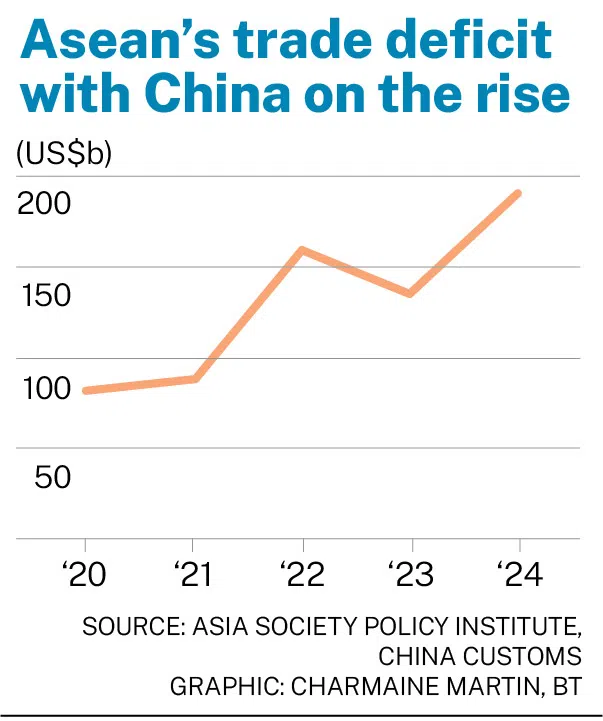
While China’s excess capacity, amplified by production shifting away from the US, may squeeze margins for South-east Asian producers, Beijing is expected to roll out major stimulus soon to spur domestic consumption, said HSBC chief Asia economist Frederic Neumann.
“This could, in turn, alleviate deflationary pressures from China, and offer export opportunities from South-east Asian producers to mainland China,” he added.
Giang from Iseas said China could deepen ties with Asean by curbing low-cost goods dumping and increasing imports as it pivots to a consumption-driven economy. “If China wants to be a responsible superpower, it should open the market to acquire more goods from South-east Asian economies,” he added.
On Monday, Xi signalled China’s willingness to boost high-quality imports from Vietnam and backed Chinese investment in the country.
Asean remains a key supplier of agricultural and energy products to China, including fruit from Thailand and Vietnam, and coal and tin ore from Indonesia and Myanmar. Analysts say the region is also well-placed to grow exports in sectors such as semiconductors from Malaysia, batteries from Indonesia, and vehicle parts from Thailand.
While Asean’s growing exports to China help diversify market exposure, they also present risks, said Mickael Driol, chief executive at Shanghai-headquartered Mekong Partners, which specialises in commodities sourcing from China and Vietnam. “China’s use of non-tariff barriers – such as sudden phytosanitary checks or opaque customs delays – poses risks,” he said.
Key supply chain node
Yap Kwong Weng, chief executive at Vietnam SuperPort, a logistics hub led by Singapore’s YCH Group, said global companies are increasingly near-shoring production to cut shipping costs and reduce supply chain risks.
“They would also need to look at shifting sourcing manufacturing to tariff-friendly regions such as Asean and other emerging markets to reduce dependency,” he added.
This has motivated YCH to establish across the region a network of multimodal ports and logistics assets – including Vietnam Superport along the railway linking China and Vietnam – to capitalise on the growing Asean-China and intra-Asean cargo flows, Yap said.
Since US-China tensions flared in 2018, Chinese manufacturers and suppliers have expanded across Asean, drawn by the region’s competitive labour costs, improving infrastructure and a growing skilled workforce.
Last year, Greater China launched more than 1,500 investment projects in Vietnam worth US$6.1 billion, accounting for 45 per cent of all foreign-invested projects and a third of total newly registered capital.
Cambodia followed closely, with Phnom Penh approving 414 Chinese projects totalling US$6.9 billion, nearly half of the country’s foreign investment.
Despite the threat of steep US tariffs, a major pullout of Chinese manufacturers from Asean countries is unlikely in the short term, as high US duties on China enhance South-east Asia’s relative competitiveness, analysts say.
There is also optimism for higher-quality Chinese investment in Asean amid growing rules-of-origin compliance. “However, there is a risk that lingering tariff uncertainty may curtail some investment until businesses receive greater, long-term clarity as to the eventual tariff regime,” HSBC’s Neumann said.