Asean Business logo
SPONSORED BYUOB logo

Asean’s Digital Economy Framework Agreement will ensure no SMEs, MSMEs left behind, says Malaysian minister

DEFA may be finalised by this September or October; implementation aimed for 2026

Summarise
Tan Ai Leng
Published Wed, Mar 12, 2025 · 12:40 PM
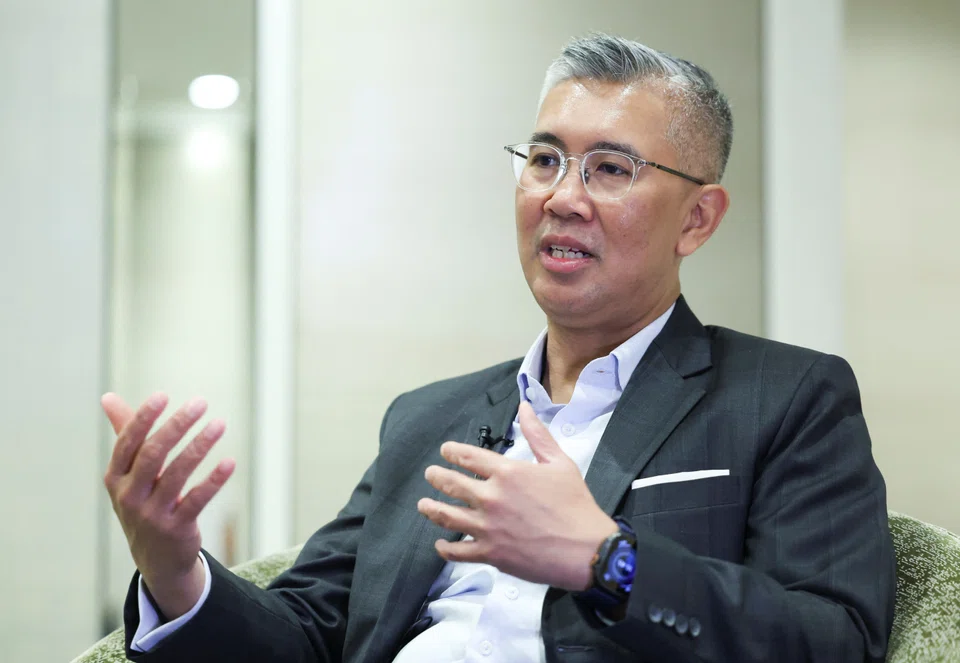
    • Malaysia’s Investment, Trade and Industry Minister Tengku Zafrul Aziz notes the Digital Economy Framework Agreement will ensure that SMEs can also benefit from trade liberalisation.
    • Malaysia’s Investment, Trade and Industry Minister Tengku Zafrul Aziz notes the Digital Economy Framework Agreement will ensure that SMEs can also benefit from trade liberalisation. PHOTO: REUTERS

    [KUALA LUMPUR] The efforts by South-east Asia to enhance trade and digital integration will ensure that more than 70 million small and medium-sized enterprises (SMEs) and micro-SMEs (MSMEs) are not left out, Malaysia’s Investment, Trade and Industry Minister Tengku Zafrul Aziz said on Tuesday (Mar 11).

    Speaking at the UK-Asean Business Forum in London, Tengku Zafrul expressed optimism about finalising the Asean Digital Economy Framework Agreement (DEFA) by September or October this year, aiming for implementation by 2026.

    “The numbers are significant. If we can get this started by 2026, we’re looking at US$2 trillion of trade using e-commerce by 2030,” he said.

    Tengku Zafrul noted that digital transformation will also be a priority for Asean, with a strong push for the adoption of e-commerce, fintech, artificial intelligence and cybersecurity.

    However, he stressed that beyond digital integration, logistical and regulatory alignment – including customs and payment gateways – must also be addressed.

    “We need a whole-of-government approach from each country to ensure our companies can leverage this agreement. My concern is that we make these announcements, but participation remains low. Education and awareness are crucial to getting SMEs involved,” he added.

    He also emphasised the importance of continuous engagement between Asean and the UK in expanding business opportunities and deepening the strong economic ties that have been built. This includes both government-to-government cooperation and business-to-business partnerships.

    SMEs key to Asean trade growth

    Asean, a region deeply integrated with global markets through trade and foreign direct investments, recorded total trade of US$3.5 trillion in 2023, with a trade surplus of US$96.7 billion, up 24 per cent from the previous year.

    Intra-Asean trade made up 22.1 per cent (US$759 billion), while the remaining 77.9 per cent (US$2.8 trillion) was with external partners.

    Despite the region’s economic growth, Tengku Zafrul noted that SMEs have not significantly benefited from Asean’s trade agreements.

    “We have seen trade improving among Asean member states, but SMEs feel excluded from the Asean Trade in Goods Agreement (ATIGA). With DEFA, we want to ensure SMEs – 99 per cent of registered businesses in South-east Asia – can also benefit from trade liberalisation,” he said.

    Asean’s gross domestic product stands at US$3.8 trillion, growing at 4 per cent to 5 per cent annually. The bloc has a population of 680 million – nearly half of whom are under 30. Tengku Zafrul emphasised that Asean must capitalise on this demographic advantage by ensuring inclusive participation in trade initiatives.

    An Asean task force to engage with US

    On the US tariff and other protectionism policies, he said Malaysia will continue its engagement with the US Department of Commerce.

    “One of the concerns for the US is that Asean is being used as a destination as a support from other countries to export goods to the US – cheap goods or subsidised goods,” he told the audience at a separate panel discussion.

    He noted that during the recently concluded Asean Economic Ministers retreat, all ministers agreed that all Asean member states should form a task force to look at how Asian engages the US as one voice.

    Malaysia’s Asean chairmanship

    As Asean chair in 2025, Malaysia will set key Priority Economic Deliverables to deepen economic integration, drive sustainable growth and accelerate digital transformation.

    One of the key milestones will be the third upgrade of ATIGA to enhance regional trade. “Malaysia also aims to strengthen supply chain resilience in high-impact industries such as semiconductors, renewable energy and tourism,” he said.

    Malaysia will champion initiatives such as the Asean Sustainable Investment Guidelines and the Asean Centre of Excellence for MSMEs in green transition, promoting best practices for sustainable investment and business growth.

    While challenges remain in harmonising policies across Asean’s diverse economies, Tengku Zafrul emphasised that regional collaboration is essential to sustaining growth.

    “Asean must remain agile, proactive and strategic in navigating global uncertainties. By leveraging our strengths and ensuring inclusive growth, we can solidify our position as the world’s fourth-largest economy by 2030,” he said.