


Asean Business logo
SPONSORED BYUOB logo

Asean’s supply-chain charm wears thin under Trump’s tariff wrath

Once key winners in the China-plus-one shift, South-east Asian economies are now on the back foot

Summarise
Goh Ruoxue
Published Thu, Apr 3, 2025 · 09:52 PM
    • Unlike during Trump's first presidency, South-east Asia is now directly in the firing line for aggressive and high levies, says an analyst.
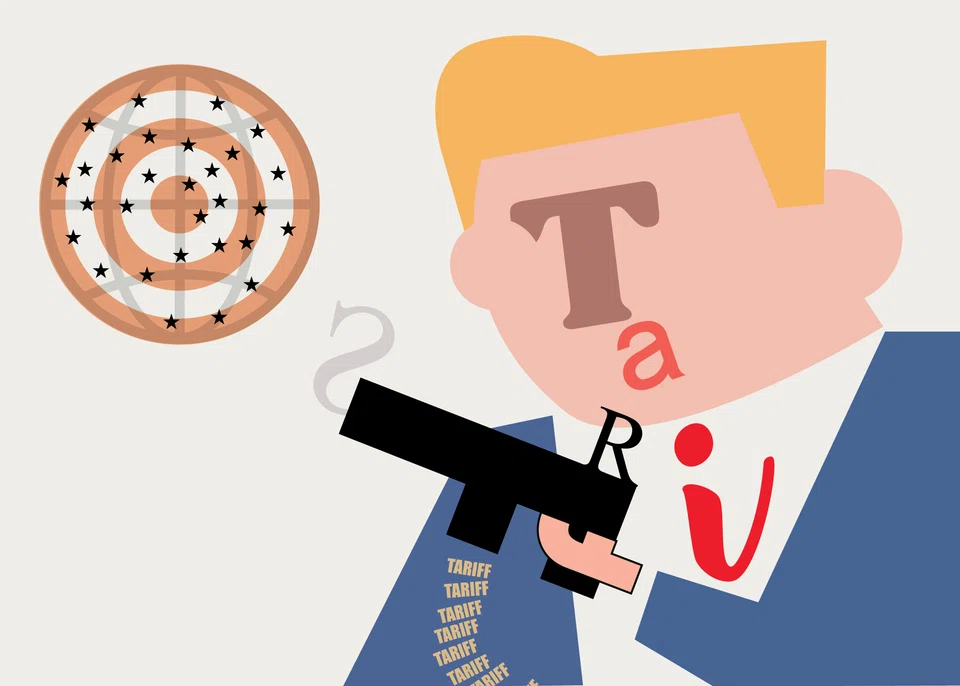
    • Unlike during Trump's first presidency, South-east Asia is now directly in the firing line for aggressive and high levies, says an analyst. ILLUSTRATION: SIMON ANG, BT

    [SINGAPORE] Export-reliant South-east Asia could lose its lustre as the darling of global supply-chain diversification, with US President Donald Trump announcing harsher-than-expected tariffs on its trading partners.

    Asean member states were blitzed by levies announced on Wednesday (Apr 2), ranging from the baseline 10 per cent tax on all American imports to additional reciprocal duties that bring the final tariff to as high as 49 per cent.

    For comparison purposes, the European Union was slapped with a 20 per cent tax.

    Said Katrina Ell, director and head of Asia-Pacific Economics at Moody’s Analytics: “These latest tariffs are a massive blow for South-east Asia, where exports are the backbone of the region, and the US is a large – if not the largest – single destination for goods.”

    The region’s dependence on the US as a final destination for goods has been growing in recent years, she noted, as evidenced by the increasingly large trade surpluses that economies such as Vietnam and Thailand have run up with the world’s biggest economy.

    Ell added that unlike during Trump’s first presidency, the region is now directly in the firing line for aggressive and high levies.

    “Trump’s latest tariff policy has made it crystal clear that Asean is no longer a viable alternative to circumvent tariffs on China,” she told The Business Times.

    As the trade war between the world’s two largest economies intensified, South-east Asian nations had risen as attractive options for Chinese companies seeking to bypass US restrictions, or firms adopting a China-plus-one strategy to diversify their supply chains.

    That shine could soon fade.

    Maybank’s regional co-head of macro research Chua Hak Bin said the China-plus-one story was not dead, but agreed that it may have been put on pause.

    The economist noted: “Multinational corporations will think twice about future foreign direct investment because of the overnight turn in the tariff handicap and excess global capacity that will be displaced from the new US tariff wall.”

    Listing Vietnam as an example, he pointed out that firms which relocated there from China now face high reciprocal US duties of 46 per cent, which narrow the tariff divide with China significantly.

    For China, the final tariffs amount to more than 65 per cent when taking into consideration the freshly announced tariffs of 34 per cent and the 20 per cent levied since March, on top of existing average tariffs of some 10 to 15 per cent.

    OCBC economists, in a note issued on Thursday, agreed that China’s prior strategy of routing exports through Asean may now be less effective.

    “The trade dynamic may shift again, potentially driving China to pivot more of its exports directly to North America, despite the broader tariff environment,” said OCBC Global Markets Research.

    First-order consequence: Growth hit

    Economic growth is expected to take a beating, and research houses across the board are downgrading their growth forecasts for most South-east Asian economies.

    J Safra Sarasin, a private Swiss bank, said in a flash report that the new tariffs are “big growth headwinds” for small Asian economies, the most affected among which include Vietnam, Thailand and Malaysia.

    OCBC economists, in a report on Thursday, lowered 2025 growth forecasts for Vietnam to 5 per cent from 6.2 per cent; Thailand to 2 per cent from 2.8 per cent; and Malaysia to 4.3 per cent from 4.5 per cent.

    Maybank’s Dr Chua cautioned that Asean will have to find new growth opportunities from the region and non-US markets.

    Since the first Trump administration in 2017, member nations of the South-east Asian alliance have diversified their trading partners, intensified ties with other economic blocs and jacked up intra-regional transactions.

    All of these put it in a much better position to shield itself from a full-blown fallout.

    Stephen Olson, visiting senior fellow at the Iseas-Yusof Ishak Institute, said that regional trade pacts will take on greater importance as a “safe harbour” from US protectionism if tariffs are increased, which he noted the executive order explicitly provides for.

    “The CPTPP (Comprehensive and Progressive Agreement for Trans-Pacific Partnership) could prove to be especially important, with additional countries likely to express interest in joining it as the US heads in a protectionist direction,” he added.

    But Ell of Moody’s Analytics noted: “Bilateral trade agreements and finding alternative markets can only work at the margins, as there are insufficient alternatives to replace the US as a destination for final demand.”

    Not cast in stone – yet

    Nevertheless, pundits broadly agree that there is still room for mitigating factors, with a potential for upside.

    Goldman Sachs analysts added in a research note that a portion of the reciprocal tariffs could be negotiated down, if targeted countries offer reductions in their own tariff rates or commit to purchasing more American goods, among other efforts.

    Ben May, director of global macro research at Oxford Economics, added that besides any concessions offered by governments to the US, the second main upside risk would be Trump rowing back “on his plans of his own accord, perhaps as a result of asset market sell-offs or a run of weaker data”.

    This would not be a major surprise, given that Trump has delayed the imposition of major hikes on Canada and Mexico and introduced exemptions, he added.

    Olson concluded: “Some countries might succeed in getting their tariffs removed, while others could conceivably see their tariffs escalated.

    “But it’s hard to imagine any scenario in which the region does not continue to play an important role in regional and global supply chains.”



