



Just what the doctor ordered: Thailand pivots from Middle East medical magnet to longevity sanctuary
The kingdom has long had a firm grip on South-east Asia’s medical tourism crown, but with Malaysia and Vietnam nipping at its heels, Thailand makes a charge for wellness. This is Part 3 of our series on Asia’s booming medical tourism.

SAIL into the sunrise along the Chao Phraya River with a plate of pad thai, then shop till you drop before smoothing out those forehead lines with a quick cosmetic treatment. Finish it all with dental care and a full-body health screening – and watch yourself look eight years younger, all before the clock strikes 12.
Thai hospitality is on a whole new echelon.
Crowned South-east Asia’s largest medical tourism revenue contributor, Thailand – where tourism accounts for about 12 per cent of its gross domestic product – has consistently drawn millions of foreign visitors year after year.
Thailand raked in a whopping US$850 million in medical tourism revenue in 2023, almost twice that of second-place contender Malaysia (US$444 million) and more than treble that of Singapore (US$250 million).
In 2023, the kingdom courted the highest number of international patients since the pandemic with some 2.86 million medical tourists visiting. The figure is expected to grow to 3.07 million in 2024, said an RHB report.
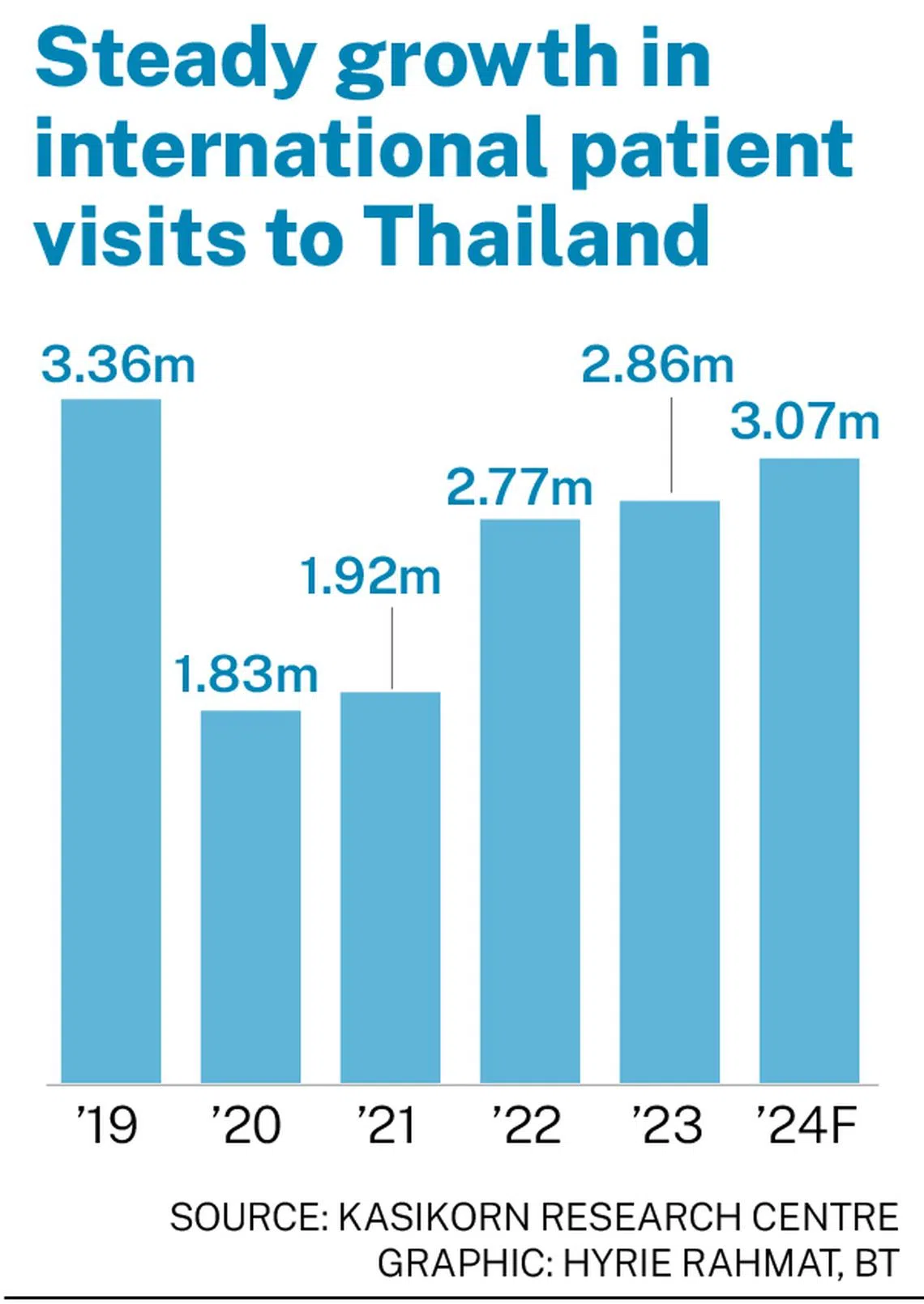
About 52 billion baht (S$2 billion) or US$1.5 billion in revenue was generated that same year.
For 2024, total revenue is expected to ramp up to 57 billion baht, driven by the ongoing recovery in tourism, with fly-in patients expected to account for 49 per cent of all foreign patient visits, up from 45 per cent in 2023.
About a quarter of the treatments sought after in Thailand were cosmetic in nature, followed by dental care and orthopaedic services.
Treatment types

- Cosmetic: 26%
- Dental care: 18%
- Orthopedic: 15%
- Cardiovascular cases: 12%
- Cancer: 11%
- Neurological: 11%
- Fertility: 8%
Gateway to Gulf health
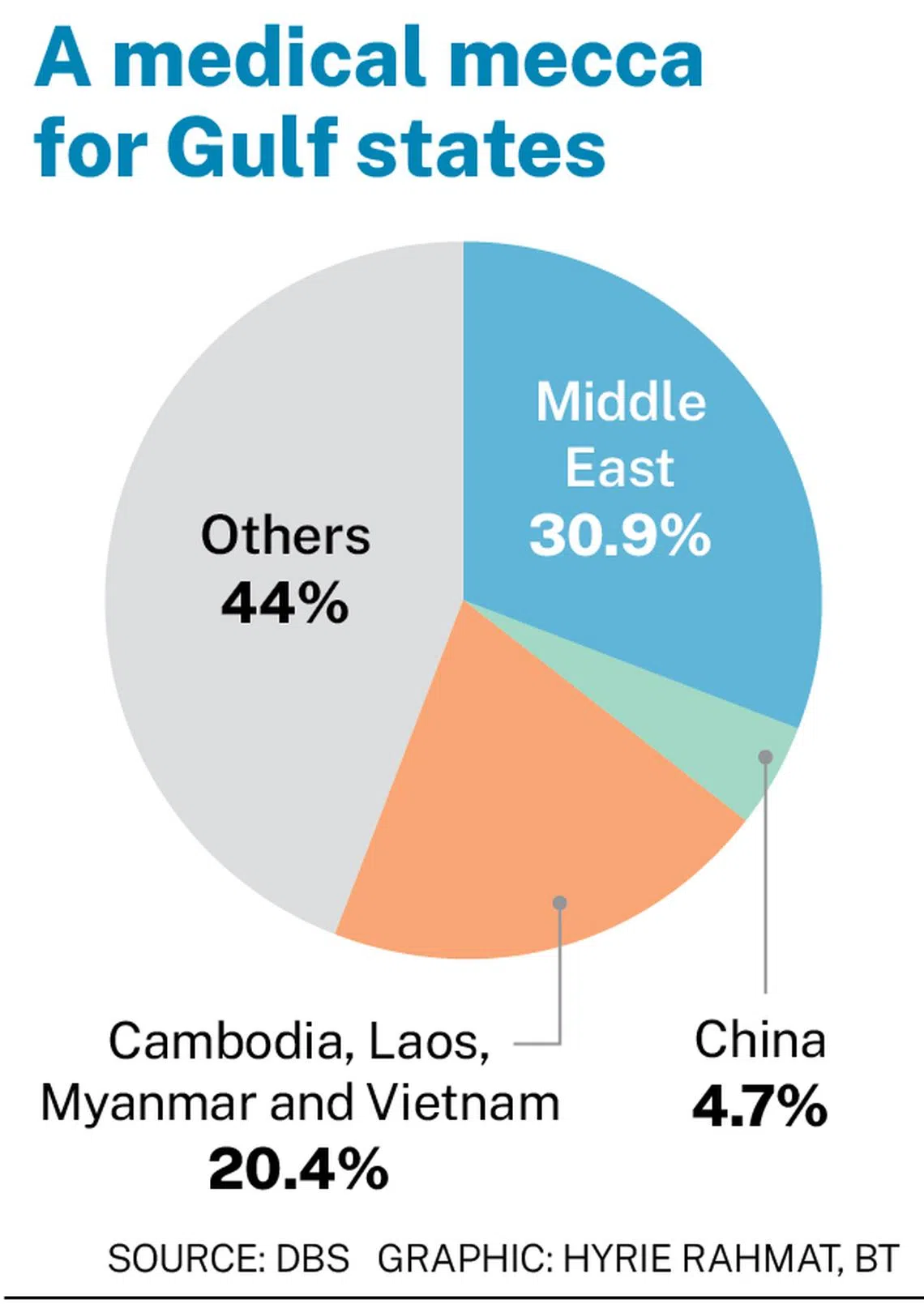
Notably, the Middle East – think Kuwait, Oman, Qatar and the United Arab Emirates – is the top source market for leading Thai healthcare institutions, accounting for more than a quarter of their foreign patients.
The next largest batch comprises medical tourists from Cambodia, Laos, Myanmar and Vietnam, followed by the Chinese and the Americans.
Founder and chief executive Henning Kalwa of Bangkok-based medical facilitator ImagineHealth explained that the tide of Middle Eastern patients swelled after the 9/11 attack when Arabic patients felt less comfortable travelling to the West for medical services.
“Thailand stepped up – very smart, very fast... The stream that was going to the Western world prior, much of it was suddenly coming to Thailand (and) it continuously grew from there,” he said.
Added Kalwa: “This whole ecosystem of hospitals then developed.”
Krungsri Research added that Middle Easterners receive health benefits from their governments or respective employers and agencies. Conditions treated are often complex, require specialised expertise and cannot be adequately addressed in home countries.
And so, deals are worked out with leading healthcare providers and clinics in Thailand. For instance, Thailand and Saudi Arabia in January pledged to cooperate on health security as well as medical and wellness tourism.
Derek Halpern, founder and managing director of medical facilitator Health Tours Thailand, told The Business Times: “The industry very much caters to (the Middle Easterners).”
“At the hospitals, often they’ll have separate wards for Arabic patients or coffee places for them (and) you have Arabic translators everywhere,” he said. “The Thais have carved out an industry for them.”
Halal meals and prayer rooms are often offered in hospitals and clinics across the kingdom.
Lure of the Land of Smiles
It is not hard to understand why Thailand is miles ahead of the competition as the list of its competitive advantages is by no means a short one, pundits say.
The way Dr Hishamuddin Badaruddin, founder and chief executive of Singapore-based primary care Bartley Clinic, sees it, big hospitals there have “gotten it down to an art form”.
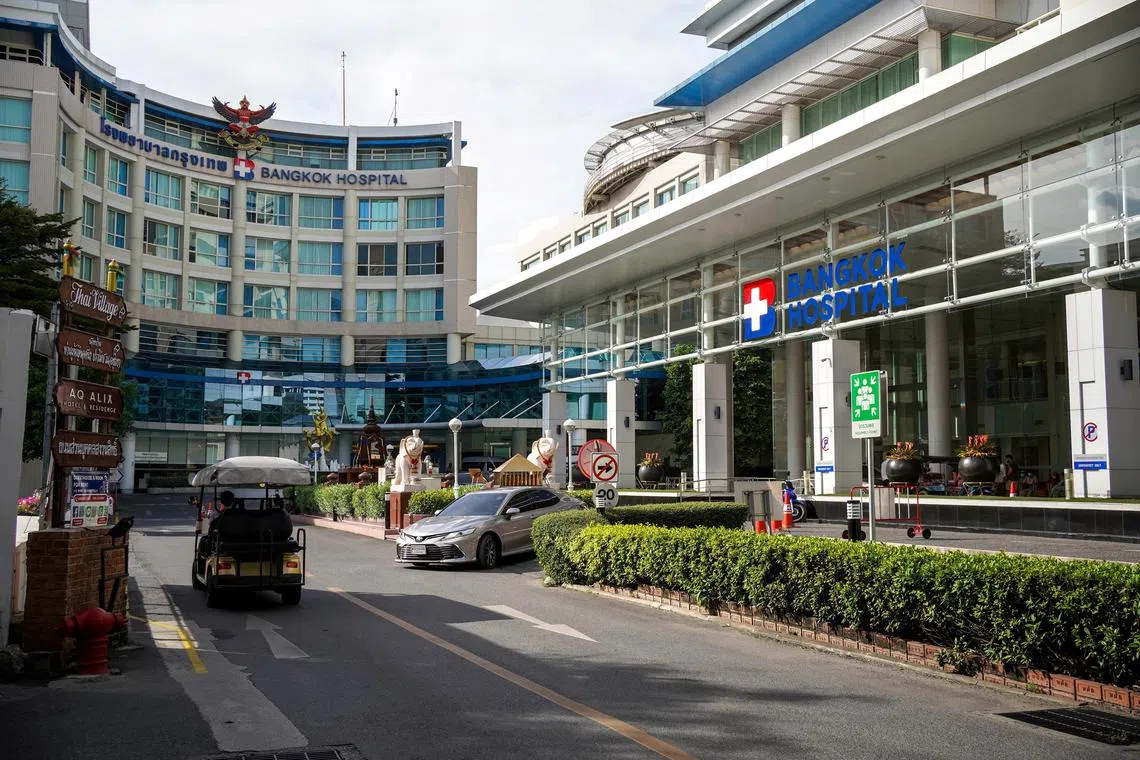
Airport pickups, pre-travel advisory, translation, accommodation and meal arrangements are just some of the basic services offered by leading Thai private healthcare providers such as Bumrungrad Hospital and Bangkok Dusit Medical Services.
“It’s more than just the facilities; you get the whole package,” explained the public health specialist.
Beyond just leveraging its expertise and reputation as a tourist hub with the promise of unparalleled hospitality, the kingdom also made a name for itself in offering high-quality services at competitive prices.
“Thailand is by no means the cheapest country. But the quality is very good,” said ImagineHealth’s Kalwa.
The German-born expert explained that while countries such as India face brain drain as medical practitioners seek opportunities abroad, Thai physicians – internationally trained, highly skilled and fluent in English – often return home.
“They return because they love their country, they love their families... and, of course, they make a lot of money too in comparison, so they have no reason to go to London or New York,” he noted.
The quality of medical tourism in the country speaks for itself, said analysts.
Thailand has more than 60 medical institutions accredited by the Joint Commission International – globally recognised as the gold standard in international healthcare. In comparison, Singapore and Malaysia currently have more than a dozen or so such institutions each.
Yet the kingdom is able to offer affordability without compromising on quality.
A patient from the US could see lower treatment costs by some 50 to 75 per cent in Thailand, versus 60 to 80 per cent in Malaysia, and 25 to 40 per cent in Singapore, depending on treatment type, said RHB analysts.
A face lift, a heart bypass or a spinal fusion in Thailand could cost up to a tenth of that in the US.
The average cost of a knee replacement done in the kingdom is roughly a quarter of that in the US, while in vitro fertilisation treatment per cycle is about a third of American prices, according to the bank’s research.
Long waiting times at hospitals in developed countries such as the US are also driving medical tourists across borders into Thailand.
Policy push
Thailand’s strengths also extend to the promotion of investments in cutting-edge medical technology.
The country’s investment board offers incentives, including corporate tax and import duty exemptions, along with streamlined regulations to attract international medical equipment businesses, said the RHB report.
With healthcare expenditure on the rise, the Thai government has implemented a 10-year plan (2017 to 2026) to position the nation as a global medical hub.
The appeal is clear – while the average spend for a regular international tourist is around US$1,600, an international medical tourist spends more than US$5,000, underscoring the government’s vested interest, noted Kalwa.
Medical visa regulations have been relaxed, with lower application costs and extended stay periods for international patients. The government is also considering extending the validity of its multiple-entry medical treatment visa to a year, up from the current 60 or 90 days per entry.
What’s next?
Demographically, there is room for growth with Middle Eastern patients, said Tanawat Ruenbanterng, head of research at Tisco Securities.
“Middle Eastern patients actually slowed down in the first nine months of 2024, mainly from factors in those countries, such as Kuwait changing its policy on sending patients abroad, while the ongoing discussion with Saudi Arabia remains stagnant,” he explained.
Tanawat also sees opportunities in niche areas such as stem cell treatments, where Thailand has a distinct advantage in wellness.
He also noted that more medical companies offering wellness services are recently listing on the stock market. “Awareness of wellness products will be the key driver to watch,” he added.
ImagineHealth’s Kalwa concurs. The big story has always been the Middle East, he said, but countries such as Saudi Arabia are seeing heavy investments and building up their own healthcare infrastructure, which could shake things up.
Turkey is renowned for hair transplants, South Korea for plastic surgery, and Singapore for heart surgery. “Everyone has a story. Thailand needs to find an identity. I believe it’s longevity and the emergence of the wellness traveller,” he said.
Quest for quality living, eternal youth
Thailand is well aware of its charms. Industry players echo the view that the kingdom is fertile ground for medical innovation.
“Thailand has a legal framework that allows physicians to do more than in other countries,” said Kalwa. “Singapore is very strict for good reasons but in some cases, it is disadvantageous; while in Thailand, the physicians have more wiggle room.”
This wiggle room is often enough to justify flying into the kingdom and trying treatments that may not be available elsewhere, explained Kalwa, who is also the regional director of German healthcare accreditor Temos International.
But he stressed that the kingdom is not a Wild West.
The crux lies in a right to try, said Health Tours Thailand’s Halpern.
About half of his clientele go to him for stem cell treatments – a contentious and highly regulated field that is becoming increasingly popular in Thailand. Of the half, about two-thirds seek treatment for illnesses and diseases such as Alzheimer’s, while the remaining pursue anti-ageing remedies.
“It’s an advantage (for) Thailand to be involved with this industry. You get people that want to do treatments because they haven’t had success in traditional medicine,” said Bangkok-based Halpern.
“A big component of it is giving people the right to try something that might improve their lives,” added the New Yorker who has been living in Thailand for more than a decade.
Dr Hishamuddin concurs.
“Thailand is always at the forefront of bringing in new technologies and treatments,” said the former director and public healthcare leader at Deloitte.
He added that the country increasingly faces competition from its neighbouring peers, such as Malaysia – known for its fertility treatments – and up-and-coming Vietnam.
“One of the challenges would be remaining open and flexible, and offering new initiatives (while navigating) regulatory pressures,” he concluded.
Read more stories in BT’s Asia Health Haven series
Coming up next: South Korea
TRENDING NOW

ComfortDelGro appoints two new independent directors

Once staunchly pro-China, Malaysian Chinese businesses are now distancing themselves from Beijing

NoonTalk needs continued financial support from CEO Dasmond Koh, auditors warn

DP Architects sets the benchmark for sustainability disclosure and design

