Asean Business logo
SPONSORED BYUOB logo

Asia-Pacific contributing ‘reasonable part’ of Lenovo’s US$21 billion AI server pipeline

Growth is not driven just by mature markets as it positions itself as a full-stack provider, says Apac president

Summarise
Lionel Lim
Published Tue, Jun 23, 2026 · 02:00 PM
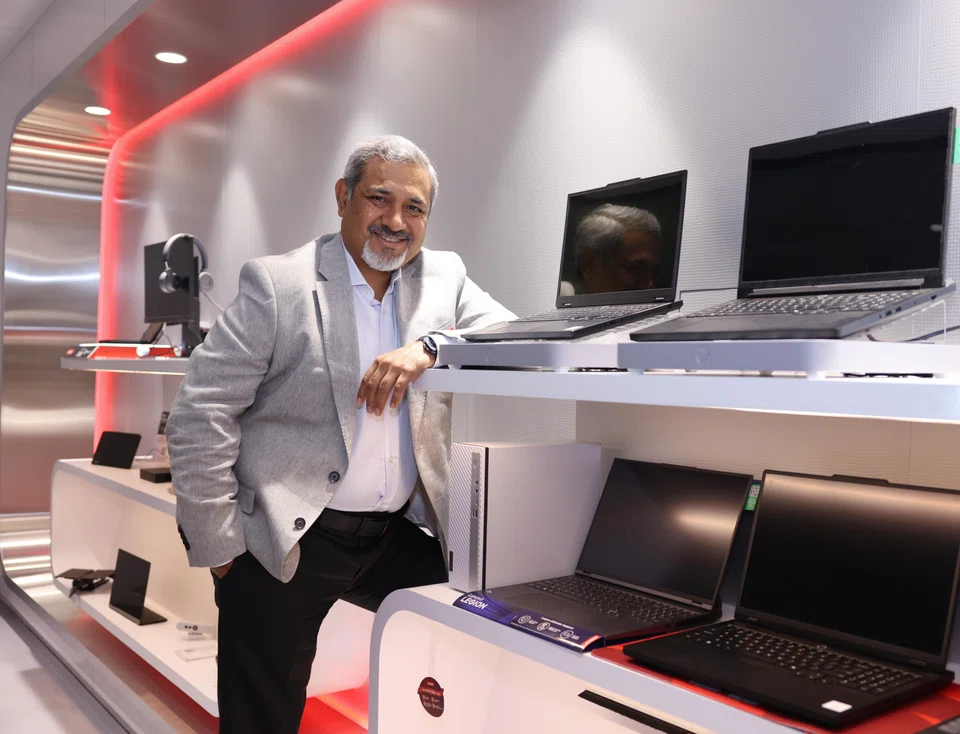
    • Amar Babu, president of Lenovo Asia-Pacific, says that the company is currently only in the first year of what he sees as a decade-long opportunity for it to capitalise on the AI wave.
    • Amar Babu, president of Lenovo Asia-Pacific, says that the company is currently only in the first year of what he sees as a decade-long opportunity for it to capitalise on the AI wave. PHOTO: TAY CHU YI, BT

    [SINGAPORE] Lenovo, which is probably best known for selling personal electronic devices such as laptops and tablets, wants to be known as more than the world’s largest PC company. It is now looking to evolve into a full-stack technology provider as it rides the artificial intelligence wave. 

    Amar Babu, Lenovo’s Asia-Pacific president, who was in Singapore recently to meet customers, told The Business Times that he thinks Lenovo is currently only in the first year of what he sees as a decade-long opportunity for the company to capitalise on the AI wave by offering its enterprise infrastructure, and services and solutions. 

    “Data within the enterprise is not going to be on the cloud because it’s got to be secure. Each enterprise’s data point... has got to be secure either on premises or in a private cloud,” he said. 

    And this is where Lenovo can play a part. Babu said the company has been investing heavily in its AI servers and services and solutions offering for years, and that the changing demands of how companies handle data is a market opportunity for Lenovo. 

    Babu revealed that Asia-Pacific is contributing a “reasonable part” of Lenovo’s US$21 billion AI server pipeline. Lenovo defines Asia-Pacific as the region excluding China. 

    He said that what excites him about the current AI opportunities is that demand is not only driven by mature markets such as Japan, Australia or Singapore, but even companies in emerging markets such as Indonesia, Thailand and India have been investing heavily in infrastructure and services that can power AI solutions. 

    Prioritising investments in AI

    In South-east Asia, companies are prioritising investments in AI and automation. The Business Times’ inaugural Asean Intelligence 2026 report, which surveyed more than 500 business leaders in the region, showed that 48 per cent of respondents ranked AI and automation investment as the top priority. This was followed by market expansion and IT and cybersecurity. 

    Lenovo also established a services and solutions business unit five years ago. Babu explained that the current AI developments represent an opportunity for Lenovo to stack its own AI-powered services and solutions on top of the personal devices and enterprise hardware it sells. 

    “We’re seeing enterprises adopt these solutions in many different ways. Some in legal marketing, some in customer service, manufacturing, logistics, warehouse management,” he said. He added that ST Logistics is one of Lenovo’s biggest customers in Singapore, as it leverages Lenovo’s robotic technology in its latest warehouse. 

    In recent years, Lenovo has positioned itself as a hybrid AI player offering solutions from its personal devices to AI servers, and AI-powered services and solutions. Lenovo’s share price is up more than 120 per cent year to date, similar to many other tech companies that have been benefitting from the AI boom. 

    “We realise AI is going to be different for different companies, based on their priorities. It’s also going to be different for different individuals, based on how they adopt AI. But we have the ability to tune, adapt and support... that journey,” he said. 

    Building up reputation as a personal device company

    The positioning for Lenovo to a full-stack provider comes after decades of building up its reputation as a personal device company. The Chinese company, which started in 1984, became a global PC heavyweight following its acquisition of IBM’s personal computer division in 2005 for US$1.25 billion. The acquisition included the iconic ThinkPad laptop. 

    Diversifying its revenue from personal devices could help insulate Lenovo from the cyclical nature of that sector. In addition, services and solutions represent higher profit margins for the company. 

    Personal devices still make up the majority of its annual revenue, as indicated in its financial results for FY 2025/2026 that ended on Mar 31, 2026. But growth for its enterprise infrastructure and services and solutions segment outpaced that of personal devices. 

    Revenue for its Intelligent Devices Group, which covers consumer and commercial hardware, rose 17 per cent year-on-year to reach US$58.9 billion. It accounted for 71 per cent of its US$83.1 billion revenue. 

    Revenue for its Infrastructure Solutions Group (ISG), which covers AI servers, rose 32 per cent year-on-year to reach US$19.2 billion. The business unit also turned profitable in FY 2025/2026.

    Revenue for its Solutions and Services Group (SSG), which covers managed IT services, rose 19 per cent year-on-year to reach US$10 billion. Profit margins for the SSG business unit was also more than 20 per cent compared to 6.9 per cent for the ISG business unit.