Asia’s trade corridors face ‘significant growth’ with Asean among main beneficiaries: Citi
Trade flows from North and East Asia to the Asean and South Asia regions rose by 44% between 2019 and 2024

[SINGAPORE] A report from Citi on Tuesday (Feb 24) noted that trade corridors in Asia are experiencing “significant growth” in recent times, with Asean emerging as a major beneficiary.
Both China and the US of late rely on a broader set of partners in trade – though transhipments may obscure underlying dependencies, said the analysts.
The report surveyed 800 supply chain finance suppliers. Among the respondents, 75 per cent experienced “moderate or no noticeable effect” from US President Donald Trump’s tariffs, while only 20 per cent cited “significant negative impacts”.
In particular, analysts from Citi said that the tariffs have failed to prevent China from increasing its goods trade surplus – the Asian superpower recorded a surplus of over US$1 trillion within the first 11 months of 2025.
While Chinese exports to the US have fallen sharply since the tariffs, exports to South-east Asia are currently growing at nearly double the pace of the past four years.
“Many experts believe a significant share of these goods are ultimately re-exported, often to the US,” the analysts wrote. They added that this realignment was already taking shape between 2019 and 2024, even before Trump’s tariffs in 2025.
For example, trade flows from North and East Asia (including China) to Asean and South Asia regions rose by 44 per cent during this period – marking a shift towards emerging markets.
Comparatively, flows from North and East Asia into the US rose more modestly at 32 per cent, indicating a diversification of China’s customer base and a repositioning within global supply networks.
Noticeably, China’s exports to the Asean and South Asia regions surged by 57 per cent between 2019 and 2024 as well, based on Citi’s data.


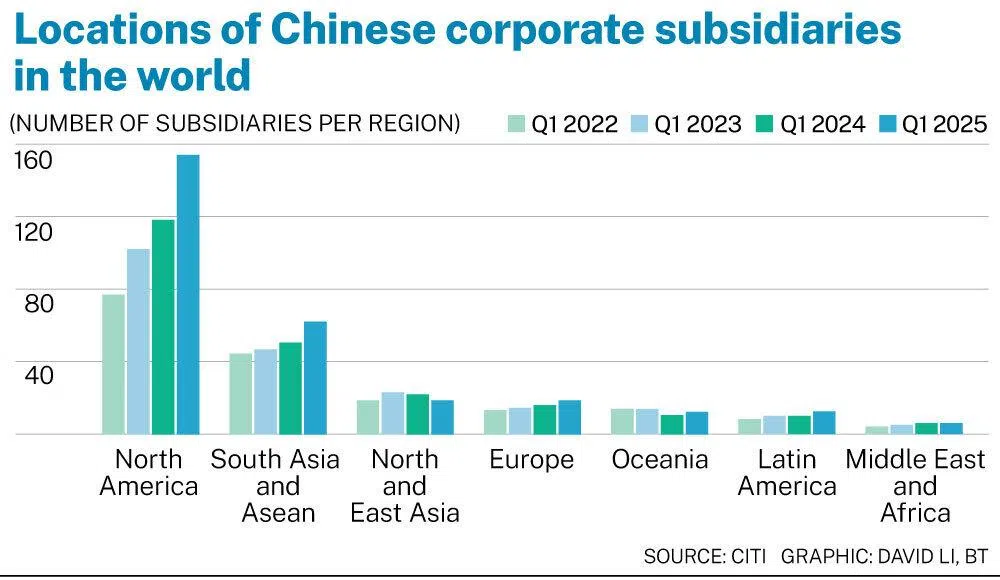
“Chinese parent companies have significantly increased their subsidiary presence in Asean and South Asia, with the number of active subsidiaries growing steadily between the first quarter of 2022 and Q1 of 2025,” said the analysts.
They added that regions with the highest export growth to the US – Asean and South Asia (up 51 per cent), and Latin America (up 40 per cent) – are also the same regions to which China has been exporting more in recent years.
“This strongly suggests that supply chains are being rerouted through intermediary countries – often with more favourable trade terms with the US – to facilitate continued Chinese exports,” the Citi analysts wrote.
New trade strategy by Chinese corporates
Such re-wiring of supply chains is increasing, flagged the analysts.
While Chinese parent companies have upkept a significant share of their subsidiaries in North America, they have also increased such presence in Asean and South Asia.
In a bid to navigate US trade, these companies are leveraging cheap manufacturing and beneficial trade policies in Asian countries such as Malaysia and Vietnam – despite relatively high US tariffs of 19 per cent and 20 per cent, respectively – as well as shorter supply chains from North American neighbours, such as Mexico.
“These overseas subsidiaries also help diversify operations, offering a buffer against sudden changes in country-specific trade policy,” they explain.
For one, Mexico alone currently hosts three times as many active Chinese subsidiaries than it did in 2022, said Citi’s analysts.
Correlation to Latin America
One region to look out for is perhaps Latin America, which experienced an 82 per cent surge in trade flows to the Asean and South Asia regions. They noted that the region has emerged as a “vital supplier” of critical minerals for Asia’s electronics industry, as well as an alternative to the US for agricultural products such as soybeans.
“It is also becoming more deeply integrated into Asia and North America-linked supply chains, with exports to North and East Asia up 39 per cent, and exports to North America up 43 per cent, from 2019 to 2024,” they wrote.
Amid less favourable conditions in North America, China is increasingly directing shipments of vehicles and parts exports to the region. “By 2024-2025, Latin America is one (of China’s) strongest growth destinations, with exports more than 200 per cent higher than in 2019,” said the analysts.
Decoding Asia newsletter: your guide to navigating Asia in a new global order. Sign up here to get Decoding Asia newsletter. Delivered to your inbox. Free.
Copyright SPH Media. All rights reserved.