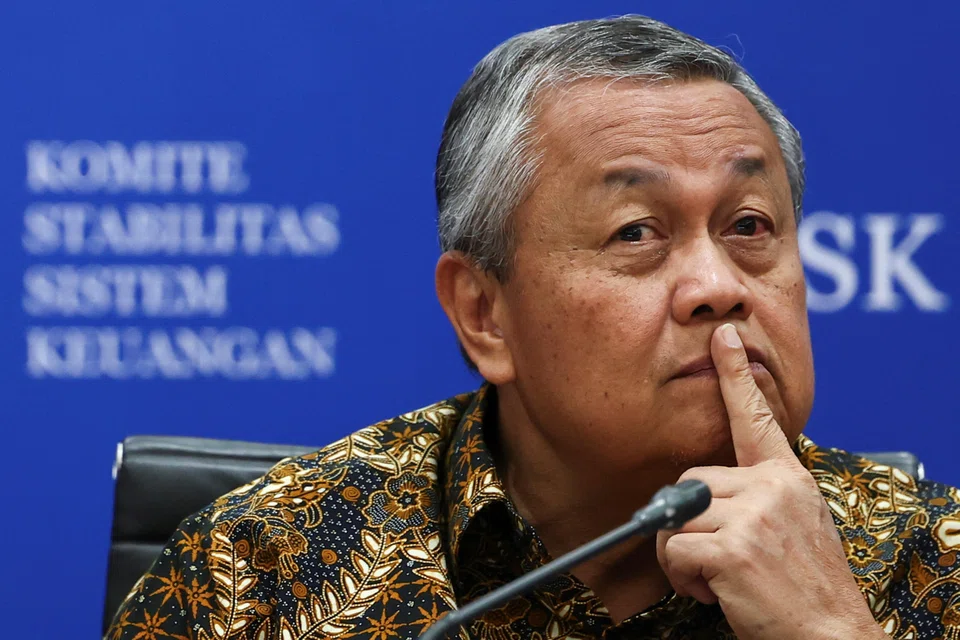
Bank Indonesia holds rates, signals focus on rupiah stability amid capital outflows
The rupiah has fallen 3.8% this year and is Asia’s worst-performing currency

[JAKARTA] Bank Indonesia (BI) held its benchmark rate on Wednesday (Nov 19) for the second consecutive meeting since October, signalling a renewed focus on stabilising the rupiah amid persistent capital outflows.
The central bank kept the policy rate at 4.75 per cent, in line with Bloomberg’s surveyed market expectations; it kept its other key rates steady –5.50 per cent for the lending facility, and 3.75 per cent for the deposit facility.
Governor Perry Warjiyo said the move underscores BI’s short-term focus on supporting currency stability and attracting foreign portfolio inflows.
He said at a media briefing: “Our short-term focus is on rupiah stability while strengthening the transmission of monetary and macro prudential easing measures implemented so far.”
He said BI will continue to assess the potential for further rate cuts, with inflation projected to remain within the 1.5-to-3.5 per cent target range for 2025 and 2026. The annual inflation rate rose to 2.86 per cent in October, the highest in 16 months, but well within BI’s target range.
“Additional reductions are expected to support stronger economic growth,” Warjiyo said.
BI is unlikely to use room for further monetary easing for now, as the yield gap between Indonesian and US government bonds remains narrow, said Helmi Arman, chief economist at Citibank Indonesia.
“The central bank is focused on maintaining the appeal of rupiah assets amid ongoing global uncertainty.”
The Indonesian currency has slumped 3.8 per cent this year, making it Asia’s worst-performing currency, with foreign outflows continuing to weigh on sentiment. Data from the Finance Ministry show that foreign investors had sold a net US$187.6 million in sovereign debt as of Nov 17.
The rupiah has maintained its position among the weaker currencies against the US dollar this year; the other currencies in the same boat are the Indian rupee, the Philippine peso and Vietnam’s dong.
Lloyd Chan, foreign exchange strategist at MUFG, expects the rupiah to remain an underperformer among regional peers, dragged down by persistent net foreign bond outflows.
“Since September, these outflows have nearly wiped out all the net inflows accumulated in the first eight months of the year, highlighting the currency’s vulnerability.”
The rupiah, which touched a daily low of 16,755 rupiah against the US dollar in the spot market on Wednesday, rebounded to strengthen at 16,703 rupiah per dollar following BI’s rate announcement.
The central bank has cut its benchmark rate by 125 basis points this year, bringing it to its lowest level since 2022.
Despite the cuts, loan growth slowed to 7.36 per cent year-on-year in October, from 7.70 per cent the previous month, as businesses remained cautious and relied on internal financing amid the relatively high lending rates.
Radhika Rao, senior economist at DBS, said the central bank is likely to focus on speeding up policy transmission and implementing macroprudential measures to bring down the effective lending rate.
South-east Asia’s largest economy grew 5.04 per cent in Q3, slowing from previous quarters, prompting the government to pledge stronger economic stimulus for the rest of the year in a bid to reach 5.2 per cent growth.
Surprise manoeuvres
Bank Indonesia faces a delicate balancing act between maintaining the stability of the rupiah and supporting the government’s growth agenda.
While inflation has stayed low this year amid strained household consumption, the central bank’s push to stimulate the economy has struggled with maintaining rupiah stability. Foreign capital outflows have continued to weigh on market sentiment, despite its interventions to support the currency.
The interventions have also come at the cost of foreign reserves, which have fallen by an additional US$2 billion since October.
This year, the central bank’s policy decisions have strayed from market expectations in half of its 10 meetings, underscoring the challenges of navigating both domestic and external pressures.
Rate cuts came when markets were expecting a pause, while holds occurred when investors anticipated movement. These developments repeatedly caught markets off guard and reinforced the perception of a less predictable policy stance in 2025.
The string of surprises also intensified scrutiny of BI’s independence, particularly as governor Warjiyo has openly endorsed president Prabowo Subianto’s pro-growth agenda.