



Bank Indonesia keeps its benchmark rate at 6% amid growing pressure on the rupiah
Central bank sees potential for further cuts this year, but timing and extent will be carefully evaluated, says governor

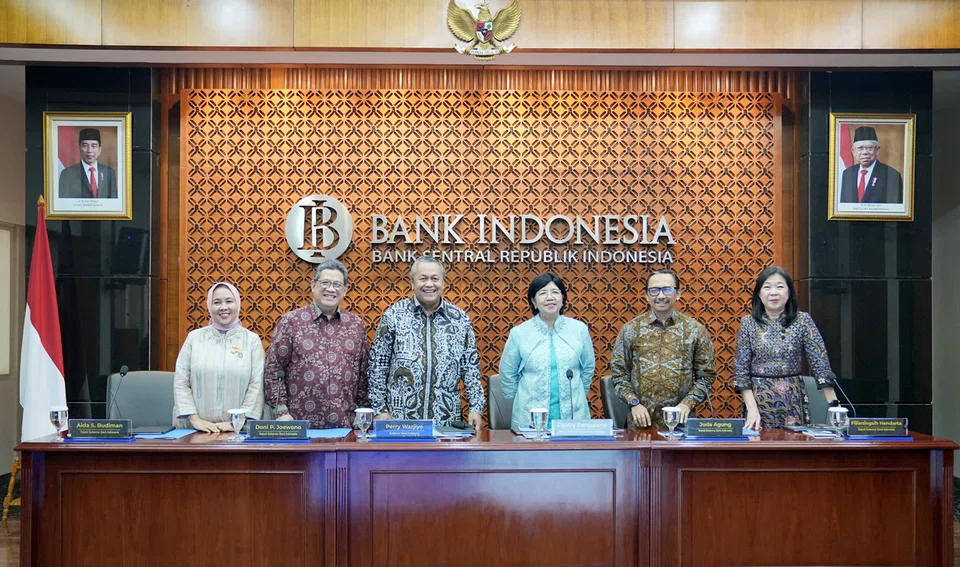
[JAKARTA] Indonesia’s central bank chose to keep its benchmark interest rate unchanged on Wednesday (Oct 16) in response to growing pressure on the rupiah following last month’s unexpected cut.
Bank Indonesia (BI) maintained its benchmark interest rate at 6 per cent, in line with the expectations of the majority of economists surveyed by Bloomberg. It also kept the deposit facility rate and lending facility rate unchanged at 5.25 per cent and 6.75 per cent, respectively.
In September, the central bank surprised markets by starting an easing cycle before the US Federal Reserve made its move.
By mid-October, the rupiah had weakened by 2.82 per cent to 15,510 versus the US dollar compared with the previous month, amid escalating tensions in the Middle East.
BI’s governor Perry Warjiyo stated that the central bank’s monetary stance is no longer solely focused on maintaining the stability of the rupiah, but has now shifted towards supporting the growth of South-east Asia’s largest economy.
“We see room for future interest rate cuts, but the timing and magnitude will need to be carefully assessed,” Warjiyo said during a press briefing.
He also emphasised that US macroeconomic data and geopolitical tensions in the Middle East are key factors to monitor, as they could influence the currency’s future movements. The central bank expects the rupiah to remain stable in the short term and strengthen over time.
Josua Pardede, chief economist at Permata Bank, noted that, after taking into consideration the Fed’s monetary policy trajectory, Indonesia’s low inflation rate, the manageable outlook for the current account deficit, and the potential for near-term rupiah appreciation, “we maintain our projection that Bank Indonesia will lower its policy rate by 50 basis points to 5.5 per cent in the last two months of 2024”.
Lavanya Venkateswaran, senior Asean economist at OCBC, anticipates another 25-basis-point cut from BI in either November or December, followed by a cumulative 75-basis-point reduction in 2025.
Indonesia recorded a decline in inflation to 1.84 per cent last month, remaining well within the central bank’s target range.
Meanwhile, industry loan growth reached 10.85 per cent annually in September.
Warjiyo announced that the central bank would extend its loan-to-value incentives until the end of 2025, instead of allowing them to expire at the end of this year, to further encourage credit growth.
The central bank has reduced the minimum down payment required for homebuyers in an effort to stimulate spending amid sluggish consumption.
BI kept its outlook for economic growth at a range of 4.7 to 5.5 per cent this year, and said that it expected growth to accelerate next year.
BI’s monetary policy is focused on fostering credit growth, in line with the country’s incoming administration under president-elect Prabowo Subianto.
Prabowo, who will be inaugurated on Sunday, has set an ambitious target of achieving economic growth of up to 8 per cent.
Indonesia’s trade figures for September fell short of market expectations, as both exports and imports declined compared with the previous month. In September, exports dropped to US$22.1 billion, a decrease of US$1.5 billion, while imports also softened, declining by US$1.8 billion to US$18.82 billion.






