Bank Indonesia surprises market with rate cut to back Prabowo’s growth goal
Central bank lowers benchmark rate to 5%, with plans to inject additional liquidity into banking system

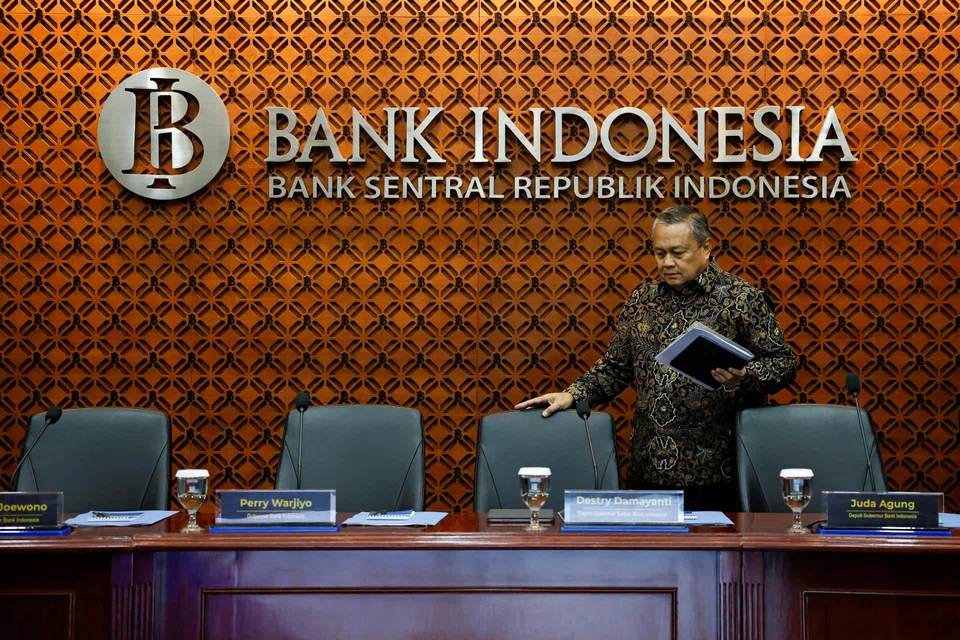
[JAKARTA] Bank Indonesia (BI) on Wednesday (Aug 20) unexpectedly cut its policy rate for the second consecutive time since July, citing low inflation and a stable rupiah as key factors.
The central bank said the move aims to support economic growth, and that it will continue to monitor the situation to decide if there is room for further cuts. It projects that this year’s growth could exceed 5 per cent after the economy unexpectedly reached 5.12 per cent in the second quarter.
BI lowered its benchmark rate by 25 basis points (bps) to 5 per cent, defying the expectations of most analysts surveyed by Bloomberg who had predicted a hold. The central bank also cut its overnight deposit and lending facility rates to 4.25 per cent and 5.75 per cent, respectively.
“While the timing is a surprise to economists’ expectations, the direction was clear-cut,” said Lavanya Venkateswaran, senior Asean economist at OCBC. “Even after discussing the need to boost the transmission of rate cuts on to bank lending rates, BI took its chance, highlighting the economy’s growth needs.”
Ambitious target
BI’s interest rate cut comes shortly after President Prabowo Subianto unveiled his 2026 economic and Budget plans on Aug 15, setting an ambitious growth target of 5.4 per cent for next year and outlining plans to accelerate the spending of 3,786.5 trillion rupiah (S$299.3 billion), with a focus on food and energy security.
Perry Warjiyo, governor of BI, said the central bank plans to inject additional liquidity into the banking system to support loan growth, channel financing towards priority sectors such as agriculture and manufacturing, and help cushion the economy against the impact of the new 19 per cent US tariff taking effect this month.
“Bank lending still needs to be further increased to support economic growth,” Warjiyo said, adding that banks should promptly lower their interest rates to boost loan growth this year.
Loan growth in Indonesia slowed in July – rising 7.03 per cent year on year, down from 7.8 per cent in June – as banks adopted a cautious approach, choosing to park excess liquidity in securities rather than extend new loans, noted Warjiyo. The central bank has set a target of 11 per cent for loan growth this year.
Dovish stance
Easing monetary policy may be needed to support growth in South-east Asia’s largest economy in the coming months, as the manufacturing index contracts for the fourth consecutive month and export gains from front-loading over the past two months could fade with the new US tariff taking effect in August.
“BI’s decision to cut rates for the second consecutive month reflects the need to reinforce domestic growth momentum amid the global economic slowdown and uncertainties, allowing for Indonesia to weather external headwinds and sustain economic growth in the second half of this year and beyond,” wrote analysts at Samuel Sekuritas.
Indonesia’s 19 per cent US tariff, while higher than the 10 per cent baseline implemented in April, remains well below the 32 per cent previously threatened. It also broadly aligns with the rates applied to other Asean peers, helping to maintain the country’s export competitiveness, wrote MUFG economists.
Venkateswaran of OCBC noted that dovishness has been reflected in the expectations that market watchers have regarding BI and other Asean central banks this year. “We now anticipate another 25 bps cut from BI before the year’s end. The risk is for further reductions as downside growth risks become increasingly evident.”
The central bank has already reduced its rate by 125 bps since the beginning of the easing cycle in September 2024.
Room for a dovish stance has been provided to the bank by a steady rupiah and subdued inflation. Indonesia’s headline inflation rate rose to 2.4 per cent in July, but remains well within BI’s target of 1.5 to 3.5 per cent.
The currency has been lifted by 1 per cent this month, making it one of Asia’s top performers, as Indonesian assets are purchased by foreign investors.
Samuel Sekuritas noted that the back-to-back cuts are expected to compress government bond yields, as investors anticipate further policy accommodation in the near term.