From bankers to technocrats, all eyes on Indonesia president-elect Prabowo’s Cabinet line-up

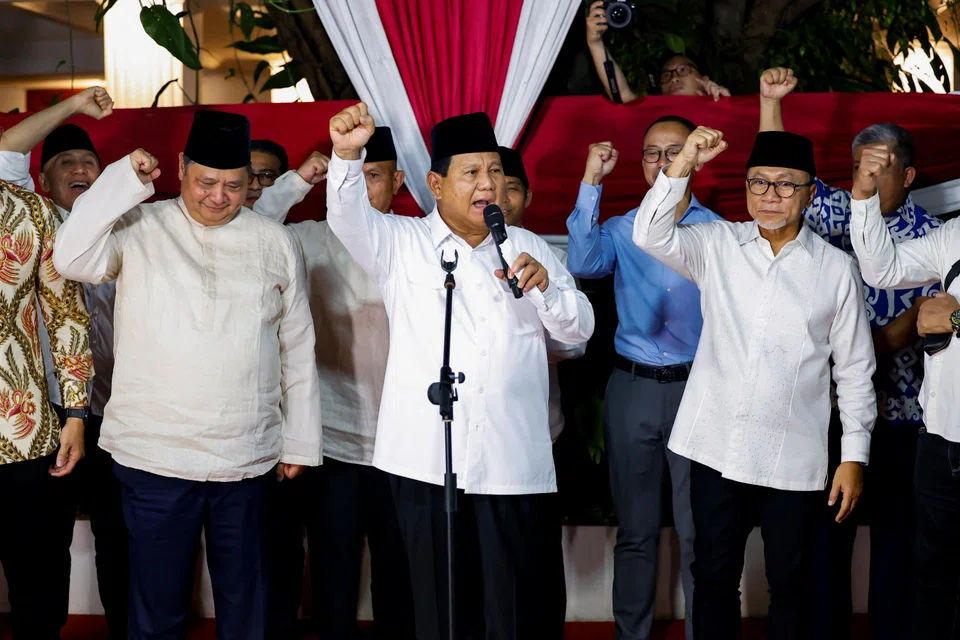
[JAKARTA] A week after Indonesia’s election commission declared Defence Minister Prabowo Subianto the winner of last month’s presidential election, the spotlight now turns to the crucial task by the former general to assemble his Cabinet.
Social media has been abuzz in recent days with various lists claiming to represent Prabowo’s potential Cabinet line-up, ranging from bankers to technocrats, purportedly originating from both supporters and opponents alike.
Erwin Aksa, deputy chairman of the Golkar party and member of Prabowo’s campaign team, said that the 72-year-old politician, set to be inaugurated on Oct 20, will not establish a transition team for a smooth power transfer from outgoing President Joko Widodo.
Instead, Erwin added, Prabowo will focus on identifying candidates and seeking professionals from the finance and energy sectors for key economic ministerial positions in the coming months.
“However, there are steps that could be taken to help bridge the gap in transition support,” said Erwin in a media briefing.
In addition to the hunt for a finance minister, Prabowo is said to be exploring candidates from the financial sector to lead the soon-to-be established National Revenue Agency, a government body tasked to oversee tax and revenue collection duties under the president’s direction.
The establishment of the new tax agency has been outlined as Prabowo’s foremost priority in reshaping the country’s fiscal policy.
Throughout his campaign, Prabowo, who ran alongside Widodo’s eldest son, 36-year-old Gibran Rakabuming Raka, aimed to increase the country’s tax-to-gross domestic product ratio to 16 per cent. This goal is aimed at broadening the tax base to enhance revenue and foster financial stability.
Currently, the tax and revenue collection is managed by the Directorate General of Taxes and Customs, both of which operate under the purview of the Finance Ministry.
Nailul Huda, a researcher at the Jakarta-based think tank Center of Economic and Law Studies, said that the autonomous role of the new state agency directly under the president is expected to strengthen the tax collectors’ authority and potentially improve tax collection efforts.
Prabowo is reportedly considering several individuals for this new position, including Kartika Wirjoatmodjo, the current deputy minister of the State-Owned Enterprises Ministry; Sunarso, president director of the biggest state-owned lender, Bank Rakyat Indonesia; and Darmawan Junaidi, president director of state-owned Bank Mandiri.
When asked about his candidacy, Kartika declined to comment. Instead, the former banker said that he would focus on completing his current duties as deputy minister. “It’s completely his (Prabowo) decision,” Kartika told The Business Times.
Crucial first year
Observers said that the formation of Prabowo’s Cabinet will determine not only the image, direction and policies likely to be implemented by the new government, but also shape the citizenry’s confidence over his leadership after 10 years of Widodo’s leadership.
Analysts say that the first year of Prabowo presidency is crucial for the Indonesian government to maintain the country’s sovereign credit ratings with a stable outlook.
Raden Pardede, chief economist at Creco Research, emphasised the crucial role of Prabowo’s ministerial appointments in restoring global investor confidence. Fiscal stability and the implementation of a sustainable financing scheme are imperative, particularly given the perceived cost of some of his campaign pledges.
“The current economic situation is highly challenging. In their inaugural year, the new government must uphold fiscal discipline to maintain currency stability,” he told a banking seminar in Jakarta.
He said that considering Indonesia’s adherence to a 3 per cent deficit ceiling, it may be challenging for the new government to fully deliver on its promises without exceeding this limit, which could affect its credit ratings.
Prabowo’s flagship social assistance programme, which aims to provide free meals and milk to about 80 million children, is estimated to cost around 460 trillion rupiah (S$39 billion) annually. This amounts to roughly 13 per cent of the government’s total expenditure budget for the entire year.
Despite the prevailing global economic uncertainty, Raden said that Prabowo will be able to implement his ambitious fiscal policy. This hinges on his ability to secure sufficient political support in the House to amend the 2003 State Finances Law, which presently imposes a 3 per cent cap on the deficit.He warned, however, that such a move would entail significant risks to economic stability.
Prabowo’s expensive campaign promises have raised concerns among investors, given that Indonesia has been praised for its prudent fiscal management under current Finance Minister Sri Mulyani Indrawati.
Foreign investors have pulled back US$1.1 billion from Indonesian bonds since an unofficial quick count placed Prabowo as the frontrunner in the Feb 14 election; there have been net foreign bond outflows in 16 out of 20 days since then, Bloomberg reported last week.
In its report dated Mar 15, Fitch Ratings acknowledged the increasing medium-term fiscal risks associated with the new government’s programmes, while still maintaining the country’s sovereign ratings at “BBB” with a stable outlook.
The research house observed that there is still uncertainty regarding the upcoming government’s funding scheme for the programmes. This was despite Prabowo’s push for a substantial increase in government revenue which will take time to realise.