



Batteries not included: China EV makers struggle to break VinFast’s dominance in Vietnam
Buoyed by success in Thailand and growing sales in Indonesia and Malaysia, Chinese carmakers are eyeing Vietnam’s market, but it’s proving challenging
[HO CHI MINH CITY] With Vietnam’s passenger electric vehicle (EV) sales more than doubling last year, competition is fierce.
Home-grown hero VinFast, which commands the lion’s share of the domestic market, is being challenged by Chinese EV makers looking to replicate their success in other parts of the region.
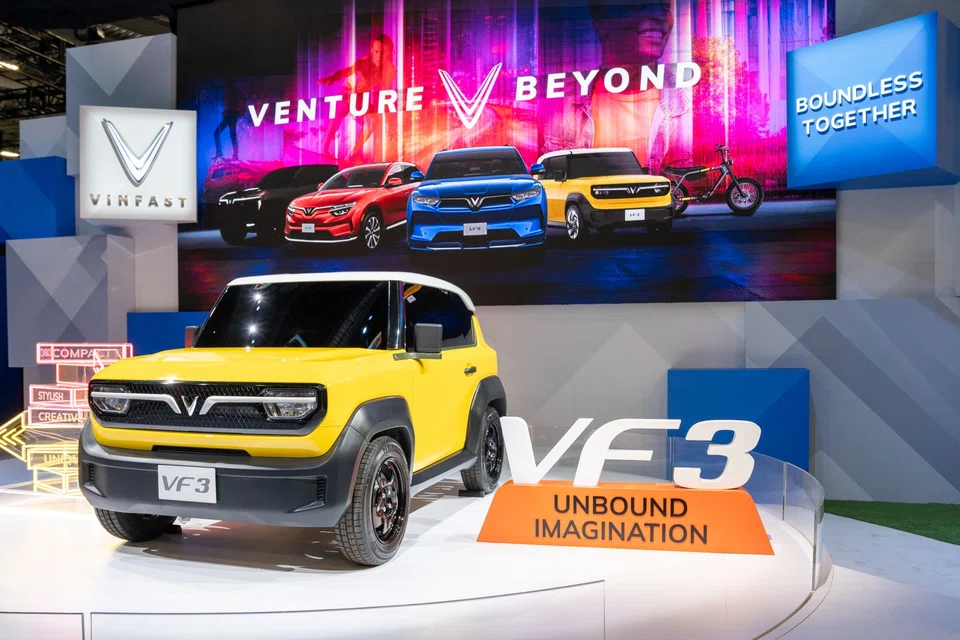
To defend its turf, VinFast launched an affordable mass-market model VF 3 at 235 million dong (S$12,512) for the non-battery version, priced at four to five times the cost of the country’s ubiquitous motorcycles. Customers choosing to purchase the car without a battery can opt for VinFast’s flexible battery subscription plan, which offers three tiers of recurring monthly costs tailored to driving needs.
In just the first 66 hours of VF 3’s three-day pre-order event in mid-May, VinFast secured nearly 28,000 pre-orders. The company hailed this as a “record-breaking” achievement in Vietnam’s automotive industry and a testament to the “very high market demand”.
At least 5,500 pre-orders could be converted to actual sales as the carmaker told The Business Times that over one-fifth of the pre-orders came from VinFast employees and its related companies.
VinFast aims to deliver at least 20,000 units of the VF 3 in 2024, aspiring to make it Vietnam’s “national car” in a country where less than 6 per cent of the population owns a car.
This ambition, however, is being challenged by Chinese EV carmakers, who are ready to compete head-on in a race to the bottom on pricing.
The VF 3 goes head-to-head with the Wuling Hongguang Mini EV, a Chinese car assembled in Vietnam and launched last June at a similar price of 239 million dong.
Underscoring the rivalry, while VinFast was still tallying pre-orders for the VF 3, Wuling swiftly cut the price of its cheapest Mini EV by 19 per cent to 194 million dong in Vietnam, making it about one-third cheaper than the battery-included VF 3.
Both the VF 3 and the Wuling Hongguang Mini EV, the smallest and most affordable cars on the market, are four-seaters designed for short-distance daily commutes in urban areas.
However, despite being one of the world’s bestselling EV models, Wuling’s Mini EV sold less than 600 units in Vietnam last year, significantly missing its target of 5,525 units.
“Sales of Chinese EVs are relatively weak in Vietnam, which is attributable to a low perception of Chinese cars, the strong performance of VinFast in the local market, and a preference for Japanese brands when it comes to foreign cars,” said Lu Yao, a sector adviser at Allianz Trade.
EV sales revving up
BMI, a Fitch Solutions company, estimated that the sales of passenger EVs in Vietnam grew by nearly 140 per cent to 20,000 units in 2023 from the prior year.
“The strong EV sales growth Vietnam experienced in 2023 was supported primarily by the continued deliveries of VinFast EVs and the arrival of more affordable passenger EVs from mainland China and the Asean region,” said BMI in a report earlier this year.
According to the Vietnam Automobile Manufacturers’ Association, the share of electric cars to total car sales in the country doubled to 10 per cent last year from a year ago.
Supportive government policies and attractive pricing are driving EV adoption in Vietnam, even though the industry is still in its early stages.
Last year, Vietnam waived import taxes on complete vehicles from South-east Asian countries until the end of 2027, benefiting Chinese brands such as BYD that have established facilities in the region, such as in Thailand.
After attaining a certain level of success in various South-east Asian markets, some Chinese firms are now looking to conquer Vietnam, as seen by Chery and BYD’s intentions to establish new factories in the country in the near future.
VinFast speeds up regional ambition
South-east Asia is firmly on VinFast’s radar, as the company ramps up its presence and sales efforts in nearby markets, starting with Thailand and Indonesia.
“VinFast will expand to new markets soon, replicating the VF 3’s domestic success,” a spokesperson told The Business Times in an e-mail, adding that pre-orders for this model will be available in several markets this year.
VinFast is expanding its global reach and aims to establish a presence in 50 countries. This is in addition to its current reach in existing markets such as the US, Canada and Europe.
The company plans to deliver 100,000 electric cars this year, nearly tripling its 2023 sales figures.
However, the going may be hard for domestic heroes to carve a slice of action outside their home turf and compete with Chinese brands in the booming EV market in South-east Asia.
China’s big auto companies such as BYD, Great Wall Motor, Hozon Auto and Chery have made big strides with leading sales in the EV markets across the region, especially in Thailand, Indonesia and Malaysia.
Allianz’s Lu highlighted that China’s vast domestic market and decade-long investment in the EV supply chain have enabled Chinese automakers to achieve economies of scale and significant cost advantages while maintaining high quality. In contrast, South-east Asian countries still lag in auto manufacturing capabilities.
“Given the relatively lower GDP per capita in the region (except for Singapore), affordable models are crucial in the South-east Asian market,” Lu said.
“Improving the localisation of car parts will be essential for South-east Asia’s EV players to lower production costs and enhance competitiveness in the global EV market,” she added.
As things stand, China’s EV dominance is believed to face no immediate challenger in the region, yet incumbent players from Japan and South Korea show potential to be strong rivals. In Vietnam, brands from Japan and South Korea hold over 75 per cent market share of the local automobile market.
“These players, along with manufacturers in South-east Asia, may emphasise performance, quality and customer experience to effectively compete,” said Rahul Gupta, an associate partner at McKinsey & Company.
TRENDING NOW

Knight Frank’s Tan Tee Khoon leaves firm, Nicholas Keong takes over auction business

Keppel Energy, Sembcorp Utilities and Tuas Power to supply biomethane in pilot project

GovTech retrenches another 38 staff in second round of layoffs

Take-up of new private homes dives 45% in Q3 as prices accelerate with 1.4% rise

