



Behind the numbers: Is Singapore really Vietnam’s top FDI source?
Much of the capital flows from multinationals, increasingly from China, go through the city-state as a gateway
[HANOI] With global supply chains realigning and US-China tensions intensifying, Singapore has become Vietnam’s top investor, acting as a strategic conduit for capital from multinationals in China, Europe, and the United States through their regional headquarters in the city-state.
Singapore’s robust regulatory and financial frameworks have drawn unprecedented amounts of capital, especially from mainland China, as companies look to invest in South-east Asian countries to reduce dependence on Chinese markets and bypass trade tariffs.
According to Deloitte’s Doing Business in Vietnam 2024 report, Singapore led total foreign direct investment (FDI) inflows into Vietnam during the 2019-2023 period, averaging a 23 per cent share, followed by South Korea, Japan, Hong Kong, and mainland China.
“We believe a large proportion of this is contributed by global companies with regional headquarters in Singapore. These would include those from mainland China, Europe and the US,” Yun Liu, Asean economist at HSBC Global Research, told The Business Times.
In 2020, FDI from Singapore into Vietnam more than doubled, reaching a new high and has since positioned the city-state as the top source of investment, surpassing Japan and Korea.
Just a year earlier, in 2019, Hong Kong held this position with a remarkable 139 per cent year-on-year surge. However, its investment quickly declined the following year amid prolonged pro-democracy protests that unsettled the East Asian financial hub.
Banh Thi Hang, a research fellow at the Asia Competitiveness Institute of the Lee Kuan Yew School of Public Policy noted that the surge in investment inflows into Vietnam from some markets aligned closely with escalating tensions between China and the US.
“Trade war has been a catalyst for FDI into Vietnam as companies continue to diversify their global value chains and avoid the additional tariffs imposed on imports from China by the US and other regions like the EU (European Union),” she said during a recent webinar organised by the Singapore-based research centre ISEAS – Yusof Ishak Institute.
Beyond favourable trade terms, Vietnam’s lower labour costs and more stable trade environment have made it an increasingly attractive investment destination compared to China.
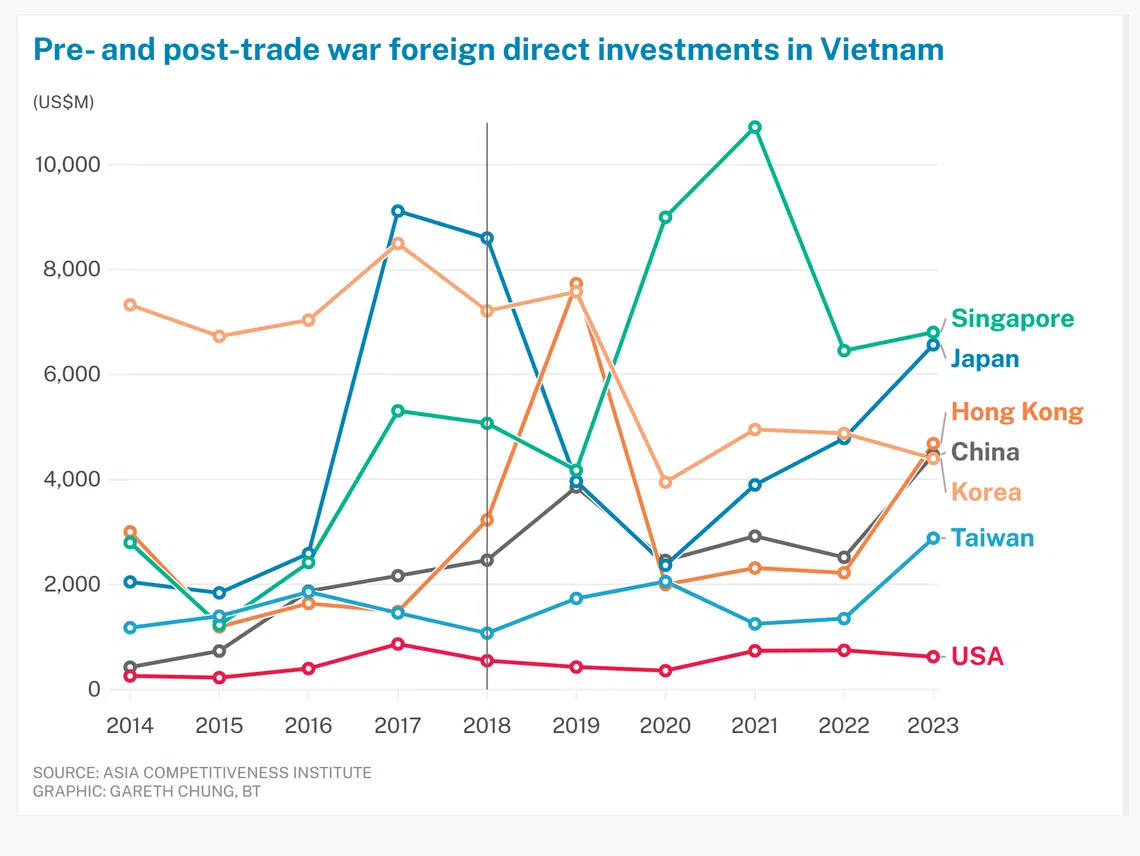
Expectations, therefore, remain high for notable increases in investments from mainland China and the US into Vietnam after 2018 as the South-east Asian nation now serves as an attractive alternative amid a global realignment of supply chains away from China to reduce trade costs.
According to the official data, although China’s FDI in Vietnam did see an uptick following the trade war, this increase was modest compared to Singapore’s growth.
“US investment in Vietnam also remains relatively low, trailing behind its investments in Thailand and Malaysia,” Hang added.
These headline numbers, however, do not tell the full story, especially regarding the true origins of FDI.
Investment pathway
Victor Ngo, chief executive of UOB Vietnam, told BT that while firms from Singapore make up 44 per cent of the bank’s client base, only about half of them are actually native Singaporean companies. “The rest – less than half – come from other countries, like China and Europe,” he said, noting that they tend to first establish in Singapore and then move into Vietnam.
While Ngo also pointed out the growing interest from American businesses that have been exploring the Vietnam market over the past year, he believed that it may take more time for them to navigate local regulations and contribute a larger share of investment.
Jack Nguyen, chief executive at Incorp Vietnam (part of Singapore-headquartered consulting firm InCorp Group), saw a clear trend of investments from Western countries and mainland China flowing through financial hubs like Singapore and Hong Kong before reaching Vietnam.
He highlighted that, with Vietnam’s complex tax regulations and fluctuating currency, these hubs – Singapore and Hong Kong – offer more favourable tax policies, robust financial and legal systems, currency stability, and extensive access to regional trade agreements.
Shifting patterns
Cai Rong, a researcher at the Peking HSBC Business School Think Tank, highlighted in a research note that amid ongoing trade tensions with the US, China’s overseas direct investment (ODI) in manufacturing grew rapidly from 2019 to 2023, hitting a record high of nearly 19 per cent in 2023.
Asean has risen as the first-choice region for China’s manufacturing industry outbound investment, with an ODI of US$9.2 billion in 2023, up 103 per cent over 2018 and accounting for a third of China’s total manufacturing ODI, Rong added.
For UOB Vietnam, Ngo also anticipates a significant acceleration in client growth from Greater China, where business customers from the region currently make up about 16 per cent of the bank’s portfolio in Vietnam. “We believe that the shift in supply chains will continue and (the number of) our clients from Greater China will grow faster,” he said, referring to the bloc covering Hong Kong, Taiwan, and mainland China.
When combined, Greater China accounted for almost half of Vietnam’s new FDI inflows in 2023.
Manufacturing remains the primary sector attracting FDI for both China and Vietnam at about 60 per cent. However, a lion’s share of investments into Vietnam’s manufacturing is still in the low value-added phases.
“For Chinese manufacturers who’ve invested in Vietnam, a large part is concentrated in low-end manufacturing,” explained HSBC’s Liu. “But this is starting to change... to encompass advanced manufacturing, technology and professional services,” she added, referring to Chinese investments in fields such as electric vehicles and renewable energy.
Hang noted that Vietnam’s government will likely focus on attracting FDI in higher value-added manufacturing in the coming period as it seeks to boost economic growth further, though obstacles like infrastructure limits, skilled labour shortages, regulatory challenges, and environmental issues could impede progress.
In the first nine months of this year, foreign investors registered over US$24.78 billion in capital in Vietnam – a nearly 12 per cent increase from the previous year. A significant amount was channelled to large-scale projects in semiconductors, energy, electronic components, and high-value-added products, according to a report by Vietnam’s Ministry of Planning and Investment.
Singapore remained the leader with US$7.35 billion, nearly 30 per cent of total pledged capital, followed by mainland China, South Korea, Hong Kong, and Japan. For new projects, however, China led with over 29 per cent of the total share.
Vietnam is expected to release its latest FDI figures for the first 10 months of 2024 in the coming week.






