
Beyond the greenback, Vietnam’s big borrowers turn to Asian-currency bonds
From the South Korean won to Singapore dollar, corporates are exploring cheaper offshore debt options
VIETNAMESE corporates are turning to Asian local-currency debt markets after being squeezed by costlier US-dollar borrowing.
This could signal a shift towards new sources of offshore capital, as double-digit growth ambitions increase investment needs, pressuring traditional funding channels.
Recent issuances by Vingroup in Korean won and Saigon-Hanoi Commercial Joint Stock Bank (SHB) in Singapore dollars underscore that push.
“We see non-USD offshore issuance as an early structural broadening of market access rather than only a temporary substitute for the USD high-yield market, although issuance volumes and pricing will remain cyclical,” Do Le Thanh Dat, associate director for ratings and research at Hanoi-based VIS Rating, told The Business Times.
“Its broader strategic benefit is access to additional pools of longer-term capital when domestic funding is tight,” he added, noting that Vietnamese corporates increasingly need term financing for capital expenditure, while banks require stable funding to support loan growth, including lending for Vietnam’s infrastructure investment drive.
For now, analysts say access to non-US dollar offshore bonds is likely to remain limited to Vietnam’s largest corporations and banks, given their stronger credit profiles, established investor networks and ability to manage currency and refinancing risks.
The foray also comes from a low base.
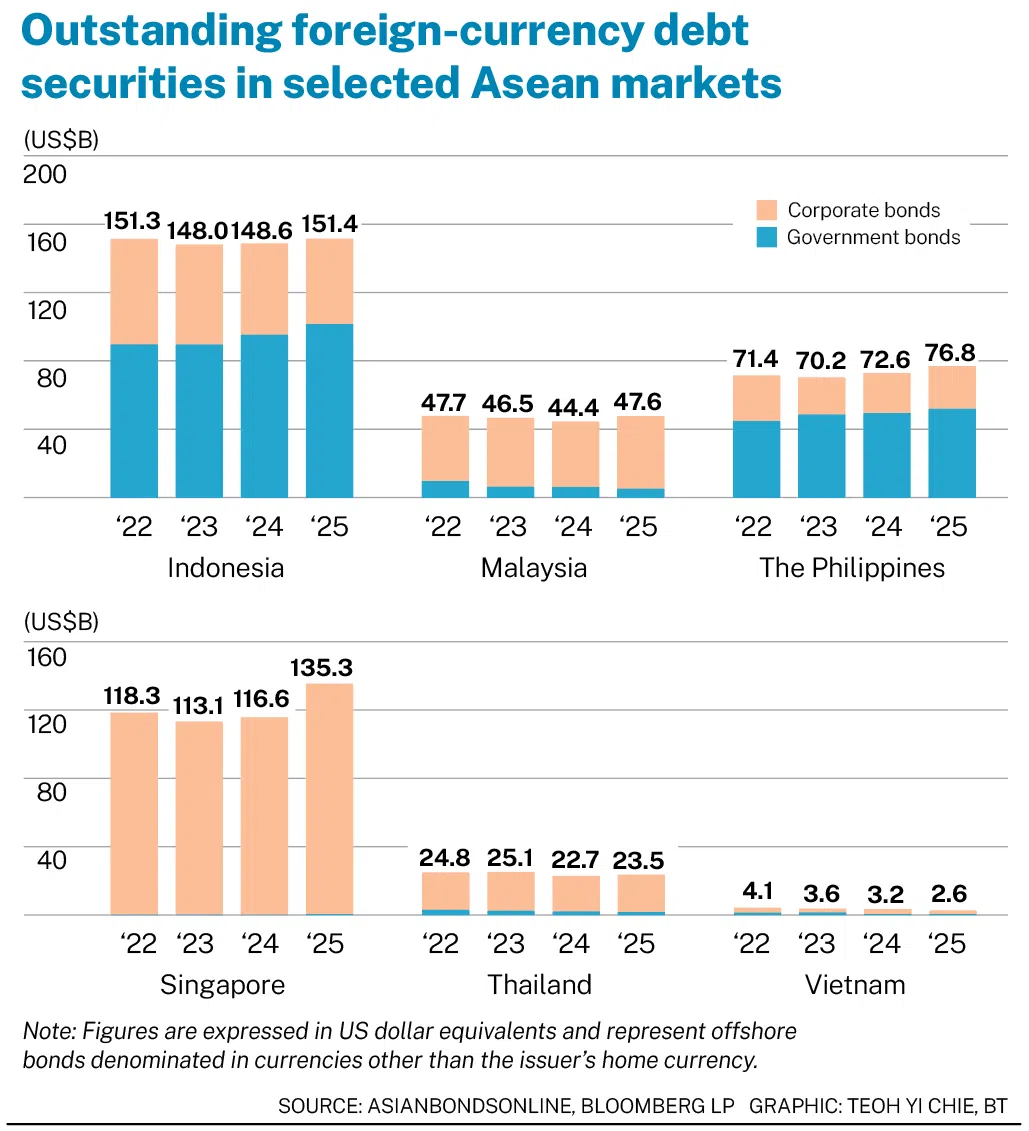
Vietnam’s offshore bond market remains small compared with regional peers, with outstanding foreign-currency debt securities falling from US$4.1 billion in 2022 to US$2.6 billion in 2025, far below Thailand’s US$23.5 billion and Indonesia’s US$151.4 billion last year, according to data compiled by AsianBondsOnline.
More diversified capital pools
Vingroup reportedly raised 230 billion won (US$160 million) in South Korea on Oct 30, paying an 8 per cent coupon on three-year bonds with an early redemption option after two years, according to Seoul Economic Daily.
The transaction followed an August board resolution approving Vingroup’s plans to raise as much as 455 billion won through secured, non-convertible bonds privately placed with South Korean investors in the second half of this year.
The debt sale followed closely on the heels of SHB’s S$229 million (US$177 million) Singapore dollar-denominated social bonds, marking the first such deal by a Vietnamese borrower. The issue comprised S$129 million of three-year notes paying 2.9 per cent annually and S$100 million of five-year notes paying 3.15 per cent.
The potential for further diversification has also widened following an October upgrade by Japan’s Rating and Investment Information, which became the first agency to assign Vietnam an investment-grade rating of BBB-.
Analysts said the move could improve access to Japanese institutional capital for the government and major state-linked companies, including through yen-denominated Samurai bonds.
The development follows similar moves by a small but established group of South-east Asian borrowers tapping non-US dollar debt markets in recent years.
Singapore Airlines raised 1.5 billion yuan (US$224.8 million) through offshore Dim sum bonds in June 2026, while Malaysia’s CIMB Bank issued three billion yuan of Panda bonds in China in October 2025. Indonesian telecommunications infrastructure firm Integrasi Jaringan Ekosistem also raised 21.4 billion yen (US$135.2 million) through Samurai bonds in Japan in July 2026.
Quan Trong Thanh, head of research at Maybank Investment Bank Vietnam, pointed out that Vietnamese borrowers should consider alternative funding markets, including China, where the availability of cheaper capital could offer an attractive option compared with dollar borrowing.
However, political sensitivities including concerns about dependence on Chinese capital, and Vietnamese regulators’ preference for highly liquid international currencies like the USD, could complicate such decisions, he said.
Rising cost of US dollar debt
For Vietnamese issuers, access to alternative currencies offers greater financing flexibility and a broader investor base. Borrowers are also able to extend debt maturities and reduce reliance on a single funding market, VIS’ Dat noted.
However, he pointed out that lower headline interest rates do not necessarily translate into cheaper borrowing.
“The funding-cost comparison should be made on an all-in basis in the currency of the issuer’s cash flows, including hedging, guarantee and issuance costs – not on the printed coupon alone,” he said.
These costs are evident, particularly in conventional US-dollar borrowing.
An October report by FiinRatings estimated that a five-year US-dollar bond for a leading Vietnamese corporation could carry an interest rate of about 8.45 per cent, compared with 10.8 per cent for domestic dong-denominated real estate bonds.
However, hedging that dollar exposure back into Vietnamese dong could add as much as 3.34 percentage points, lifting the total borrowing cost to about 11.8 per cent and potentially wiping out the savings.
This poses a particular challenge for companies generating most of their revenue domestically while servicing debt denominated in foreign currencies. “Foreign-currency funding looks cheaper on paper, not always in practice,” FiinRatings said in the report.
The ratings agency also warned that elevated US interest rates could make offshore borrowing less competitive through 2027. The Federal Reserve raised its benchmark rate by 25 basis points in September to a range of 3.75 to 4 per cent, with policymakers signalling another increase before the end of 2026.
Beyond interest rates and currency risks, Vietnam’s sovereign credit rating remains a major constraint, with the three leading global agencies – S&P, Moody’s and Fitch – keeping the country below investment grade.
This rating limits access to global institutional investors and pushes up borrowing costs as lenders demand higher returns to compensate for perceived credit risk. “The sovereign ceiling (Ba2/BB+) caps how much further costs can fall,” FiinRatings said.
However, analysts said credit guarantees and enhancement can lift bond ratings and widen the investor pool. SHB’s Singapore dollar bonds, for instance, received an AA rating from S&P Global Ratings, backed by a guarantee from the Asian Development Bank’s Credit Guarantee and Investment Facility, helping secure lower headline coupons.

Offshore debt gains momentum
Vietnam has been absent from international sovereign bond markets since its last US$1 billion US dollar-denominated issuance in 2014, leaving domestic companies without a current offshore government bond benchmark to help price their debt.
Recent developments, however, suggest that offshore bond issuance is gaining momentum again.
The Vietnamese government is weighing a return to international bond markets. Its 2026 public borrowing plan includes offshore sovereign bonds as a potential funding source, while the finance ministry held a non-deal roadshow with international investors in September to gauge demand, although officials stressed that no immediate issuance was planned.
US-dollar debt remains on the radar for corporate borrowers.
SeABank raised US$150 million in Singapore in November 2025, while Vingroup issued US$325 million in December 2025 and a further US$350 million in April 2026, both listed in Vienna.
More deals could be in the pipeline, with Vietcombank reportedly exploring its first public offshore bond sale and HDBank planning to raise up to US$500 million through an international bond issuance expected to trade in London.
US-dollar bonds still dominate international borrowing. It accounted for 85 per cent of Asian non-financial corporate bond issuance in foreign currencies between 2014 and 2024, up from 80 per cent in 2000-2013, according to OECD’s Asia Capital Markets Report 2025.
“USD issuance remains an important benchmark and source of global investor access,” VIS’ Dat said. “Regional-currency markets should be viewed as complementary channels that can reduce reliance on any one market rather than as a complete replacement for domestic or USD funding.” THE BUSINESS TIMES